Get Full Government Meeting Transcripts, Videos, & Alerts Forever!
Get email alerts on the Academic Programs topic
No spam. Unsubscribe anytime.
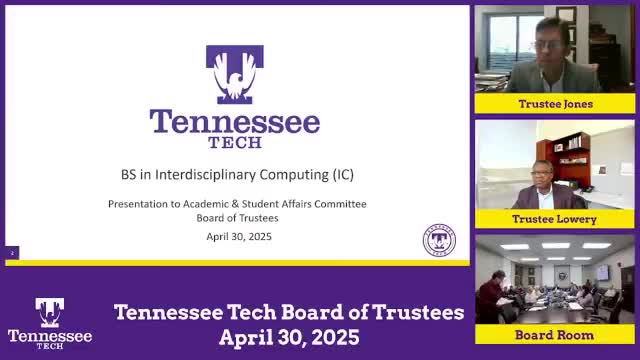
Tennessee Tech board approves Bachelor of Science in Interdisciplinary Computing
Summary
The Tennessee Technological University Board of Trustees voted to approve a new Bachelor of Science in Interdisciplinary Computing and to place the proposal on the PTAC Commission agenda for May 15, citing workforce demand, a structured cognate approach and experiential learning requirements. Trustees recorded the approval by roll-call vote.
The Tennessee Technological University Board of Trustees voted to approve a proposal to create a Bachelor of Science in Interdisciplinary Computing and to place the proposal on the PTAC Commission agenda for May 15.
The board was presented with program details by Dr. Sharon Ho, who described the degree as a cross-disciplinary bachelor’s program that combines computing, artificial intelligence and data science with a student’s chosen “cognitive” field — for example business, agriculture or journalism. The degree will be housed in the College of Engineering Studies and guided in partnership with the College of Interdisciplinary Studies, Dr. Ho said.
Proponents told trustees the program is designed to respond to items in the state higher-education master plan and to meet employer demand for graduates who can apply computing skills in other fields. Dr. Ho said letters of support from regional employers and external reviewers describe the proposal as “the right program at the right time.” The development team also reported a campus survey showing strong student interest: 94% of survey respondents indicated Tennessee Tech should offer the degree, and 72% said it aligned with career goals.
The curriculum as presented requires 120 credit hours on a typical undergraduate structure and includes: 41 credits of general education, 30 credits of computing, 25 credits in the chosen cognitive area and 18 credits in an “intersectional” core; the program also includes 10 credit hours of experiential learning and 6 hours of electives. Dr. Ho said four new courses have been developed for initial delivery (two from computer science and two from engineering/public health-related units).
Enrollment and finance projections were part of the trustees’ discussion. The development team projected roughly 10 new students in year one, growing to about 40 students by year five. Estimated first-year operating costs were presented at about $240,000, rising to roughly $274,000 by year five. Projected tuition revenue was reported as approximately $114,000 in year one and about $512,000 by year five, driven by enrollment growth, according to the materials presented to the board.
Trustees pressed presenters on quality controls and on metrics for continuing or closing the program if enrollments do not meet projections. Dr. Oldham and other trustees said typical review timelines call for frequent monitoring and the ability to adapt or sunset a program if it is not meeting enrollment or financial benchmarks; presenters said departments and a future program director would be responsible for ongoing recruitment, cognate engagement and program adjustments. Multiple trustees emphasized that campus departments must actively partner with the new program for it to succeed.
Trustees noted the program’s explicit emphasis on producing graduates who can work at the intersection of computing and another discipline — described by presenters as an effort to deliver “literacy” in computing plus domain knowledge rather than producing only traditional computer-science majors.
After discussion, the board approved the proposal by roll-call vote. Those recorded voting "Aye" were Trustee Jones, Trustee Lowery, Trustee Luna, Trustee Land, Trustee Rose, Trustee Bridal, Trustee Sykes and Trustee Harper; the motion passed. The board directed that, if approved by the board, the proposal be placed on the PTAC Commission agenda for its May 15 meeting for the next step of external review and recognition.
Trustees and presenters said they expect further reporting to the board on early enrollments, cognate participation, course delivery and any needed budget adjustments. Presenters repeatedly emphasized that the program’s success depends on sustained partnership from cognate departments and on regular review of enrollment and financial metrics.