Get Full Government Meeting Transcripts, Videos, & Alerts Forever!
Get email alerts on the Zoning Ordinance Rewrite topic
No spam. Unsubscribe anytime.
Leesburg planning commissioners take detailed second look at Article 3 of zoning rewrite; schools, short‑term rentals and mixed‑use rules draw questions
Summary
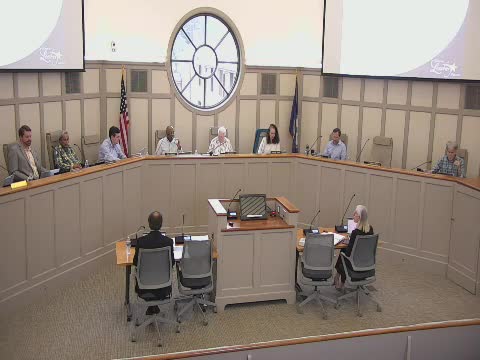
Leesburg Planning Commission members spent their meeting reviewing Article 3 (use regulations) of the town’s draft zoning ordinance rewrite, taking public comment and debating whether dozens of uses should be permitted by right, limited, or subject to special exception.
Leesburg Planning Commission members spent their meeting reviewing Article 3 (use regulations) of the town’s draft zoning ordinance rewrite, taking public comment and debating whether dozens of uses should be permitted by right, limited, or subject to special exception. The work session ranged across childcare and short‑term rentals, congregate housing and group homes, telecom testing facilities, and whether public schools should remain permitted by right or become special‑exception uses.
The zoning rewrite is part of a council‑endorsed project to align the town code with the town plan, modernize definitions and procedures, and launch an online interactive platform. Staff framed the meeting as a detailed review of Division 10 use tables and associated use‑specific standards; commissioners paused repeatedly to ask staff for clarifications and to place items on a “dive list” for later, deeper consideration.
Developer Morgan Hadlock of Curata Partners, who said her firm has multiple Leesburg applications pending and that she is a Leesburg resident, told the commission the draft creates "a lot of sort of layers to work through" and asked staff to consider ways to streamline how applicants and reviewers determine which standards apply to a given use. Beverly Tate, planning and GIS services director for Loudoun County Public Schools, asked the commission to keep public schools permitted by right rather than moving them to special‑exception review and to adopt tiered parking ratios for elementary, middle and high schools rather than the draft’s single ratio for all educational facilities.
Staff presentation and public‑comment context
Brian Boucher of the Department of Community Development summarized the project history: the rewrite began in 2023, the commission’s in‑depth review began in February, and a 60‑day public comment period that opened March 6 runs through May 5. Boucher noted some draft sections were released as placeholders and that when the town releases finalized text for those sections staff will give an additional 60 days for public review.
Boucher and other staff explained the draft’s permissibility codes: P = permitted by right; L = limited (by‑right if the use meets codified additional standards); M = minor special exception (administrative review routed to council); S = special exception (planning commission recommendation, council decision). Staff walked commissioners through examples, including the family day home standard (where state code is referenced for childcare licensing, and local lot‑size thresholds and notice requirements determine whether administrative approval applies or a special exception is required).
Major discussion points and staff follow‑ups
- Public schools and parking: Beverly Tate said the draft rezones all existing public school properties to a Government Center (GC) district, which would make many schools special‑exception uses. Tate asked that public schools remain permitted by right and requested differentiated parking ratios by school type (staff noted the draft proposes a single ratio of 3 parking spaces per 1,000 sq. ft. for educational facilities and agreed to follow up). Tate also asked for clarification of sign standards, outdoor lighting requirements, and how the new limited‑use category would apply to schools.
- Short‑term residential rentals (STRs): Commissioners discussed the draft’s STR rules, which appear as a limited use in several residential districts and include detailed use standards (for example, an owner‑occupancy requirement and limits on length of stay tied to state law). Staff said the town adopted STR rules in recent years and that the proposed rewrite largely retains administrative registration and standards; commissioners asked staff to bring data on how many existing permits were issued and whether the proposed rules will tighten or relax current practice.
- Congregate housing vs. group homes: Commissioners and staff clarified the distinction: congregate housing (the town’s term used for some homeless‑shelter and transitional housing facilities) was treated as a nonresidential/mixed‑use concept with specific standards (for example, proximity to bus shelters was included in standards), while state‑defined group homes remain a residential use required to be accommodated in residential districts. Staff noted the commission had recently worked on standards for congregate housing tied to a specific shelter project (Fort Evans Road).
- Family day home and childcare standards: Staff used the family day home example to illustrate how the L category works: state licensing thresholds (1–5 children exempt, higher counts subject to notice and standards) combine with local lot‑size cutoffs (e.g., staff referenced a 2,000‑square‑foot threshold in the draft) to determine whether administrative approval or special‑exception review is required.
- Telecommunications testing facilities: Commissioners asked why temporary/mobile land‑based telecom testing facilities are listed as a by‑right use in some districts. Staff said federal and state telecom law constrain local authority and that the town has relied on outside telecom counsel for detailed vetting; staff agreed to ask the town’s telecom attorney to review the draft language and to report back on whether the provision is required or could be narrowed.
- Kennels and catteries: Commissioners flagged apparent inconsistencies—catteries are allowed in some mixed‑use and industrial districts while kennels for dogs are treated more restrictively (often special‑exception) because outdoor dog noise is generally treated as an impact‑mitigation concern. Staff said use standards exist to limit impacts and agreed to align treatment or explain the rationale.
- Mixed‑use vs. Innovation Center (IC): Commissioners observed there is limited practical distinction in permitted uses between the MU and the IC districts in the draft; staff said the policy intent is different (IC oriented toward employment and tech/corporate campuses, MU toward residential and neighborhood retail), but acknowledged the zoning tables show little daylight. Staff will run test cases (for example, Village at Leesburg) and invite the town’s land‑use manager to a follow‑up to demonstrate whether the two districts need to remain distinct or should be combined or redefined.
- Drive‑throughs and craft production: Commissioners questioned why drive‑through facilities are restricted in IC/MU (staff said vehicle queuing and walkability concerns drove the restriction) and asked about scale definitions for craft beverage production (brewery vs. large craft production is distinguished in other jurisdictions by barrel volumes; staff said they will add clarifying scale thresholds and cross‑reference state code where applicable).
Process items, hyperlinks and next steps
Commissioners and staff noted some hyperlink errors in the online draft (use‑table links pointing to headers rather than specific subsection letters); staff agreed to correct link anchors. Staff also told the commission the public comment list and a running “dive list” of items flagged for deeper review are being maintained and will be updated with staff responses (for example, noting whether an item was changed, deferred, or requires further policy direction).
The commission set follow‑ups and directions: - Staff will confirm and report back on whether temporary/mobile telecom testing provisions are required by federal or state law and, if not required, whether the town can narrow or relocate the use. (staff: Brian Boucher / telecom counsel) - Staff will provide the commission with counts or an estimate of permitted short‑term rentals and clarify whether the rewrite makes STR compliance more or less restrictive than today. (staff) - Staff will revisit the treatment of public schools in the use tables and consider whether codified use standards could reduce the need for special‑exception review for routine school changes. (staff) - Staff will correct hyperlink targets in the online document and update the public comment/dive lists with checkboxes or status notes. (staff) - Staff will run zoning test cases for Village at Leesburg and other existing mixed‑use sites to confirm the rewrite’s effects and will invite the Land Use Manager for an IC vs. MU policy discussion. (staff / Rich Klusick)
Ending
Commissioners agreed to continue the Article 3 review at the next meeting and to begin the next session with diving into use standards (Divisions 11–13) and accessory/temporary use rules, plus an agenda item (Shenandoah Square special exception for a drive‑through) noted for the next meeting. Staff reminded the public that the formal 60‑day comment window runs through May 5 and that any further draft releases for placeholder sections will carry a fresh 60‑day review period.
Key direct quotes from the meeting: "It seems like there are a lot of sort of layers to work through ... it might be helpful to see if there's any way to sort of streamline that thought process," Morgan Hadlock, associate, Curata Partners. "We would respectfully request that public schools remain by right," Beverly Tate, planning and GIS services director, Loudoun County Public Schools.
(Reporters: the meeting included extended technical discussion of specific tables and cross‑references; those use‑table references and staff examples are preserved in the town’s draft document and will be updated with corrected hyperlinks.)