Get Full Government Meeting Transcripts, Videos, & Alerts Forever!
Get email alerts on the Security Council Program topic
No spam. Unsubscribe anytime.
Greece outlines packed Security Council program for May, highlights maritime security and protection of civilians
Summary
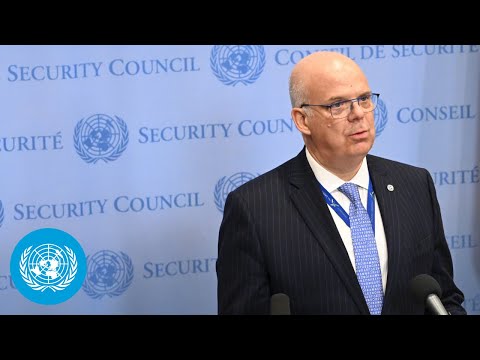
Ambassador Evangelos Sekeris, Greece’s permanent representative to the United Nations and president of the Security Council for May, on Thursday presented a program of work that schedules high-level debates and briefings on maritime security, protection of civilians and a slate of country-specific issues.
Ambassador Evangelos Sekeris, Greece’s permanent representative to the United Nations and president of the Security Council for May, on Thursday presented a program of work that schedules high-level debates and briefings on maritime security, protection of civilians and a slate of country-specific issues.
The most prominent events include an open debate on maritime security on May 20, titled “Strengthen maritime security through international cooperation for global stability,” which will be chaired by Greek Prime Minister Kyriakos Mitsotakis with the U.N. secretary-general serving as the main briefer. Greece also plans to elevate the annual debate on protection of civilians in armed conflict to ministerial level and to have Foreign Minister George Gerapetritis chair that session, Greece said.
“These are the two main events that we will host as a presidency,” Ambassador Sekeris said, adding that the maritime debate will “showcase the interest that Greece as a member state, as a maritime nation, as a country, 1 of the biggest merchant fleets attaches to this very important subject.” He also said, “We pay tribute to all journalists and media workers who lost their lives in the line of duty.”
Beyond those signature sessions, the Greek program lists consultations and briefings across the month: a closed consultation on Lebanon tied to a secretary-general report; a semiannual debate on Bosnia and Herzegovina with High Representative Christian Schmidt; an informal interactive dialogue on the peacebuilding architecture review co-organized with the General Assembly and the Peacebuilding Commission co-facilitators (Egypt and Slovenia); an informal interactive dialogue on Operation IRINI (related to Libya); monthly briefings on Yemen and Syria; an expected briefing by the International Criminal Court prosecutor Karim Khan on Libya; and a scheduled open briefing on the situation in the Middle East, including the Palestinian question.
Ambassador Sekeris told reporters that Greece intends to bring gender perspectives into the protection-of-civilians debate and the Yemen briefing: he said Greece will include a Women, Peace and Security (WPS) angle and expects briefers such as the executive director of UN Women and the International Committee of the Red Cross. He also said civil-society voices, including Save the Children, will brief at the protection-of-civilians session.
Greece emphasized international law as a central frame for the maritime debate. Sekeris said the Greek presidency will showcase the role of the United Nations Convention on the Law of the Sea (UNCLOS) in settling maritime disputes and pointed to U.N. Security Council Resolution 2768 (2025) as an example of recent action tying maritime security to protection of global supply chains.
On process, Sekeris said the Security Council program includes “free slots” that are likely to be filled by additional requests from member states responding to unfolding crises. He said the presidency will consult with other council members in advance of scheduling and is prepared to convene extraordinary meetings if needed. He also noted that Greece, for the time being, is chairing subsidiary bodies in a caretaker capacity because elected members and permanent members have not yet agreed on allocations for committee chairs.
During the question-and-answer session, Sekeris addressed a range of near-term concerns raised by correspondents: he condemned recent terrorist attacks in Jammu and Kashmir and said such acts are “condemned in all its forms,” noted Greece would be prepared to process requests for emergency council meetings should India–Pakistan tensions escalate, and said the council would likely take up files such as Ukraine, the Red Sea/Houthi attacks affecting shipping and migration across the Mediterranean if member states request meetings.
Sekeris warned that the calendar presented is a working draft: “We all know … this program will look much fuller than it looks now,” he said, adding that emergencies can require rapid scheduling changes. He told reporters Greece seeks to consult widely with council members to avoid surprises and to manage polarizing debate where possible.
The presidency’s month closes with procedural items and a wrap-up session; among the listed events are an election to fill a vacant international court seat and meetings tied to sanctions and renewals, including the 1718 sanctions committee on the DPRK and potential renewals related to South Sudan.
Greece also signaled it will mark World Press Freedom Day during its month in the presidency and said a friends group it co-chairs on protection of journalists (with France and Lithuania) will issue a statement.
The program circulated by the Greek mission is a schedule of planned briefings and consultations; Ambassador Sekeris said the presidency will continue to monitor developments and respond to member-state requests to add items to the calendar.