Get Full Government Meeting Transcripts, Videos, & Alerts Forever!
Get email alerts on the K9 Medical Transport topic
No spam. Unsubscribe anytime.
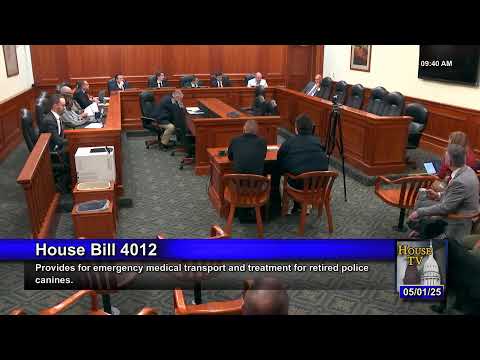
Hearing held on 'Kanjo's Law' to allow emergency transport for retired K‑9s
Summary
House Bill 4012, known as Kanjo's Law, received testimony from handlers, retired officers and an animal‑welfare nonprofit. Witnesses urged allowing emergency medical transport for retired K‑9s and permitting handlers to accompany them; no committee vote was taken.
The House Committee on Government Operations on May 1 held a hearing on House Bill 4012, dubbed “Kanjo’s Law,” which would allow emergency medical transport for retired law‑enforcement canines and permit a trained handler or caregiver to accompany a retired K‑9 during emergency transport.
Representative Mike Hoadley, the bill’s sponsor, said the change would “simply expand service to official retired canines” and emphasized the bill would not mandate ambulance service or “change the precedent of human life over that of the K‑9 unit.”
Retired officers, former handlers and a representative of the nonprofit K9 Hero Guardians described the dogs’ duties and medical vulnerabilities. Retired Officer Brad Hogue (testimony in transcript also refers to an “officer Holt” during remarks about K9 Segan) described K9 Segan’s duties over an 8‑year career: narcotics detection, evidence searches, tracking missing people and community outreach in schools. Hogue described the physical toll on working dogs — frequent in‑and‑out vehicle movement, repeated jumping, and intensive training — and said those demands contribute to degenerative back and hip problems.
Doug Stacer, Kanjo’s former handler, recounted retiring Kanjo after years of service and described a multi‑year medical decline that culminated in back surgery and subsequent complications. Jody Welk of K9 Hero Guardians described Kanjo’s medical care timeline: an MRI and surgery at Michigan State University, a subsequent diagnosis of sepsis and other complications, and episodes when rapid transport and continuous monitoring would likely have improved chances for timely care. Welk said that in Kanjo’s case, “there were times that when Jody would take him down to Lansing, she was not even sure she was gonna get him there,” and that allowing a handler to ride in emergency transport could speed care and allow immediate treatment en route.
Several committee members asked questions about typical service lives and post‑retirement care. Witnesses said active duty service life varies widely depending on agency workload — often four to eight years, sometimes longer — and that retired dogs can show depression or loss of purpose unless given structured activity. Testifiers noted that Michigan certified K‑9s must meet Michigan Commission on Law Enforcement Standards training requirements, including full‑day training sessions every other Wednesday to maintain certification.
Support on the record: committee staff read registration cards indicating support from Deborah Murphy (Saginaw), Anne Griffin (Michigan Humane) and Mike Caproni (Human World for Animals). The hearing concluded with no committee vote recorded on the bill.
The bill’s proponents said Kanjo’s Law would not ask ambulance services to provide medical care for animals or burden taxpayers; rather, it would allow trained handlers or nonprofit volunteers to accompany retired K‑9s and provide care while transport is arranged.