Get Full Government Meeting Transcripts, Videos, & Alerts Forever!
Get email alerts on the Procurement Climate Disclosure topic
No spam. Unsubscribe anytime.
Bill would require state contractors to disclose greenhouse‑gas footprints and climate risk; business groups warn of cost burdens
Summary
SB 755 would require large state contractors to report scope 1, 2 (and for larger tiers, scope 3) greenhouse‑gas emissions and climate-related financial risks; sponsors said disclosure is needed to manage procurement-related climate exposure, while trade associations cautioned about compliance costs and the readiness of reporting frameworks.
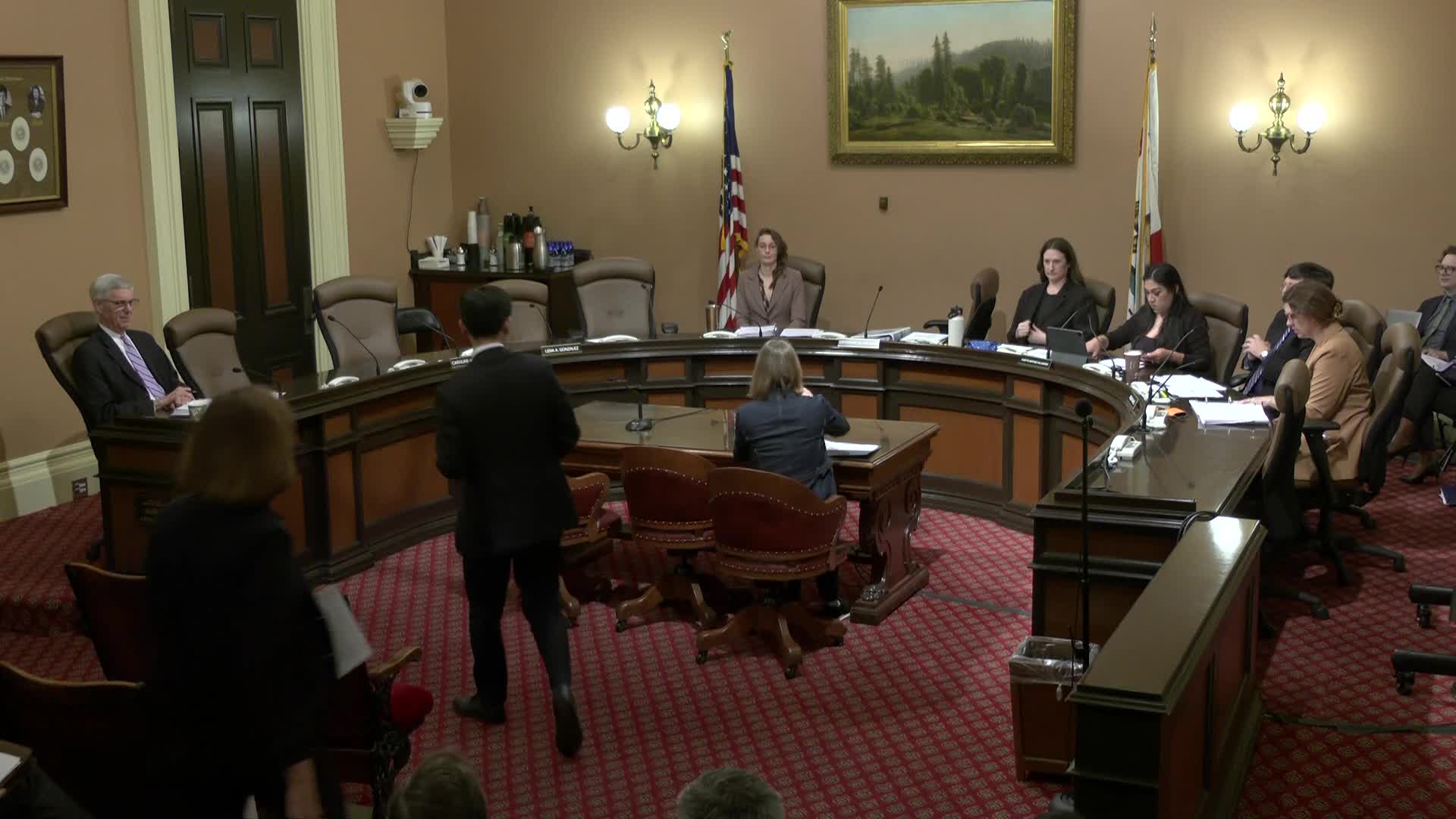
Sen. Blakespear presented SB 755 (California Contractor Climate Transparency Act) to the Senate Committee on Environmental Quality, proposing mandatory climate and emissions disclosure for large state contractors.
"State procurements total more than $60,000,000,000 per year, and we should know what that means to the climate," Sen. Blakespear said. The bill would require contractors with more than $25,000,000 in state contracts to disclose scope 1, 2 and 3 emissions and climate-related financial risk; contractors with $5 million–$25 million in state contracts would be required to report scope 1 and 2.
Catherine Atkin of Carbon Accountable and Brandon Wong of Ceres testified in support, saying reporting fills gaps left by corporate disclosure rules and helps the state assess supply‑chain risk. Atkin noted voluntary reporting rates among state suppliers remain low and argued the state's purchasing power can signal best practices.
Construction and business groups opposed or urged amendment. Felipe Fuentes of the Associated General Contractors of California said the bill’s thresholds capture many small and mid‑sized contractors that lack capacity to prepare scope 3 inventories and predicted compliance costs could reach hundreds of thousands of dollars for some firms. The California Chamber of Commerce urged caution, describing scope 3 as complex and the timing as premature while CARB continues to promulgate regulation under SB 253 and SB 261.
Opponents warned the proposal could shrink the bidder pool for public works, raising costs and slowing delivery; supporters countered that scope 1 and 2 calculations are already widely available and the bill aligns reporting with CARB’s ongoing rulemaking. Committee members asked about timing and said coordination with CARB’s regulatory schedule would ease implementation.
Sen. Blakespear noted the bill is designed to build on SB 253 and SB 261 and to provide procurement-specific transparency for state dollars; she asked the committee to continue refining timelines and to coordinate with stakeholders on feasible compliance approaches.