Get Full Government Meeting Transcripts, Videos, & Alerts Forever!
Get email alerts on the Criminal Justice topic
No spam. Unsubscribe anytime.
Senate passes $3.5 billion judiciary and public safety omnibus; panel approves a range of policy changes and amendments
Summary
The Minnesota Senate approved the judiciary and public safety budget and policy package (House File 2432) covering courts, corrections, public safety and related policies. The bill contains approximately $3.5 billion in appropriations and multiple policy provisions and task forces; floor debate produced a string of amendments and narrow votes.
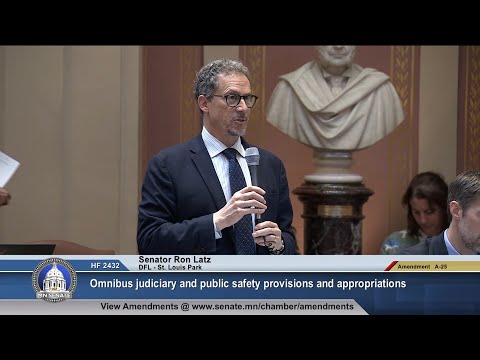
The Minnesota Senate on April 30 passed the judiciary and public safety omnibus bill, House File 2432, combining budget increases and a series of policy changes for courts, corrections and law enforcement.
The legislation’s sponsor, Senator Lats, described the package as a bipartisan construct that funds courts, corrections, half of the Department of Public Safety and other public‑safety entities. “This bill contains both budget and policy. It’s approximately a $3,500,000,000 appropriations bill,” he said. The bill includes funding for crime‑victim services, the Bureau of Criminal Apprehension, violence prevention research, law enforcement training and a range of policy measures including a prohibition on AI‑generated child sexual abuse images, a new civil commitment coordination element in the attorney general’s office and a task force on mandatory minimum sentences.
Debate on the floor produced multiple amendments. Senator Limmer’s A9 amendment restored money for the Philando Castile Memorial Training Fund and passed on a roll call (adopted by vote shown in transcript). Several other amendments were offered and debated: A10 (VSET funding), A11 (radio replacement), A1 (grant reporting requirements), and amendments affecting felony‑murder adjustments (A23) and corrections staffing (A12). One amendment (A11 as amended) failed on a close roll call; others were adopted. Senator Croon and Senator Limmer were among members who pressed for public‑safety priorities; Senator Jasinski and others advanced corrections‑related proposals.
Senate debate included numerous technical fixes and stakeholder‑driven language — for example, an amendment to clarify landlord and Section 8 eviction language and an amendment to require grant reporting. After lengthy debate and roll calls on several amendments, the Senate gave final passage to House File 2432 by a recorded vote reported in the transcript (bill passed; roll call recorded as 34‑32 in the record).