Get Full Government Meeting Transcripts, Videos, & Alerts Forever!
Get email alerts on the Air Quality Diesel topic
No spam. Unsubscribe anytime.
Bill would restrict public agencies from selling most polluting diesel locomotives; transit groups seek clarification
Summary
Sen. John Cortese introduced SB 30 to bar public agencies from selling or donating the oldest diesel locomotives and to require a public air-quality finding before some transfers of newer engines.
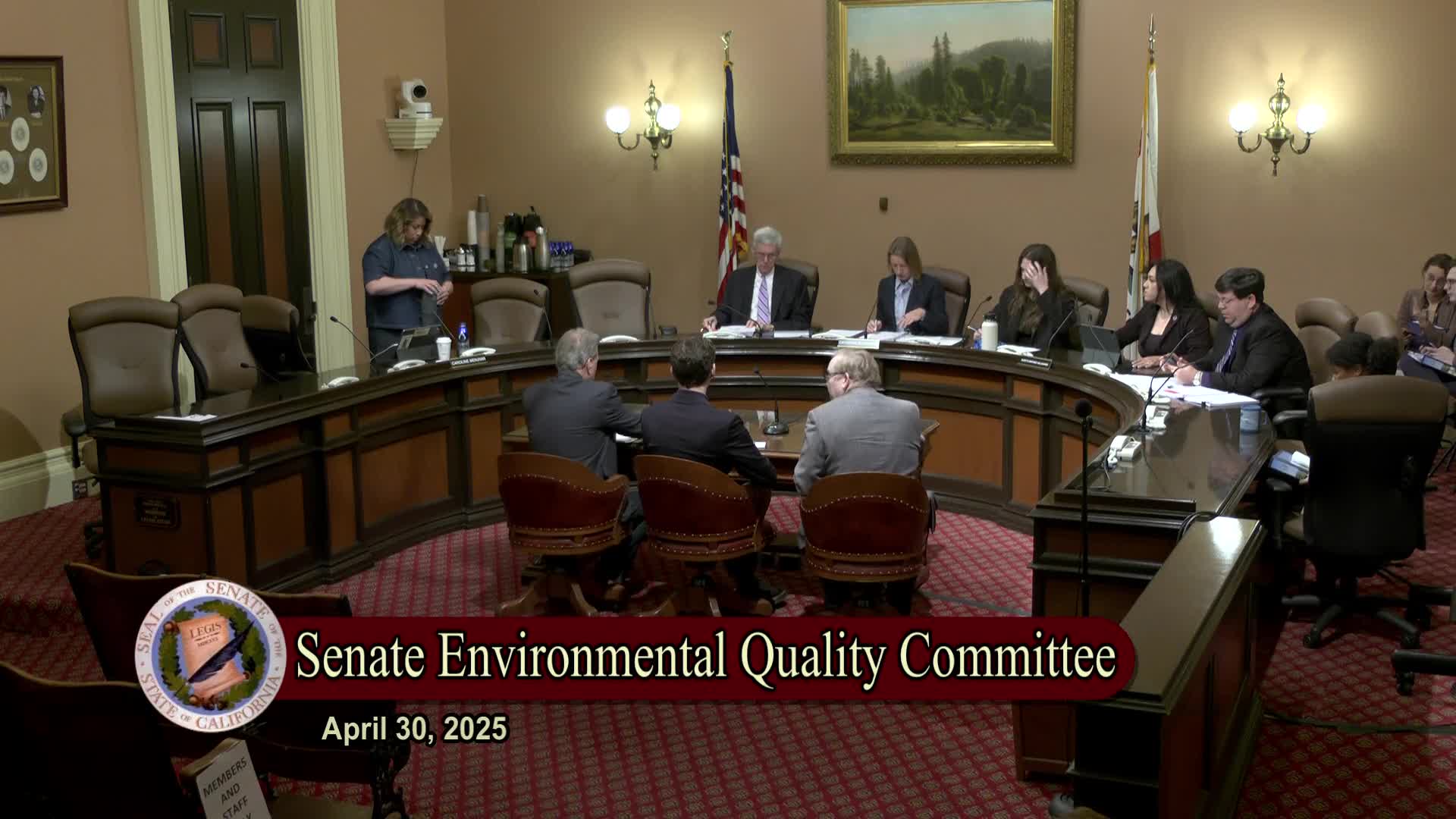
Sen. John Cortese presented SB 30 to the Senate Committee on Environmental Quality, proposing limits on transfers or sales of the oldest, most polluting diesel locomotives by California public agencies.
“Tier 0 engines are the most polluting by far,” Cortese said in opening remarks, and he framed the bill as a measure to prevent exporting pollution when agencies decommission old locomotives after electrification projects. He cited Caltrain’s transfer of retired locomotives to Peru as a motivating example and said the State should avoid shifting pollution to other communities.
Environmental and health witnesses supported the bill. Jacob Evans of Sierra Club California testified SB 30 “will ensure that as California takes action to decrease air pollution, we're not passing along this pollution and its harms into other communities.” Jonathan Cole of Climate Action California urged clearer, rigorous definition of “net air quality benefit” and said federal or overseas transfers must account for all pollutants, not only CO2.
Transit agencies and operators raised concerns. Matt Robinson of the California Transit Association (representing Caltrain and Metrolink) said committee amendments improved the bill but warned of lingering impacts on maintenance equipment and agencies that still rely on older locomotives. Gus Korn of Sonoma–Marin Area Rail Transit said equipment is expensive, useful-life rules apply, and converting to zero-emission traction requires system and infrastructure investments that go beyond rolling stock.
Committee members explored the bill's scope. Chair (Senate Committee on Environmental Quality) noted the measure applies only to transfers by public entities (about 1% of locomotives in the state) and that private freight operators — responsible for the majority of locomotive pollution — are not covered. Cortese said the bill prohibits tier 0 and tier 1 transfers outright while allowing tier 2–4 transfers when a net air-quality benefit is shown and public notice provided.
Committee debate highlighted definitional and implementation questions: how “decommission” is defined, whether maintenance or non-decommissioned equipment is affected, and how to evaluate “net air quality benefit.” Multiple members said the committee should receive additional data on the number and distribution of tier 0 and tier 1 locomotives; a staff note cited “under 50” locomotives in passenger fleets as a rough figure discussed at the hearing.
The author accepted committee amendments and asked for an “I” vote; the committee signaled willingness to work with transit agencies on tightening definitions and technical aspects before further votes.