Get Full Government Meeting Transcripts, Videos, & Alerts Forever!
Get email alerts on the Landfill Expansion topic
No spam. Unsubscribe anytime.
Benton County staff recommends denial of Coffin Butte landfill expansion after finding gaps in noise, odor and site plans
Summary
At a public hearing April 29, 2025, Benton County planning staff recommended denial of LU-24-027, Republic Services/Valley Landfills’ conditional use permit application to expand Coffin Butte Landfill, citing insufficient noise and odor analyses and unclear site plans; the hearing was recessed for continuation and further review.
Benton County Planning Commission members heard the staff presentation and extensive commissioner questions April 29, 2025, on LU-24-027, an application by Republic Services (property owner Valley Landfills) to expand the Coffin Butte Landfill and to add employee and maintenance buildings, revised access roads, relocated leachate infrastructure, an outbound scale and other improvements.
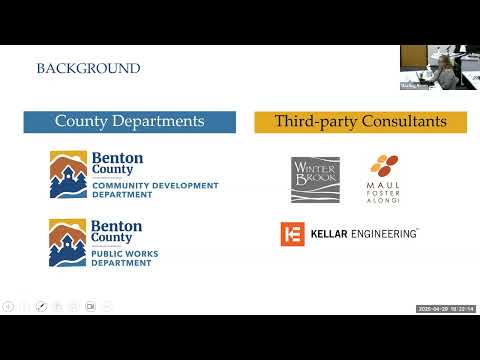
The staff report recommended denial. Planning Director Petra Sheets told the commission that, based on the applicant’s materials and third‑party consultant reviews, "the noise and odor analysis and evidence provided by the applicant does not sufficiently demonstrate that the proposal will not seriously interfere with uses on adjacent properties or the character of the area. Therefore, staff recommends denial of this application." The commission recessed the hearing and scheduled additional sessions to allow more evidence and updated staff materials.
The project area described in the application includes multiple tax lots totaling several hundred acres of landfill property and adjacent lands. Staff and the applicant described the sizes of key tax lots in the application: tax lot 801 (~89 acres), tax lot 1101 (~4 acres), tax lot 1107 (~59 acres), tax lot 1108 (~29 acres) and tax lot 1200 (~82 acres). The proposal would add an approximately 1,800‑square‑foot employee building, a new maintenance/shop area and modifications to access roads and leachate handling; the application notes an elevation change of roughly 60 to 160 feet across the site. The applicant reported an extensive pre‑application review that began in mid‑2024 and a completed application submitted Jan. 15, 2025.
Why it matters: commissioners and staff said the expansion would extend the landfill’s operational life and raise recurring issues — noise, odor, groundwater/leachate, PFAS and traffic — that affect neighboring residents, Adair Village and other downstream users. Staff noted they had received roughly 185–190 public submissions by April 29 (roughly 3,000 pages in total) with the vast majority opposing the expansion and citing leachate, odor, traffic, water quality and PFAS concerns.
Staff findings and legal framework
Sheets and the county’s consultants framed the review around Benton County Development Code provisions and the established approval criteria for conditional uses in the landfill site zone. Staff identified the most relevant review factors as noise, odor, visual impacts, traffic and groundwater effects, and said they evaluated the application under county code chapters including the development code administration, general review criteria (BCC 53), the landfill site zone and the forest conservation zone (BCC 60). Sheets noted the county treated the applicant’s chosen analysis area for "character of the area" broadly (the applicant used a 90‑square‑mile area in materials supplied to the county), but staff concluded that the applicant’s technical analyses for noise and odor contain gaps.
Noise and odor
An engineering review by county‑retained consultants found that the applicant’s noise analysis appears to exceed the DEQ regulatory threshold that staff used as the practical benchmark for a "seriously interfere" determination, and that the applicant did not adequately evaluate potential noise impacts to more distant adjacent properties. The county’s consultant also flagged multiple technical inconsistencies in the applicant’s odor model and said locations of potentially odor‑sensitive uses were not clearly identified in the applicant’s mapping or analysis.
Because the county found the applicant’s analyses do not demonstrate the expansion "will not seriously interfere" with adjacent uses or the character of the area, staff concluded the record currently supports recommending denial. Staff said some DEQ rules (including noise rules) remain on the books but have limited active enforcement capacity at the state level; air and other DEQ permits and monitoring run in parallel to the county land use review.
Groundwater, leachate and PFAS
Staff acknowledged groundwater and leachate are highly contested topics among commenters and noted limits on the county’s technical jurisdiction, citing state and federal regulatory frameworks as the principal venues for monitoring and permitting groundwater impacts. County engineering reviewers concluded that — in the county’s review context and given the multiple state/federal regulatory frameworks — the applicant’s groundwater and leachate analyses met county review criteria, but commissioners persisted in questioning monitoring, capture rates for leachate, and potential PFAS (per‑ and polyfluoroalkyl substances) impacts. Commissioners and staff said the county will incorporate public comments and agency referrals into an updated staff report; Sheets said the county will provide a revised staff report before deliberations, with that revised report available at least seven days before the scheduled deliberation date (the commission set a tentative deliberation on June 17).
Forest Conservation Zone and site plan gaps
Staff also identified a plan‑documentation issue: the proposed maintenance/shop building on tax lot 1200 was not clearly identified on the submitted exhibits, preventing staff from completing required forest conservation zone review. Staff said the unclear mapping/identification of the shop structure could be a separate basis for denial because it prevents full evaluation under BCC 60 standards.
Traffic, public agencies and public comment
County staff said the applicant’s transportation analysis concludes traffic impacts from the expansion would be minimal, and county consultants largely concurred. Staff noted a late‑arriving set of comments from the Oregon Department of Transportation and said those agency comments will be incorporated into the record. The county also solicited and received comments or referrals from Oregon Department of Fish and Wildlife (noting mapped heron rookeries), DOGAMI (no substantive comments), ODOT and local advisory committees; the county said it has treated the Environmental Natural Resources Advisory Committee (NRAC) input as an agency referral and will include DSAC (Disposal Site Advisory Committee) materials in the record as public comments.
Commissioners’ questions and legal/process issues
Commissioners raised numerous procedural and substantive questions during the staff presentation. Topics included: whether hazardous materials disposal (e.g., materials from train derailments) could be accepted at the landfill, how the county will incorporate DSAC/NRAC reports and annual reports into the record, whether DEQ and EPA permitting and investigations affect the county’s land use decision, how conditions of approval and enforcement would be imposed and carried forward on property transfers (staff said land use conditions "run with the use" and would be recorded against the property), and whether the county could impose a tonnage cap as a condition of land use approval even if a franchise agreement contains different terms.
Several commissioners urged clearer mechanisms for monitoring and enforcement if the commission were to approve the expansion, including bonds, recorded notices on title and dedicated inspection or compliance resources; staff and county counsel said those are options the county could adopt but had not established an enforcement approach in the current report because staff recommended denial.
Next steps
The planning commission recessed the hearing and scheduled continuation of the applicant presentation and additional testimony at 6 p.m. on the next meeting date (a Thursday evening session). Staff said it would continue to post and add agency referrals, NRAC and DSAC materials and public comments into the record, and would publish a revised staff report that incorporates late agency comments and public submissions; the county committed to provide the updated staff report at least seven days before the deliberation hearing currently scheduled for June 17.
The applicant’s presentation and rebuttal were not started on April 29. The record remains open for written evidence while the hearing is continued; the commission outlined the process for requesting continuances or leaving the record open for additional written submissions.