Get Full Government Meeting Transcripts, Videos, & Alerts Forever!
Get email alerts on the Land Use topic
No spam. Unsubscribe anytime.
Caldwell leaders discuss land swap to expand fairgrounds; parking, leases and railroad access flagged as next steps
Summary
Caldwell city and Canyon County officials met with the Caldwell Rodeo and the College of Idaho at a joint workshop to consider a proposed property exchange that would move the county fair into the city's Griffith Park parcel in return for the county's indoor arena and the Ag Extension building.
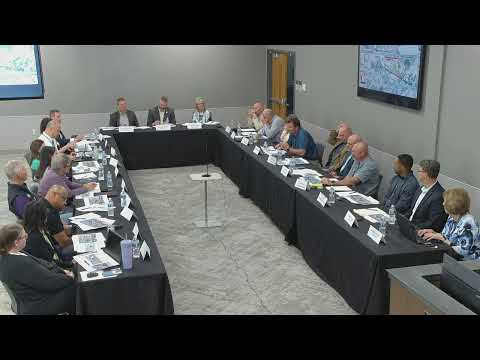
Caldwell city and Canyon County officials met with representatives of the Caldwell Rodeo and the College of Idaho in a workshop to discuss a proposed property exchange that would relocate county fair operations into the city's Griffith Park parcel in return for county-owned facilities including the indoor arena and the agricultural extension office. "This is a workshop, which means no decisions are made," the mayor said at the opening of the meeting.
The proposal under discussion would transfer the city's parcel identified on workshop maps as "number 2" (donated Griffith Park land) to the county, and in return the county would convey the indoor arena (3A) and the Ag Extension building at 501 Main Street (3B) to the city. Staff reported that two independent market estimates produced average values of about $5.9 million for the Griffith Park parcel, about $4.7 million for the indoor arena parcel and about $833,000 for the Ag Extension building; those averages produce a roughly $5.9 million value for the city parcel and about $5.6 million for the county holdings under discussion.
Why it matters: stakeholders emphasized the economic and operational consequences of any transfer. A rodeo representative, Nicole, told the group the rodeo brings "over $6,000,000 into Canyon County with new money" annually, and the rodeo is simultaneously conducting a roughly $7.5 million capital campaign for facility upgrades. Rodeo and fair organizers said they need legal certainty in lease terms and site access before making capital commitments.
Key details and areas of discussion
- Property specifics and deed limits: Staff noted the Griffith Park parcel was donated in the 1990s with deed language that limits its use to public purposes or county fair use. That deed restriction was cited repeatedly as a constraint that would affect any swap and will need formal legal review.
- Appraisals and parity: City staff said no formal appraisal has been ordered yet; the numbers discussed were averages of two market estimates produced for preliminary comparison (Griffith Park: ~$5.9M; indoor arena: ~$4.7M; extension building: ~$833K). City staff offered to circulate the underlying estimate emails to elected officials for review.
- Timing and transition: Officials and stakeholders agreed a move would take time. "If this does look like it's a positive entry moving forward ... the county fair is not gonna move over for the fair this year. Nor next year," the mayor said, describing a multi-year transition that would allow new buildings to be constructed and operations to relocate gradually.
- Parking and circulation: Parking was a recurring concern for the College of Idaho and rodeo organizers. The workshop reviewed conceptual layouts that would add paved parking (the city's responsibility for certain "wingtip" lots) and retain or design grass event parking for cooler summer walking surfaces. The county said realignment of Stock Trail (the road that currently bisects the site) would be the county's responsibility to fund as part of the swap discussion.
- Railroad lease: Staff explained that much of Stock Trail sits within Union Pacific railroad right-of-way and that the current lease with Union Pacific is expiring; the county representative said he is negotiating a new lease with the railroad. That lease, and any new terms, would affect access and the scope of possible road realignment.
- Leases and legal certainty: Rodeo and college leaders said long-standing "handshake" arrangements and outdated leases create operational uncertainty. The rodeo requested that customary access and usage agreements be memorialized and extended in writing so the rodeo and its donors can proceed with capital fundraising. "We're seeing some pushback from sponsors on the length of our lease," a rodeo representative said, urging a longer, clearer agreement before major investments.
- Operational details for the near term: Rodeo and fair staff described year-to-year operational plans should construction proceed. For the coming fair, livestock unloading and most animal operations will continue on-grounds inside the fence; organizers said only sheep and goats historically walked from the nearest dirt lots and the fair is revising unloading and parking passes (fair entry deadlines were said to fall around early June, "June 5, somewhere around there," but the date was not specified precisely).
Concerns raised by elected officials and partners
- Coordination of events and a scheduling authority: Several city councilors and commissioners urged creation of a coordinator or single point of contact to schedule uses of the shared area, avoid conflicts between large events and manage shared parking. "We have to have a coordinator for all this," one county commissioner said.
- Long-term maintenance and capital responsibility: Council members asked whether the city should accept buildings whose capital and maintenance needs are not yet fully known. Councilor Kelsey Dodie asked for full building assessments (roof life, deferred maintenance, ADA and utility upgrades) before the city accepted responsibility for buildings 3A and 3B.
- Community impacts and compliance: Council members asked staff to verify whether converting parkland use or changing ownership would affect compliance with any federal grants used to build existing amenities, and whether replacement park amenities would be required elsewhere in the city.
Next steps and staff homework
No formal motions or votes were taken; the meeting functioned as a stakeholder workshop to test whether the swap concept has sufficient support to merit detailed study. Staff and stakeholders agreed on a package of follow-up work: obtain formal appraisals and detailed building condition assessments for 3A and 3B; circulate the two preliminary valuation emails and the appraisal assumptions; draft updated lease terms and scenarios for note-taking by the rodeo and college; clarify railroad lease options and the cost implications of Stock Trail realignment; produce a parking plan with capacity figures and phased staging for near-term and long-term events; and return to elected officials with a refined proposal for direction.
The mayor closed by asking staff to compile the requested analyses and reconvene as soon as feasible; no date was set. The workshop record shows substantial stakeholder support for further study but also clear requirements (deed restrictions, updated leases, Union Pacific access and capital estimates) that must be resolved before any formal property transfer or execution of an agreement.
Ending
City and county staff will gather the requested appraisals, building assessments, lease language and parking/traffic plans and return the results to the council and commission. Stakeholders asked that any future proposal include written lease commitments addressing long-term use and access before the rodeo or college make major new capital investments.