Get Full Government Meeting Transcripts, Videos, & Alerts Forever!
Get email alerts on the Budget Override topic
No spam. Unsubscribe anytime.
Easton leaders recommend $7.3 million override to close budget gap; question headed to voters
Summary
Town Administrator Connor Reid presented an alternative fiscal 2026 budget that would add a $7.3 million operating override to avert deep cuts across town departments and schools, saying rapid health-insurance and other fixed-cost increases and low state school aid created a structural shortfall the town cannot close without new recurring revenue.
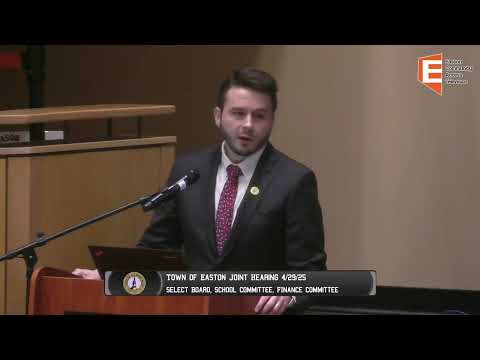
Town Administrator Connor Reid said at a joint public hearing that Easton faces a structural budget gap that cannot be closed without additional recurring revenue and recommended a $7.3 million operating override to avert deeper cuts to services and schools. "Eighty-five percent of our operating budgets are our people," Reid said, adding that rapid increases in fixed costs — especially health insurance and regional education assessments — and low state education aid have combined to push the town into an unusually large shortfall.
Reid said the town's early-year, preliminary shortfall totaled about $6,360,000 before months of reductions and use of reserves. The administration reduced that gap in planning but said balancing without additional recurring revenue would require the largest cuts to town and school services since the 2008 recession, including more than 50 municipal full-time-equivalent position eliminations and hundreds of school staff reductions.
"Fixed costs are expenditures over which the town has little to no immediate control," Finance Director Wendy Nightingale said in the presentation, describing rapid increases to Group Insurance Commission premiums, pension assessments and regional school assessments. Nightingale said some GIC health plans rose as much as 17.2% this year and that health insurance increases alone accounted for roughly $2 million in two years.
The administration and department heads walked through how those increases translated into service reductions under the non-override budget. Dr. Alicia Cabral, Superintendent of the Easton Public Schools, said the school department initially faced an 8.2% level-service ask that was reduced through attrition, incentives and other measures to a $51.5 million request (3.6% year-over-year), and that 44.81 FTE reductions are included in the non-override plan. "This year, we're in the lowest level of regression that we've ever seen," Cabral said, adding the district has moved from primarily "reactive and essential" staffing toward cuts that reduce students' access to electives, specialist support and technology.
Public safety leaders described immediate operational consequences. Fire Chief Justin Alexander said the department already is down staff and that the non-override scenario forces the closure of the Lothrop Street fire station and consolidation of apparatus into two stations. "The override cut for the Fire Department, it was two positions and a loss for about half of our training budget," Alexander said, and warned the department is already struggling to recruit because uncertain budgets make it harder to promise job stability.
Police Chief Keith Boone said cuts would reduce the force to a level similar to 2014 and shrink detective and overnight staffing, with a direct effect on investigations and response capacity. "We're going to be here. You need us," Boone said, but he warned that reduced staffing would increase response times and reduce the department's ability to handle simultaneous priority calls.
Public works and other departments also reported cuts. DPW Director Dave Field said staffing is lean across divisions and that the override would restore roughly $148,000 and one of two eliminated positions; without additional funding, the town will have fewer mechanics and building-maintenance staff than peers. Health and community services and the Ames Free Library reported smaller reductions but noted unavoidable fee increases and program changes under the non-override budget.
The administration framed the override as part of a broader plan advanced by the Promoting a Sustainable Easton (PACE) advisory group. The PACE committee recommended a $7.3 million override coupled with a community compact that includes a specialized override reserve stabilization fund and commitments to limit future operating requests. The proposed override would also eliminate the use of about $3.3 million in one-time reserves in fiscal 2026, preserving those reserves for later years and reducing the risk of a fiscal cliff.
Reid said the proposed $7.3 million override would be funded by an additional real-estate and personal-property tax levy and estimated the effect at about $800 per year for the median homeowner (individual impacts vary by property value). He also said $800,000 of the override would be placed into a dedicated override reserve stabilization fund to offset future wage and insurance pressures and lengthen the override's effective life. Some restoration priorities were identified for schools and public safety, but Reid cautioned that the override would not restore every cut and that departments would still need to pursue efficiency measures.
After department presentations and public comments, the Select Board, Finance Committee and School Committee voted at the hearing to include and recommend the non-override budget article and the contingent override articles (Article 2A: creation of the override reserve stabilization fund; Article 2B: the $7.3 million contingent override). The boards also approved the ballot language to present the override as a proposition to voters at a special election on June 10, 2025, and set the town meeting schedule for May 19. The approved ballot wording asks: "Shall the Town of Easton be allowed to assess an additional $7,300,000 in real estate and personal property taxes for the purpose of funding the operating budgets of the Town and public schools and funding a specialized override reserve stabilization fund for wages and insurances for FY2026?"
What happens next
Town meeting will consider the non-override and override articles on May 19; if town meeting adopts the contingent override article, the override question will appear on the special election ballot on June 10. Officials urged residents to review the budget materials posted on easton.ma.us and at public open houses run by PACE. Speakers at the hearing emphasized the trade-offs voters will face: accepting projected cuts that officials say will reduce staffing and services, or approving a tax increase to restore some positions and avoid further reductions next year.
Community members and department leaders asked about state advocacy and longer-term strategies. Cabral and Reid said the town and school administration continue to press state lawmakers for changes to the education funding formula, increased "minimum aid" and higher reimbursements for special education and transportation; they also cited the town's efforts to encourage growth and development (sewer districts, targeted new housing) to broaden the local tax base.
The hearing record, slide decks and a tax-impact calculator are posted on the Town of Easton's override information page and the Easton Public Schools business office site. The PACE open house series will hold a final public session the week before town meeting to answer questions and review specifics on restorations and exemptions for seniors and veterans that the override would expand if voters approve it.