Get Full Government Meeting Transcripts, Videos, & Alerts Forever!
Get email alerts on the Public Health Budget topic
No spam. Unsubscribe anytime.
Cochise County supervisors review public health budget; health director seeks two positions
Summary
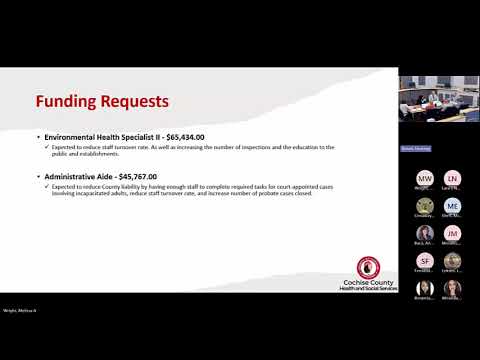
Cochise County health department Director Barb Lang reviewed the department's fiscal year budget during the Board of Supervisors' April 30 work session, saying the department receives about half of its operating funds from grants and half from the county general fund and asking supervisors to approve two additional positions to address inspection and administrative backlogs.
Cochise County health department Director Barb Lang reviewed the department's fiscal year budget during the Board of Supervisors' April 30 work session, saying the department receives about half of its operating funds from grants and half from the county general fund and asking supervisors to approve two additional positions to address inspection and administrative backlogs.
"48% of public health is paid for through grants. 52% general fund," Lang said, presenting a budget breakdown that she said places many program expenses outside the general fund. Lang asked the board to approve one additional environmental health specialist — increasing that unit from eight to nine inspectors — and an administrative aide for the public fiduciary office to handle court-driven paperwork for wards of the court.
The request, Lang said, aims to reduce inspection backlogs for restaurants, septic systems and residential wells and free fiduciary staff to focus on casework. "We're asking for 1 position to increase inspections for restaurants, for septic, for private residents, and then we're asking for administrative aid for the public fiduciary's office," Lang said. She added later, "We're just asking for those 2 positions and consider that, and we appreciate the time."
Lang also described other budget items and program functions the board questioned: the department contracts with an out‑of‑state medical director, paid about $42,000 in the professional‑services line, who is on call for clinical questions and post‑exposure guidance such as rabies and tuberculosis testing; maintenance‑of‑effort transfers that cover jail medical and mental‑health services; and multiple grant‑funded programs ranging from public health emergency preparedness to WIC nutrition services and opioid overdose prevention.
On the medical director, Lang said the contract physician is used for clinical guidance when county nurses need direction and that the role is statutorily required. "He contracts with us and talks us through any complications with TB testing, any kind of rabies," Lang said. Supervisors pressed on cost and on whether the county could recruit a local physician; Lang replied the position has not been full time and the county has struggled to recruit a local doctor for the role.
Supervisors also sought clarity on how grant funds and general‑fund items are displayed in the county's financial systems. Lang explained that account coding conventions in the county's financial software can make grants and interfund transfers appear in different places on printed reports, and that formal interfund transfers are run as separate agenda items for board approval.
Board members raised programmatic questions about the department's work: statutory inspection requirements for restaurants (the department said annual inspections are required but the department is not currently able to reach every establishment every year), the county's role in well and septic plan reviews for new construction, and the public fiduciary office's role managing finances and placements for court‑appointed wards. Lang described five county clinics (Douglas, Benson, Bisbee, Wilcox and Sierra Vista) and said clinic staff include nurses and a shared practitioner who also provides jail services.
Lang highlighted grant programs aimed at prevention and outreach, including public‑health emergency preparedness, the Arizona prescription drug overdose program (which supports Narcan distribution and overdose prevention work), suicide mortality review data collection, and WIC breastfeeding support. She told the board the department "operate[s] fairly lean" and that grant funding supports the bulk of those programs.
The board did not take a formal vote during the work session; Lang's presentation was part of the budget review process. Supervisors asked for additional detail and for clearer presentation of which line items are grant funded versus supported by county general fund dollars before formal budget adoption.
What happens next: Lang said the budget materials and any requested clarifications will be available to supervisors ahead of subsequent budget work sessions; interfund transfers and final budget figures will come back to the board as agenda items for approval.