Get Full Government Meeting Transcripts, Videos, & Alerts Forever!
Get email alerts on the Water Supply topic
No spam. Unsubscribe anytime.
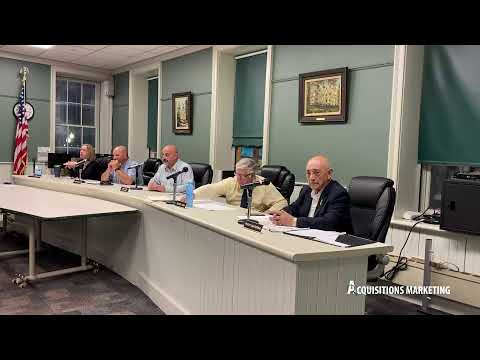
Goshen engineers outline consolidated water district, new rates and phased upgrades after residents report brown water and low pressure
Summary
At the Town of Goshen—s annual water meeting, Delaware Engineering presented a plan to operate a newly consolidated water district, outlined a revised rate structure averaging about $932 per year for a typical home, and described phased capital work including green-sand filtration to remove iron and manganese that has discolored taps and reduced pressure in multiple neighborhoods.
At the Town of Goshen—s annual water meeting, Delaware Engineering presented a plan to operate a newly consolidated water district, outlined a revised rate structure and described phased infrastructure work to address high iron and manganese levels and low pressure reported by multiple neighborhoods.
John Brush of Delaware Engineering said the consolidated district spreads capital costs across more users and that "the water that the revenue that is generated stays in the district. It does not become part of the town general fund." He and colleagues described a 2025 operating budget of $534,210, a bonded debt service of about $217,000 and an average annual water bill for a typical home of roughly $932 under the new facility-plus-usage structure.
The presentation and an extended public comment period focused on three technical priorities: removing iron and manganese from source water, restoring reliable pressure for affected customers, and completing replacement or repair work (hydrant replacements, tank repairs and well improvements) across small districts such as Arcadia Hills, Hamiltonian Park, Scotchtown Park and Stonehenge.
Why it matters: residents in several small water districts have reported discolored or pink water, clogged household filters and intermittent pressure losses that prevent normal bathing and laundry. The town and its contractor said capital work is already complete in Hamiltonian Park, where a new green-sand filtration system brought measurable improvements; other districts will be scheduled for projects and grant applications.
Most important facts
- Consolidation and rates: Delaware Engineering said the town consolidated several small, separate water districts to create a single larger district. The firm described a facility fee plus a usage fee; the average home (estimated at 30 gallons per day in meeting materials) would see about $932 per year under the proposed structure. A facility fee of $136.26 was discussed and confirmed in the meeting as billed quarterly.
- Budget and debt: Annual operating and maintenance costs for the consolidated district were given as $534,210 for 2025. Bonded debt to finance recent projects (Arcadia Hills work and the Hamiltonian greensand installation) was described as about $217,000.
- Treatment and projects: The town and Delaware Engineering put a greensand filtration system into service in Hamiltonian Park roughly a month before the meeting; officials said that system, designed to reduce iron and manganese, cost about $1,500,000. Additional green-sand or alternate filtration will be evaluated for other districts. Scotchtown was named as the next candidate for design work because of its small size and perceived manageability.
- Grants and financing: Engineering staff said the town will pursue grant funding through New York State Environmental Facilities Corporation (EFC) and other state and federal programs; they said grants are commonly partial (for example, 60% is cited) and that applications usually require local matching funds.
- Immediate operations: Dominic Hiller, the system operator, said the system is flushed regularly ("We flush, biannually. And I personally flush that element.") and described a plan to replace a problematic hydrant in Scotchtown before a full flushing program. Hydrant replacement and flushing timing was described as a few weeks after parts/pricing and board approval.
What residents said
Residents described repeated incidences of discolored water and low pressure. Linda Mulligan, a Scotchtown resident, said water went out during a power outage and that she had no water to flush toilets. Multiple residents described replacing home filters every few months and bringing samples to town staff. One attendee, Chris Haley, told the board that petitioning and door-to-door outreach showed widespread complaint about both rates and water quality.
Technical and policy context
- Water quality: Engineers and the operator explained the brown/black discoloration is iron and manganese precipitating when source water reacts with disinfectant. They said orthophosphate sequestration can reduce aesthetic discoloration at lower concentrations but has diminishing returns when metal concentrations are high. The firm emphasized filtration (greensand) as the more reliable remediation in the town's geology.
- Source variability: Presenters said wells drilled or brought online in recent years vary in iron and manganese concentrations; staff will monitor raw-water concentrations at each well to determine whether blending or selectively using wells could help short-term.
- Sewer and backwash: Green-sand systems generate backwash that typically requires sewer or an approved disposal method; some districts lack public sewer, which complicates the choice of filtration technology and may point to cartridge filter or other systems for those areas.
Actions and next steps
- Immediate: Hydrant replacement in Scotchtown was prioritized and described as likely within weeks once prices are obtained and the board approves parts and work. Dominic will begin more frequent flushing following hydrant work.
- Near term: Engineers will design a treatment solution for Scotchtown and evaluate Arcadia Hills' needs (Arcadia was described as a larger, more complex project). Staff will continue applications to EFC and federal/state representatives for grant funding and will supply supporting documentation the funders require.
- Long term: The town expects to sequence projects to avoid doubling costs for residents; engineers said residents will likely continue to see incremental rate impacts as projects advance unless larger grant awards cover more of a project's cost.
Meeting close
The meeting opened and closed by motion; no formal town vote on rates or capital contracts was taken at the session. Town staff and Delaware Engineering encouraged residents with ongoing concerns to provide addresses and to use the on-line meter portal the town has enabled so unusual usage or leaks can be detected.
Ending note
Officials urged patience while describing concrete short-term fixes (hydrant replacement and more frequent flushing) and continued pursuit of grants and designs that, officials said, will reduce iron and manganese and restore service quality to additional districts over the coming year.