Get Full Government Meeting Transcripts, Videos, & Alerts Forever!
Get email alerts on the Housing Affordability topic
No spam. Unsubscribe anytime.
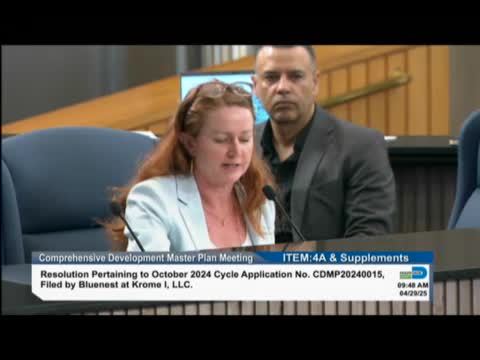
Commissioners approve Bluenest Chrome project with requirements for workforce pricing, pump station and green stormwater landscaping
Summary
The Miami‑Dade Board of County Commissioners voted unanimously to transmit a comprehensive plan amendment and related zoning for the 90‑acre BlueNest at Chrome development, including conditions capping townhome prices at a workforce level, requiring 20% income‑restricted units, building a pump station sized for the basin, and adding green stormwater landscaping.
The Miami‑Dade Board of County Commissioners voted unanimously to transmit a comprehensive plan amendment and related zoning for the 90‑acre BlueNest at Chrome development, a proposed mixed‑housing project south of Southwest 272 Street between Southwest 177th/Chrome Avenue and Southwest 172nd Avenue that the developer says will offer about 700 homes and neighborhood retail. Commissioner Cohen Higgins moved the motion; Commissioner Gilbert seconded it; the measure passed unanimously.
The board’s action sends the county’s October 2024 cycle CDMP application (Bluenest at Chrome 1 LLC, CDMP 20‑24‑15) on to the State Land Planning Agency for review while attaching three additional local conditions requested during the hearing: (1) cap all townhomes at the workforce‑housing sales price while retaining a 20% workforce income‑restricted set‑aside (140 of 700 units); (2) require the applicant to provide a sanitary pump station sized to accommodate the basin as a whole; and (3) incorporate landscaping and tree‑based “green infrastructure” to help manage stormwater runoff.
Why it matters: Commissioners said the county faces a severe shortage of for‑sale housing affordable to local workers, teachers and first responders. Supporters — many of whom spoke at the public hearing — told the board they need more homeownership options close to jobs and transit. Opponents said the proposal’s density and product type conflict with the nearby Redland agricultural character.
What the developer said: Pedro Gassana, attorney for Bluenest Development, told the board the project would deliver “workforce housing homeownership” and said the developer is committing to price and down‑payment terms it described as affordable. Gassana summarized the offer as a maximum workforce sale price of about $451,000, a $4,500 down payment and an example monthly payment of about $2,600 that the team said would include principal, taxes and insurance. He also said the project will connect to water and sewer (replacing septic), build sanitary infrastructure and make impact‑fee contributions. On the record he noted an estimated fiscal impact/impact fees package “over $12,200,000.”
Public comment: The record included dozens of speakers. Supporters — including young workers, teachers and longtime county residents — told the commission the development would provide rare ownership opportunities at price points they could reach. Several residents and long‑term farmers objected, saying the plan’s density and rowhouse design do not match the rural character of Redland and expressing concern about schools, water, traffic and other services.
Commissioner discussion and conditions: Commissioner Cohen Higgins, the district commissioner and sponsor, said the developer engaged the community and that the project addresses a long‑standing homeownership shortage in the county. Several commissioners pressed for infrastructure assurances. Commissioner Regalado emphasized that the pump station planned by the applicant should be sized so it can serve the basin beyond the single site (a “sub‑regional” station), and asked the applicant to use native trees and other green infrastructure in the stormwater plan; the applicant agreed on the record. The district commissioner asked the developer to increase the workforce set‑aside; the applicant replied they would cap townhome sale prices at the workforce sales price and maintain the 20% income‑restricted units.
Formal action: The board approved transmission of the CDMP amendment and its companion zoning item with the three additional conditions described above. Commissioner Cohen Higgins moved the motion; Commissioner Gilbert seconded. The roll call recorded unanimous approval.
Details and limits: The board’s action transmits the CDMP amendment (a first step) to the State Land Planning Agency; transmission does not itself authorize development construction. The board reserved the right to take additional public hearings or final action after state review. The developer still must complete site plan review, obtain permits and satisfy any state or agency conditions before building.
Context: The applicant and staff noted the parcel lies inside the county’s Urban Development Boundary and that the county’s comprehensive plan encourages a mix of housing types on sites over 40 acres. The developer said the proposal aims to provide townhomes for the “missing middle” and estate‑style houses on the site perimeter.
What’s next: The transmittal sends the county’s CDMP amendment to the State Land Planning Agency for review; zoning approvals and detailed permitting remain to be completed by the developer before construction can begin.