Get Full Government Meeting Transcripts, Videos, & Alerts Forever!
Get email alerts on the Inspections And Standards topic
No spam. Unsubscribe anytime.
Finance committee reviews Inspections & Standards budget, flags staffing shortages and fee changes
Summary
Providence City’s finance committee reviewed the Department of Inspections and Standards proposed FY2026 budget on April 24, 2025, discussing an estimated $10 million in departmental revenue, persistent inspector vacancies tied to state licensing and pay, a proposed new position, and planned increases to fines for unpermitted work.
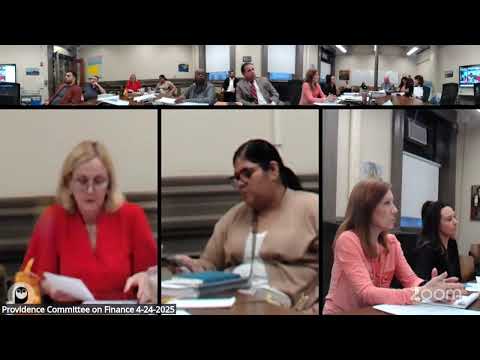
Providence City Committee on Finance Chair Helen Anthony on April 24, 2025 heard a budget presentation from the Department of Inspections and Standards (DIS) showing the department is projected to generate just over $10 million in revenue in fiscal 2026 and is asking for personnel and cost adjustments to respond to enforcement and inspection demands.
The department’s presentation, included in the committee packet, said permitting fees (set by state statute) are the primary revenue source and that DIS is forecasting roughly $10 million in FY2026, consistent with recent trends. Department staff told the committee that year-to-year revenue rose from about $6.2 million in fiscal 2023 to $9.4 million in 2024, with year-to-date 2025 at approximately $10.3 million.
Committee members pressed the department on persistent staffing vacancies and recruitment challenges. The presentation lists FY2026 salaries for DIS at about $2.9 million, up from $2.7 million in FY2025. Department staff attributed the increase to a 2.75% cost-of-living adjustment and step increases; they also requested one new full-time equivalent (FTE) described in the budget package as a “floodplainting coordinator and plans examiner supervisor.” Staff said they expect to fill that role internally where possible, which would yield about $30,000 in savings if an existing employee is promoted and paid a stipend while moving into the new role.
Council members and staff described multiple vacant inspection and plans-exam positions. Department representatives said some mechanical and plumbing inspector roles are hard to fill because Rhode Island requires licensed inspectors for those trades, and pay in the private sector can be substantially higher. As the department put it, licensing and market pay for licensed trades “means we cannot recruit out of that” industry at current municipal rates.
Committee members also discussed DIS enforcement and tools for addressing vacant or unsafe properties. Staff said boarding and demolition are contracted out and can be costly; demolition work on properties can run into tens of thousands of dollars. The department reported using fines and lien authority to recover costs and said it places liens against properties where the city pays for cleanups or makes repairs.
The committee heard that the city’s targeted home-repair assistance tied to DIS enforcement has been substantially reduced. Staff stated the department previously completed work on roughly 74 properties and spent about $3 million on remediation tied to enforcement actions; that specific discretionary repair fund is no longer available in the department’s current resources. Members discussed using other grant sources and interdepartmental programs to assist homeowners who cannot afford repairs.
DIS staff told the committee they currently identify roughly 8% of work done without permits through active field inspections. The department and legal staff are reviewing the existing fee for unpermitted work: the budget discussion said the previous “catch-up” fee was $250 and that the department is pursuing an increase to $500 and a higher daily penalty to better align enforcement incentives with enforcement costs. Staff described the enforcement workflow: initial penalty calculations, escalation to a daily penalty (the department described using $500 per day as a proposed level), and referral to court after a set period (discussed at 30 days in the presentation).
Council members asked about operational changes the department is making to improve throughput. Presenters described process changes that reduced “drag” in permit processing in past years, implementation of digitization pilots, and planned counter-facing permit simplifications (prescriptive permit submittals for common homeowner work and faster counter permitting for small projects). The department also discussed a proposed move of DIS staff to a building shared with the Department of Public Works to improve coordination and public access for permit customers.
No formal votes on budget items or ordinance changes occurred in the committee during this presentation. Committee members requested additional detail in future budget iterations, including clearer line-item breakdowns of services versus supplies and confirmation of which fines and fee changes will be incorporated into the final revenue figures.
The committee moved on to the Planning Department budget after the DIS presentation.