Get Full Government Meeting Transcripts, Videos, & Alerts Forever!
Get email alerts on the Wildfire Risk And Valuation topic
No spam. Unsubscribe anytime.
Thousand Oaks homeowner argues wildfire risk is depressing market value; assessor recommends upholding enrolled value
Summary
A Thousand Oaks homeowner told county appeals board members on April 28 that adjacency to open space and rising wildfire risk are lowering market demand and prices for homes in his neighborhood; the assessor presented nearby sales and recommended the enrolled Jan. 1, 2024 value be upheld.
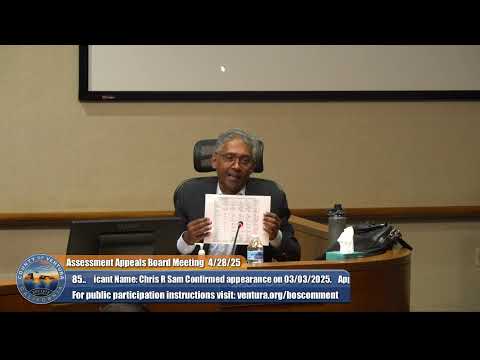
Chris Sam, a Thousand Oaks homeowner, told the Ventura County Assessment Appeals Board No. 2 on April 28 that growing wildfire risk and related insurance constraints are depressing market values for homes that back onto open space and urged the assessor and the board to adopt valuation criteria that account for those risks. The assessor, after presenting four nearby sales the office judged comparable, recommended the board sustain the assessor’s enrolled factored base‑year value for the Jan. 1, 2024 lien date.
Sam said his home abuts Wildwood Regional Park and described recent efforts to “harden” the property — vent screens, gutter guards and tree removal — at a cost he estimated at about $9,000, with additional measures still being considered. He told the board that difficulties obtaining homeowner insurance and buyers’ reluctance to purchase properties in high fire‑risk zones have already caused market setbacks in his neighborhood, including recent price reductions and canceled sales.
“Properties adjacent to large open‑space areas with elevated fire hazard are facing a real market impact,” Sam said. He urged the assessor’s office and the board to work with experts to develop a defensible method to take wildfire vulnerability into account when assessing market value.
The assessor’s presentation Andrew Pineda, on behalf of the assessor, told the board the office used the sales‑comparison approach and picked four sales within the subject neighborhood that are also adjacent to the same open space. Because the assessor could not physically inspect the interior condition of the subject (Sam declined a requested site inspection), listing photos and a neighborhood site visit conducted April 4, 2025, were used to judge condition and view quality.
Pineda said three of the four comparable sales are in the subject’s immediate neighborhood and that all four are adjacent to Wildwood Regional Park; he applied time adjustments where sales preceded the Jan. 1, 2024 lien date and made adjustments for living area, lot size, view quality and miscellaneous improvements. The assessor estimated a fair market value for Jan. 1, 2024 of $2,300,000 and noted that figure is effectively equal to the property’s factored base‑year value ($2,298,648). On that basis the assessor recommended the board sustain the assessor’s enrolled value.
Board discussion and next steps Members asked clarifying questions about the evidence Sam supplied, the timing of the market data and the format of documents the assessor prefers to receive. Board member comments acknowledged the seriousness of wildfire‑risk impacts on homeowners but noted that any change to valuation methodology would need durable market evidence and likely broader policy work at the county or state level.
Sam said he was willing to work with the assessor’s office to develop — with experts — a methodology for capturing wildfire vulnerability in valuation, and he said he planned to refile or pursue appeals again if market evidence for 2025 continued to show a decline. The assessor emphasized that the board and assessor must follow the property tax rules and established approaches (comparable sales, cost and income approaches) and that, with the evidence presented, the assessor’s comparable‑sales analysis supported the enrolled value as of the Jan. 1, 2024 lien date.
No final board decision on the appeal was announced on the record at the conclusion of the hearing; the board said it would take the evidence under consideration and communicate its determination through the clerk’s office.
Why the hearing matters The hearing highlights a recurring local policy question: how best to reflect environmental and insurance‑market changes (including wildfire exposure and the availability/cost of homeowner coverage) in assessments that rely on recent arm’s‑length sales. Homeowners, appraisers and county officials are already grappling with how post‑sale insurance availability and wildfire mitigation costs affect market demand and price; those trends can take several years of market evidence to show up in comparable‑sales approaches that underpin current assessment practice.
Ending Sam asked the board to consider a collaborative process for developing an approach that addresses wildfire vulnerability in assessed value. The assessor and board said they will consider the record and follow up by mail; Sam indicated he would continue to pursue counsel and additional evidence for future filings if needed.