
Middletown begins review of FY2025-26 budget as schools, public safety and public works request major resources
Get AI-powered insights, summaries, and transcripts
Subscribe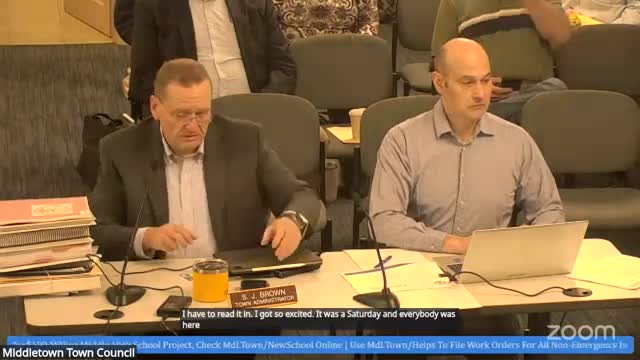
Summary
Town officials opened a full-day budget review May 10, receiving the FY2025–26 proposed budget and beginning line-by-line hearings. Key items: school staffing reductions to match enrollment, public-safety capital funded partly from a rescue-wagon special fund, a large public-works equipment request, and library and outreach staffing concerns.
The Town of Middletown council received the proposed fiscal year 2025–26 budget and began a full-day review May 10, focusing on major requests from the school district, public safety, public works and municipal departments.
Town Administrator Sean Brown presented the combined draft and the council voted to receive it and begin the formal review process. The preliminary total would raise overall municipal spending and includes a 4% request by the school department; Brown and department heads said the final tax rate and sewer rate remain to be set.
Nut graf: The hearing brought into sharp relief competing priorities for the town: the school superintendent said demographic and state-aid shifts require staff and program changes; police and fire leaders outlined sizable capital and equipment purchases, some paid from a dedicated rescue-wagon fund; public works asked to replace an aging fleet in a multiyear push; and library and community-outreach leaders warned grant funding that supports services may not continue. Councilors and staff underscored the need to balance one-time capital, ongoing operating needs and limited new revenues.
School budget and staffing: Superintendent William (Billy) Niemeyer said the district faces a projected shortfall after the state revenue estimate declined and that enrollment patterns allow some consolidation. The district’s proposal reduces roughly 9.8 full-time equivalent positions overall but repurposes three positions to add a school social worker, extra multilingual-learner (MLL) support and additional special-education administrative help. Niemeyer said those choices aim to protect core programs while addressing increased student needs in mental health and English learner services. He said the district has already begun implementing a curriculum and staffing plan to increase early intervention and MLL supports and that he expects measurable changes over a multi-year period.
Public safety: Police and fire chiefs described years of investment in accreditation, new computer-aided dispatch and records systems and shared capital needs. Police Chief Jay reported the department is adopting a new CAD/RMS platform and continuing traffic and mental-health response initiatives; he said vehicle replacement was being phased back to two patrol cars and one admin vehicle per year but supply-chain and tariff risks remain. Fire Chief Rob described a large capital package that includes a pumper-tanker for areas of town without hydrants, radio and station alerting upgrades and rescue apparatus; chiefs noted some public-safety capital will be paid from the rescue-wagon special revenue fund, which has been set aside for emergency-services capital. Councilors pressed for clarity about which costs are operating versus capital and were reminded that the town’s CIP plans several years of replacements to avoid future spikes.
Public works: Director Bob Hanley presented an unusually large equipment request, citing a backlog of aging vehicles and machinery after years of deferred replacement. The list included a 10-wheel dump with hook lift, three smaller replacement dump trucks, a rubber-track mini excavator, a Tiger Boom mower and other specialty equipment. Staff proposed financing much of the package through a five-year lease tied to a special revenue source; councilors asked for a detailed schedule of replacements, life-cycle costs and options to phase purchases to avoid large spikes and to confirm staffing to operate new equipment.
Sewer: Town staff and the sewer superintendent explained a projected operating increase largely reflects higher treatment costs to Newport and a required capital contribution tied to a regional metering point; they said the town is performing an SSES (system evaluation) and a wastewater facilities plan to identify efficiencies and decrease the load on the Wave Avenue pump station. Officials described a longer-term plan to reroute some flow toward Conanicut/Coddington and reduce overflow risk; funding for those projects will require state or federal grants.
Library and senior services: Library Director Kim told the council the library is understaffed for current services and must meet revised state standards that define a “librarian” as a person holding an ALA-accredited master’s. Kim said the town’s proposed budget does not fully fund the library’s requested staffing or substitute coverage and warned that without additional hours the library could have to reduce open hours or request a waiver from the state — a step that could jeopardize state grant aid and future construction reimbursement. Senior Center Director Arlene outlined a busy year for the senior center — 23,700 in-and-out visits and nearly 8,900 seasonal passes across the parks and beaches programs — and said much of the center’s programming is supported by a special-revenue activity fund run by the center’s volunteers.
Community outreach and prevention: Laurie Turner and Middletown Prevention Coalition leaders sought three months of bridge funding to cover the coalition while a major federal grant application (the Partnership for Success SAMHSA application) is decided in the fall. Turner said the coalition submitted a five-year PFS application that could bring up to $250,000 a year if funded; she and councilors discussed contingency plans in the event federal funding is not released. Outreach leaders also outlined a growing situation-table program and partnerships with Newport-area social-service providers.
Shared services and facilities: Ed Collins, the new facilities director, described initial work to consolidate building systems, access control and a single townwide work-order system; he and Councilors discussed potential savings from centralized purchasing for custodial supplies and consolidated preventive maintenance. Collins said construction for the new school will be an opportunity to adopt “open architecture” building controls that can connect to townwide platforms and ease long-term maintenance.
Software and finance: Finance Director Mark Tanguay and the town’s IT and finance teams described the planned July 1 implementation of a new municipal financial system (general ledger) and a January 1 rollout of in-house payroll/HR modules; staff said the project is on schedule and within the agreed funding envelope. IT described progress on security, identity management and protections as more services move online.
Other items: Several smaller items received attention: a delay and revised schedule for speed-camera installation; a planned purchase and LED conversion of street lights that could save roughly $200,000 a year if financed and completed; the town’s refuse/recycling subscription program and the senior-center thrift-shop revenue model; and the school building program and library construction timing.
Votes and next steps: Councilors voted to receive the FY2025–26 proposed budget and to begin formal review. Brown and staff said they will return updated revenue estimates (tax rate and sewer rate), the public-works equipment replacement schedule, and detailed breakouts of any items councilors asked staff to prioritize for possible inclusion or removal before the public hearings May 21 and May 28.
Council President Paul and Town Administrator Sean Brown asked department heads to return supporting schedules and to identify which items are one-time capital versus ongoing operating costs so the council can weigh tax impacts. The council will hold two public hearings (May 21 and May 28) before final action.
Ending: The review showed widely shared priorities — safety, student supports and deferred infrastructure — but also little spare operating capacity. Councilors asked staff to bring back clearer trade-offs and schedules so voters and the council can see short-term choices and longer-term capital plans before finalizing the tax rate and any fee changes.