Get Full Government Meeting Transcripts, Videos, & Alerts Forever!
Get email alerts on the Public Safety topic
No spam. Unsubscribe anytime.
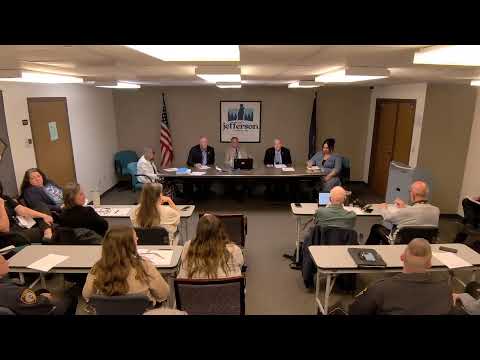
Jefferson County links local dispatch, state police radios to improve response for critical incidents
Summary
County emergency-services staff said they have patched Pennsylvania State Police and local radio channels to allow direct voice communications on a single channel for high‑priority incidents; the work was funded by the Homeland Security grant program and has been rolled out across the Northwest Central Region.
Jefferson County’s director of emergency services told commissioners the county has established a patched radio channel that links local law-enforcement agencies and the Pennsylvania State Police for critical incidents, improving situational awareness and mobile-to-mobile communications, particularly during pursuits and large-scale incidents.
The director said the county built interoperable radio capabilities to allow dispatchers and officers from municipal, county and state levels to communicate directly on a single channel during high‑risk events. The system has been patched and used unofficially on a few occasions, and department staff and state police conducted training sessions. The director said the county will meet with law-enforcement partners after the meeting to review operational details.
Officials said much of the project was supported by grant funding from the Homeland Security Grant Program and that the build-out leveraged resources across the Northwest Central Region, including Clarion, Clearfield, Cameron and Elk counties. County staff acknowledged that commissioners advanced some upfront funds that will be reimbursed by the grant.
Speakers praised specific staff and contractors who worked on the project: Ed Matts (who secured grant funding and built infrastructure links), Alan Hawker of Center Communications (installer), and county dispatch specialist Chris Clark (who configured the radio screens in the 911 center). The director also thanked the Bureau of Communication Information Services at the Pennsylvania State Police and Troop C leadership, including Colonel Parrish, for their support in linking the systems.
Local officers described technical difficulties under previous radio systems—car radios and portable radios requiring channel switches during pursuits—and told the board the patching system reduces the chance of missed communications and blue-on-blue incidents by enabling direct radio communication between agencies.
Why it matters: the patch provides immediate operational communication during pursuits, searches and other time-sensitive incidents, improving officer safety and coordination across county lines.