Get email alerts on the Integrated Programs Application topic
No spam. Unsubscribe anytime.
Douglas County SD 4 board approves 2025–27 integrated programs application
Summary
The Douglas County SD 4 board approved submission of its 2025–27 integrated programs application to the Oregon Department of Education, consolidating funding priorities for literacy, mental and behavioral health, CTE and other aligned programs.
The Douglas County SD 4 Board voted to approve the district's 2025–27 integrated programs application to the Oregon Department of Education, Assistant Superintendent Michelle Nee told the board during a presentation and review session. The board adopted the application by voice vote after brief discussion.
The application combines several state and federal program requirements and funding streams into a single plan and budget. "The purpose of our presentation is to share what's prioritized in our plan, to explain how the plan was developed, and then also to hear feedback on that plan and to seek board approval," Assistant Superintendent Michelle Nee said.
Why it matters: the integrated application brings together Measure 98 (high school success), the Student Investment Account (SIA), Perkins CTE funds, the early indicator and intervention systems, and the early literacy grant into one submission. Those funding streams support high school graduation initiatives, students' mental and behavioral health, career and technical education (CTE) equipment and curriculum, and early literacy for preschool through third grade.
Nee told the board the district's preliminary Student Investment Account budget is a little over $5,400,000 for the biennium covered by the application. High school success funding was revised downward from earlier estimates by roughly $77,000, requiring a modest reallocation of priorities. Early literacy funds have increased in preliminary notice by about $400,000, which would bring total early literacy resources to more than $800,000 if confirmed; the district must nonetheless prepare its plan based on current service levels and include contingencies for potential additional funds.
The application identifies district priorities that will continue into 2025–27: supporting students' mental and behavioral health; improving literacy outcomes, particularly K–3; increasing overall student achievement and graduation rates (the district lists a target of 90 percent graduation); expanding CTE pathways and STEM options; and providing professional learning for staff. Specific investments listed in the presentation include special education teachers and instructional assistants, skills trainers, STEAM teachers, a social and emotional learning coordinator, graduation coaches and ninth-grade on-track programs, summer transition and credit-retrieval courses, and district literacy coaches.
On Perkins CTE performance targets, Nee said the state looks at graduation rates for students enrolled in CTE pathways and at demographic balance in access to career fields. "Perkins performance targets ... are looking at graduation rate for our students who are in our CTE programs, which are over 95 percent for our students who take more than one CTE course," Nee said, adding that the state also monitors gender balance and access to CTE courses.
The board's approval authorizes district staff to submit the application to ODE by the state's April 30 deadline. Nee reminded the board that ODE will review the submission, may request budget-code or plan adjustments, and may select districts for additional quality-assurance review. If ODE issues grant agreements, Nee said she will return to the board for a subsequent approval of the grant agreement and any final budget adjustments.
The vote: a board member moved to approve the proposed 2025–27 integrated programs application "as presented," the motion was seconded and carried by voice vote. No roll-call tally was recorded in the meeting transcript.
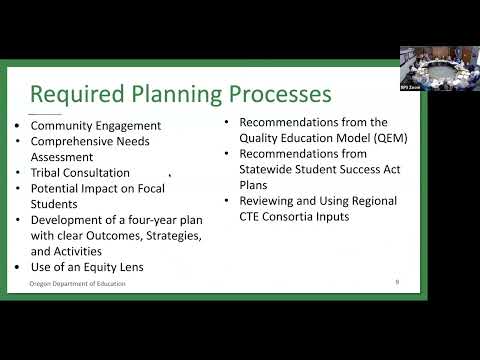
The presentation drew on multiple community-engagement activities the district reported using in plan development, including surveys, empathy interviews with students, and data review. The district identified focal groups for prioritized supports as students with disabilities, students in poverty and students experiencing homelessness.
Next steps: staff will submit the integrated application to the Oregon Department of Education, respond to any ODE requests during intake and review, and return to the board for approval of the final grant agreements when they arrive.
AI generated
The text on this page is AI generated. Summaries, highlights, analysis, and video transcripts are all produced from the original source material.
AI can make mistakes, so if you spot one, and we will fix it for everyone.
Note: the source content is unaltered by us. Any content source we link to, be it a video, an audio recording, or a document, is presented exactly as its publisher released it. That publisher is usually a government body, sometimes an individual official or another organisation.