Get Full Government Meeting Transcripts, Videos, & Alerts Forever!
Get email alerts on the Nonconforming Structures topic
No spam. Unsubscribe anytime.
Committee agrees staff should allow replacement of nonconforming agricultural structures without new special‑exception if footprint and use are unchanged
Summary
The committee directed staff to craft a rule allowing agricultural structures in nonconforming locations to be rebuilt without a Board of Supervisors special exception so long as the replacement occupies the same footprint and does not increase floor area, height or change the use; applies only to bona fide agricultural structures/operations.
Loudoun County staff and committee members agreed on April 24 to permit replacement of nonconforming agricultural structures under limited conditions, and asked planning staff to prepare draft language to implement the change.
Background
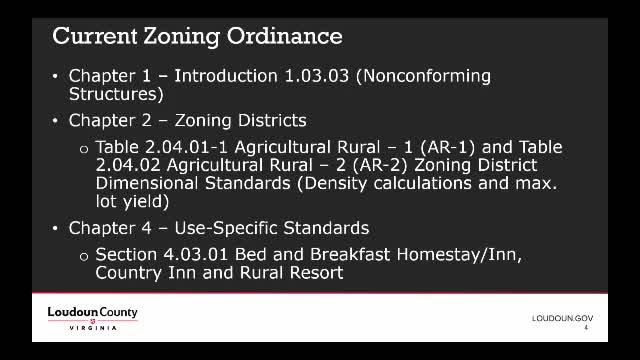
Under Loudoun’s current nonconforming‑structure rules, rebuilding a nonconforming structure generally requires the owner to obtain a special exception from the Board of Supervisors to remove nonconforming status. The zoning code allows replacement without loss of nonconforming status when a structure is damaged or destroyed by a casualty beyond the owner’s reasonable control (with specified time limits for reconstruction), but routine voluntary demolition and replacement has been restricted in many cases.
Committee direction and limits
Committee members indicated support for a narrowly tailored waiver directed at agricultural structures associated with bona fide agricultural operations. Under the approach staff described and the direction the committee gave, a property owner could rebuild an agricultural structure in a nonconforming location provided:
- The replacement structure occupies the same footprint as the original structure; - The replacement does not increase floor area, height, or number of stories; and - The use remains an agricultural structure/operation (no change to a non‑agricultural use).
Staff emphasized that the waiver would apply only to bona fide agricultural structures tied to agricultural operations and would not be a route to increase density or convert buildings to different uses. The committee asked staff to draft language that preserves the county’s ability to require permits and inspect for safety but reduces the need for lengthy special‑exception proceedings for routine agricultural rebuilds.
Why this matters
Committee members said the change reduces an administrative burden on farm owners who maintain agricultural buildings, avoids forcing long‑established farm structures into unnecessary special‑exception processes for routine replacement, and mitigates potential negative impacts on farm financing. At the same time, several members emphasized the replacement cannot enlarge a nonconforming building or convert it into a more intensive, non‑agricultural use.