Get Full Government Meeting Transcripts, Videos, & Alerts Forever!
Get email alerts on the Public Health Regulation topic
No spam. Unsubscribe anytime.
CDTFA seeks one-year funding to implement flavored tobacco seizure authority
Summary
The California Department of Tax and Fee Administration requested $3.5 million from the cigarette and tobacco compliance fund to implement new seizure authority under AB 3218 and SB 1230, while the LAO cautioned about staffing and revenue uncertainty after recent declines in tobacco inspections and staffing.
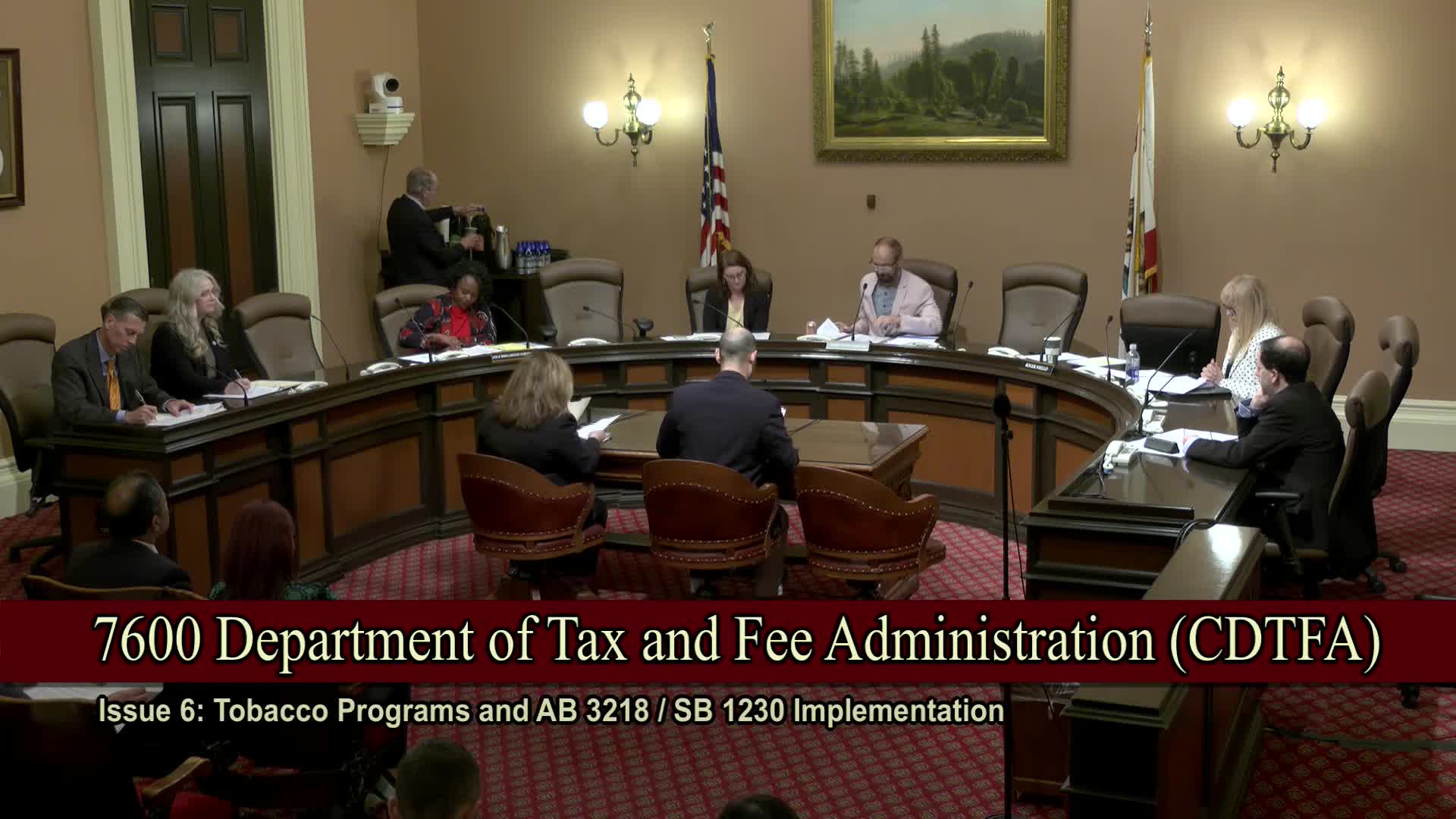
The California Department of Tax and Fee Administration asked the Senate Budget Subcommittee No. 4 on April 24 for a one-year augmentation of $3.5 million from the Cigarette and Tobacco Compliance Special Fund to implement recent laws authorizing seizure and destruction of flavored tobacco.
CDTFA director Trista Gonzales and Chief Financial Officer Jason Mallett said AB 3218 and SB 1230 (as referred to in the department’s submission) authorized the agency, beginning Jan. 1, 2025, to seize flavored tobacco products from retailers. CDTFA requested limited-term funding for FY 2025–26 because the department does not yet have a reliable estimate of how much seized product value or penalty revenue the program will generate.
LAO summary and department response
Seth Kirstein of the Legislative Analyst’s Office told the subcommittee that recent state-level revenue trends suggest flavor-related tobacco revenue losses might be in the $300 million–$400 million range, but it is uncertain how much of that loss is due to tax avoidance versus actual declines in use. The LAO also flagged that CDTFA’s tobacco program staffing and inspections decreased substantially in recent years: the department had about 32% fewer filled positions for tobacco programs in FY 2023–24 than in FY 2018–19, and inspections fell by about 52% over the period cited by the LAO.
CDTFA replied that it has made hiring progress: the tobacco program vacancy rate has fallen from 40% to about 10% since earlier shortfalls and that the agency has targeted inspectors toward smaller retailers and higher-return enforcement. Jason Mallett told the subcommittee that product seizures and the value of seized product have risen in recent years (from roughly 600,000 cigarette sticks seized four years ago to more than 2 million last fiscal year), and that since Jan. 1, 2025 the department has conducted more than 100 inspections and seized more than 300,000 packages of illegal flavored product.
Why the one-year request
CDTFA said it seeks one-year funding because the value of seized product and penalty revenues is uncertain: seizing illegal inventory that otherwise would have been sold reduces the pool of taxable product and may depress future revenues. The agency told the subcommittee it will return with an ongoing funding recommendation once actual seizure and penalty outcomes are better understood.
Legislative issues and next steps
- Funding source: CDTFA proposed to use the Cigarette and Tobacco Compliance Special Fund; that fund also supports licensing and other tobacco enforcement work.
- Implementation risk: LAO cautioned that even if funding is approved, CDTFA has historically struggled to hire and retain inspectors, and new duties could spread enforcement resources thin until staffing stabilizes. CDTFA reported recent hiring successes and said it will monitor workload and revenue closely.
- Possible licensing fee increase: CDTFA noted that if the compliance fund is insufficient, the licensing fee (around $265 per retailer, as cited by the department) could require an increase to sustain enforcement.
Speakers quoted or relied on in this article: Trista Gonzales, director, California Department of Tax and Fee Administration; Jason Mallett, CFO, CDTFA; Seth Kirstein, Legislative Analyst’s Office.
Ending: The subcommittee held the item open for further agency reporting and directed CDTFA to provide metrics and evaluation criteria to guide any decision about ongoing funding.