Get Full Government Meeting Transcripts, Videos, & Alerts Forever!
Get email alerts on the Retirement Savings topic
No spam. Unsubscribe anytime.
CalSavers reports growth, readies outreach as employer mandate expands to micro employers
Summary
CalSavers told the Senate Budget Subcommittee No. 4 it has 550,000 funded saver accounts and $1.2 billion in assets under management, and outlined outreach and technical steps ahead of a December 2025 deadline expanding the employer mandate to firms with one or more employees.
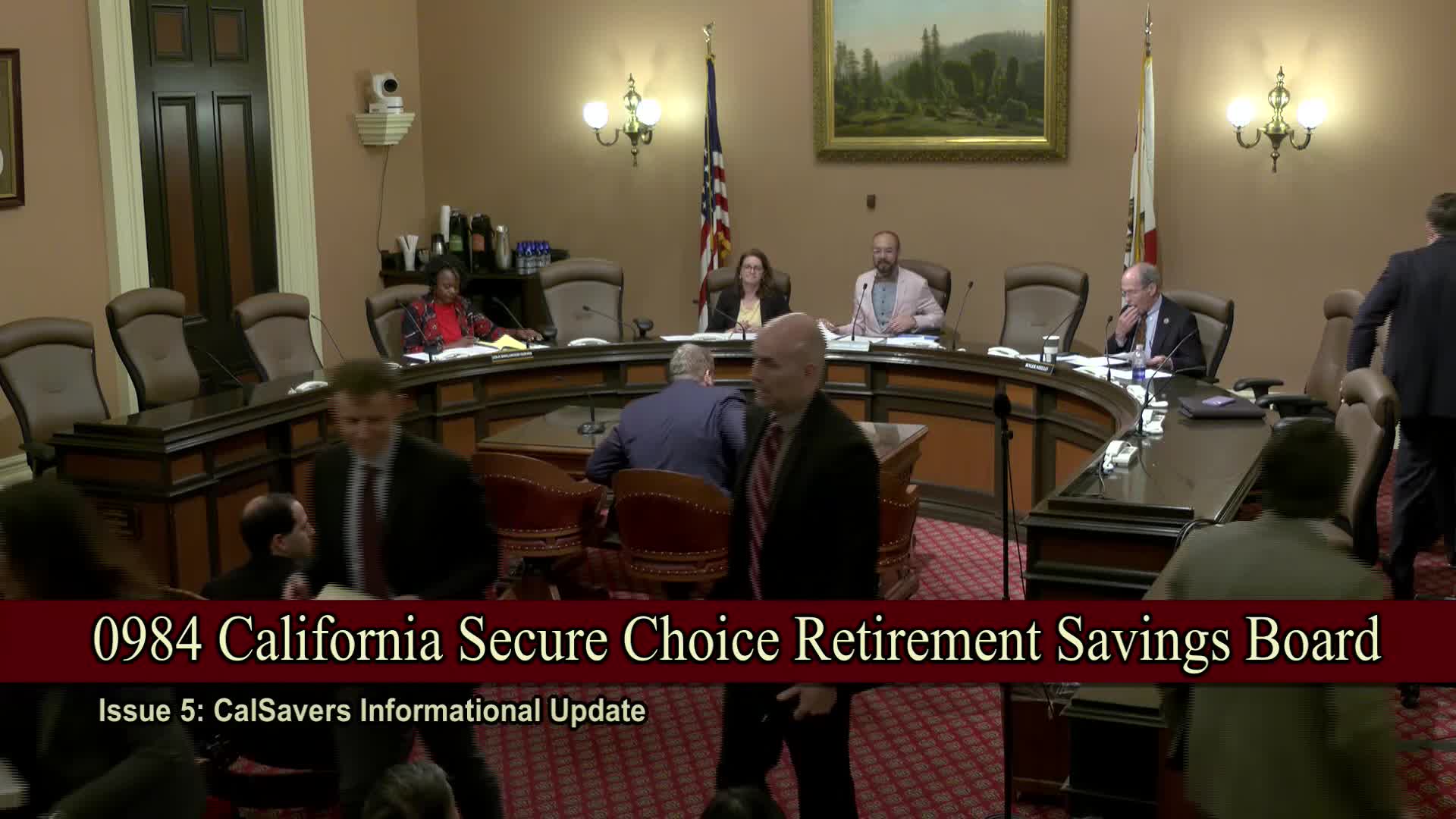
CalSavers executive director David Takartz told the Senate Budget and Fiscal Review Subcommittee No. 4 on April 24 that the state-run retirement program has more than 550,000 funded saver accounts and about $1.2 billion in assets under management.
The program, formally the California Secure Choice Retirement Savings Board’s CalSavers program, requires employers that do not offer a qualified retirement plan to facilitate payroll-deduction access to a Roth IRA for employees. Takartz said the program has about 58,000 employers actively moving payroll deductions and roughly 58,000 businesses that have uploaded rosters and are facilitating contributions.
CalSavers emphasized the program’s design features: automatic enrollment, automatic 1 percentage-point escalation in contribution rates up to 8% and no employer fees or fiduciary exposure for participating employers. "If the employee decides not to do anything, if they just simply passively allow this to happen, then the savings does occur for them," Takartz said.
Why this matters: CalSavers targets workers without employer plans, often low- and moderate-income earners. The program’s fiscal model depends on growing assets under management (AUM) because its operating revenue comes from a small percentage of saver assets rather than direct state funding. Takartz told the subcommittee CalSavers’ break-even AUM target is roughly $6 billion; the program currently averages about $2,000 per account.
Key details and near-term priorities
- Enrollment and scale: CalSavers reported more than 550,000 funded accounts and 1,200,000,000 in AUM. The average participant salary range is roughly $32,000–$45,000 a year and the average account balance is slightly above $2,000.
- Employer mandate expansion: On Dec. 30, 2025, the legislative deadline for facilitation expands to nearly all employers, including those with a single employee (not the owner or spouse). CalSavers staff said that expansion will roughly triple the pool of employers subject to the mandate and is the program’s largest near-term outreach challenge.
- Outreach strategy: CalSavers described a multi-pronged campaign aimed at micro-employers and their workforces: targeted mailings using Employment Development Department (EDD) data, partnerships with small-business development organizations, unions (for example, SEIU outreach to in‑home health providers), chambers of commerce, translated materials in the top 10 state languages, and paid and social media. The program is launching an early-employer incentive campaign that uses a portion of penalty funds to reward employers who sign up early and integrate payroll providers.
- Technology and ease of integration: Officials said integration with payroll providers (QuickBooks, ADP and others) is a top priority; CalSavers is developing automatic payroll connections and chatbot support (multilingual) to answer employer and worker questions.
Concerns, performance and timeline
Legislators and analysts pressed CalSavers on account balances, turnover and financial sustainability. The Legislative Analyst’s Office and several senators noted the program was slower to reach financial self-sufficiency than originally projected; CalSavers now projects it could reach break-even in the neighborhood of fiscal 2029–30. CalSavers said staff expect to reach the $6 billion AUM threshold before then, though projections are uncertain.
CalSavers described high participant mobility (typical for small-employer workforces) and said it cannot track savers who leave for employers that offer private retirement plans. The agency reported that the program has raised employer offers among private-sector firms: "there has been a 20% bump in larger businesses that offer private sector plans since CalSavers came up," Takartz said.
What’s next
CalSavers will focus staff and marketing resources on the employer-mandate expansion this year, strengthen payroll-provider integrations, scale multilingual outreach to micro employers and develop automated help features for employers and employees. Lawmakers asked CalSavers to return with updated metrics and projections as the December 2025 threshold approaches.
Speakers quoted or relied on in this article: David Takartz, executive director, CalSavers Retirement Savings Board; Senators and staff who questioned CalSavers included Senator Nilo and Senator Smallwood Cuevas.
Ending note: CalSavers framed the mandate expansion as its most complex operational step yet: the agency must combine technical integrations with broad community outreach to micro employers who have little payroll-administration experience.