Get Full Government Meeting Transcripts, Videos, & Alerts Forever!
Get email alerts on the Early Childhood And Youth Services topic
No spam. Unsubscribe anytime.
Hartford department outlines FY26 budget increases, expands early learning and youth services
Summary
The Department of Families, Children and Youth presented a FY26 recommended budget and described program expansions across early learning, youth services and family supports, citing new grants and staffing shifts while warning some grant funding remains uncertain.
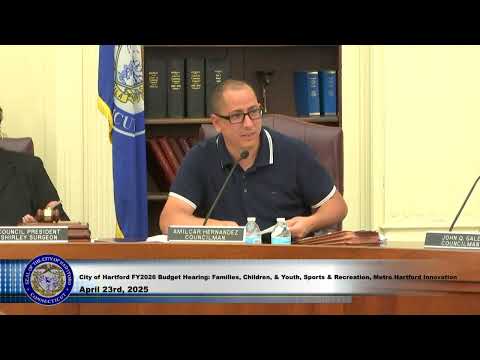
The Department of Families, Children and Youth presented its recommended FY26 budget to the Hartford City Council Operations Management Budget and Government Accountability Committee on the evening of the department budget hearings, outlining program expansions in early learning, youth services and family supports.
Director Christina Baldwin told the committee the department’s recommended FY26 budget is $28,985,847, with a general‑fund component of $3,590,337 and a 5.6% increase from FY25 in the general fund. “We so appreciate the opportunity to be here today to present our FY26 budget for the Department of Families, Children, and Youth,” Baldwin said during the presentation.
The department described several areas of growth and grant activity that drove its recommended budget. Baldwin said investments include funding for a service navigator to support family enrollment and workforce stabilization, continued support for a parent‑connecting program, expansion of the Child and Adult Care Food Program (CACFP) at city early learning centers, and funds for training and professional development for early childhood educators.
The office reported early learning highlights including: - 14 general‑fund full‑time positions and a total of 55 staffed positions in the department; - launched a parent ambassador position and four volunteer outreach ambassadors providing 25–30 hours of community engagement monthly; - Hartford Talks literacy program participation listed as 220 children and families to date and distribution of 200 books to early childhood centers; - nutrition and health: the department said it serves 3,970 meals through CACFP at Metzner and Highland early learning centers and that 50 providers are enrolled in CACFP.
On youth services, Baldwin said the city’s Youth Service Bureau — statutorily required in Connecticut — provided workforce and justice diversion services for hundreds of young people, reporting figures that include 2,316 disengaged youth served by the Youth Services core program and 818 youth served through summer employment and learning programs since the youth employment program’s inception in 2016. Baldwin noted the department received its first referrals this year for a new wraparound supports initiative for homeless or unstably housed youth ages 13–17.
Councilmembers pressed department leaders on the durability of grant funding, state cost‑of‑living adjustment (COLA) grants for providers, and progress on a data‑sharing effort with Hartford Public Schools. Baldwin said the department’s grant portfolio includes a mix of federal and state sources and that while the department maintains strong relationships with funders, grant awards statewide have been volatile. “Some of our grant funding is from federal sources. ... there is a concern,” she said, noting partner agencies had seen reductions as recently as that morning.
Assistant Director Shailene Lopez addressed the PowerSchool transition and state data initiatives. Lopez said the state is rolling out “EarlyStart CT,” and the department is pausing some local data collection while positioning Hartford to be a local governance partner in the state transition. She said the department currently uses Sparkler developmental screening and an ETO system for staff family child care provider data and that the planned PowerSchool integration aims to allow tracking of child outcomes across early learning providers and into kindergarten.
Council members asked for specifics on grant amounts and program metrics. Baldwin listed recent grant awards cited in the presentation: over $5,000,000 for child daycare funding to expand infant and toddler access; $2,000,000+ for expansion of infant and toddler slots for licensed home‑based providers; $691,000 to support more than 70 licensed family staff family childcare network providers; $200,000 from the state Department of Economic and Community Development for youth programming; and $183,000 from DCF for the Youth Service Bureau (as described during the presentation).
Baldwin and assistant directors emphasized workforce development and credentialing supports, noting providers completed Child Development Associate (CDA) training and that the department supported accreditation and trauma‑informed care training for dozens of providers. The director also said the city is shifting a casework supervisor position from grant funding to the general fund to stabilize youth justice capacity.
The presentation concluded with staff composition figures reported by the department (60% city residents among DFCY staff; workforce diversity percentages were presented), a list of community events and partnerships, and a reminder that strategic planning is ongoing after a July 2024 departmental restructuring.
Why it matters: DFCY programs touch families, early‑childhood centers and opportunity youth across Hartford. Budget choices and grant stability will determine capacity for early learning slots, nutrition services and youth employment or reentry programs in the coming year. The department repeatedly cautioned that some grant funding is subject to state or federal changes and therefore subject to risk.
Next steps: Council members requested continued updates on the PowerSchool/EarlyStart CT alignment and asked staff to keep the council informed if grant awards change. The department said it will continue to pursue and manage grants while pursuing general‑fund investments that stabilize core positions and services.