Get Full Government Meeting Transcripts, Videos, & Alerts Forever!
Get email alerts on the Urban Forestry topic
No spam. Unsubscribe anytime.
Urban Forestry reports net tree gains, ramps pruning and planting amid staffing and funding constraints
Summary
Bureau of Urban Forestry reported on April 24 that it is pruning thousands of street trees and projecting a net positive in planted trees this year, while noting contractor onboarding delays, stump‑grinding backlog and uncertainty about sustained planting funding.
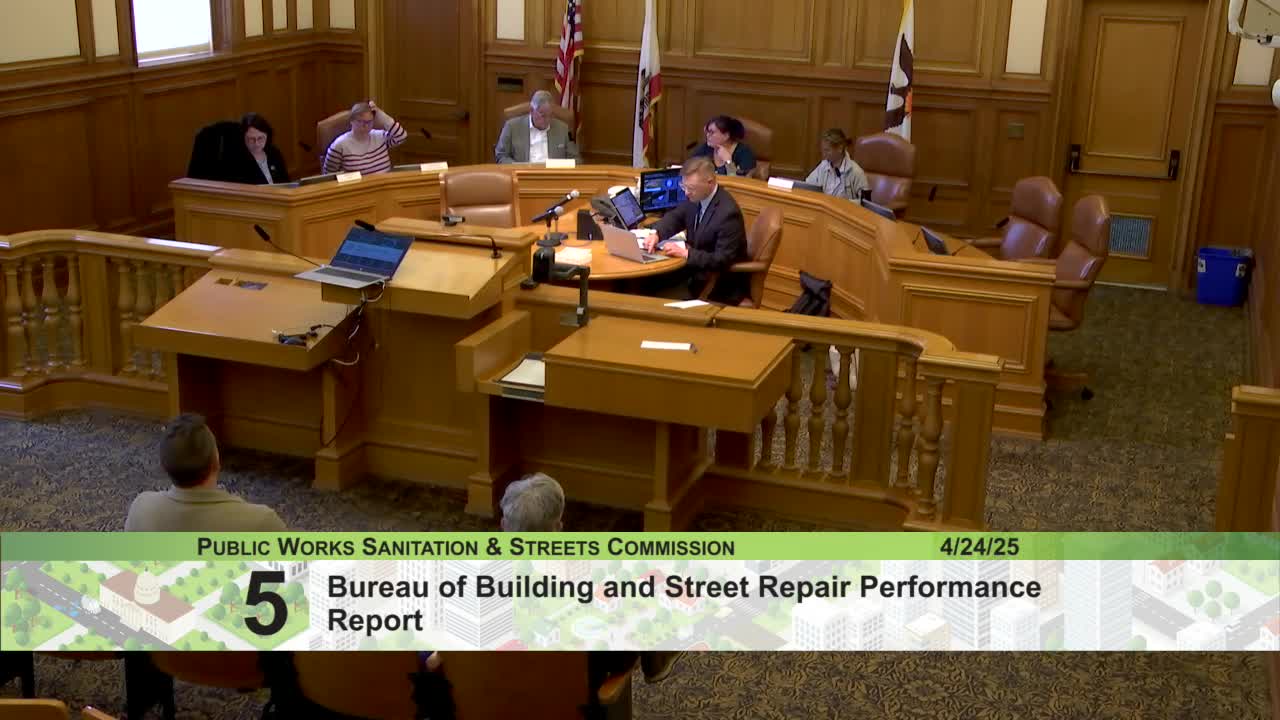
Nicholas Crawford, assistant superintendent for Urban Forestry, presented the bureau’s performance report at the Sanitation and Streets Commission meeting on April 24, 2025. He said the bureau’s Street Tree SF maintenance program has pruned about 77 percent of street trees since the program’s start and is projecting to prune roughly 7,409 trees this fiscal year.
Crawford said the bureau’s total street tree inventory is about 125,000 assets and highlighted reductions in annual removals compared with prior years. He reported removal counts peaked near 1,466 in fiscal 2023 (about 1 percent of canopy) and have since fallen to roughly 600 trees annually, helping to preserve canopy. Crawford said fewer than 40 storm‑related failures occurred this winter and crews cleared those failures.
The bureau projects planting roughly 1,300 trees this fiscal year through a mix of bureau planting and grant partners such as Friends of the Urban Forest and Climate Action Now; Crawford noted an additional roughly 250 permit‑triggered plantings tied to private development permits. He cautioned that tree‑planting momentum depends on continued funding and said federal funding opportunities remain uncertain.
Crawford also discussed operational constraints: contractor onboarding has taken longer than expected, slowing supplemental pruning capacity; stump grinding is being completed in batches and emergency removals may wait longer for stump grinding and sidewalk repairs; and the bureau has recently migrated data into the citywide CMMS system, which affected reporting.
On staffing, Crawford said the bureau has hired additional arborists and added two tree inspectors — positions requiring urban forestry experience — but still has vacancies it plans to fill. He described proactive maintenance, median programs and a rotating pothole/sweep approach for street work that aims to reduce 311 requests by addressing issues before they become open requests.
Commissioners asked about canopy percentage and how SF compares to other large cities; bureau staff said San Francisco’s overall canopy percentage (including all canopy, not just street trees) is low relative to many large cities — reported at about 13.7 percent — and that increasing canopy percentage is a longer‑term process because young trees provide limited immediate canopy.
No members of the public spoke on the item at the meeting.