Get Full Government Meeting Transcripts, Videos, & Alerts Forever!
Get email alerts on the Refuse Rates topic
No spam. Unsubscribe anytime.
Controller proposes lower refuse-rate increases than Recology; public hearing held
Summary
At an April 24 public hearing, Jay Lau of the Controller’s Office presented a three-year refuse-rate proposal that would raise rates less than Recology’s request (12.59% vs. 18.18% over three years); the hearing drew questions about a proposed contingent $35 million trash-processing facility and timeline for the rate board.
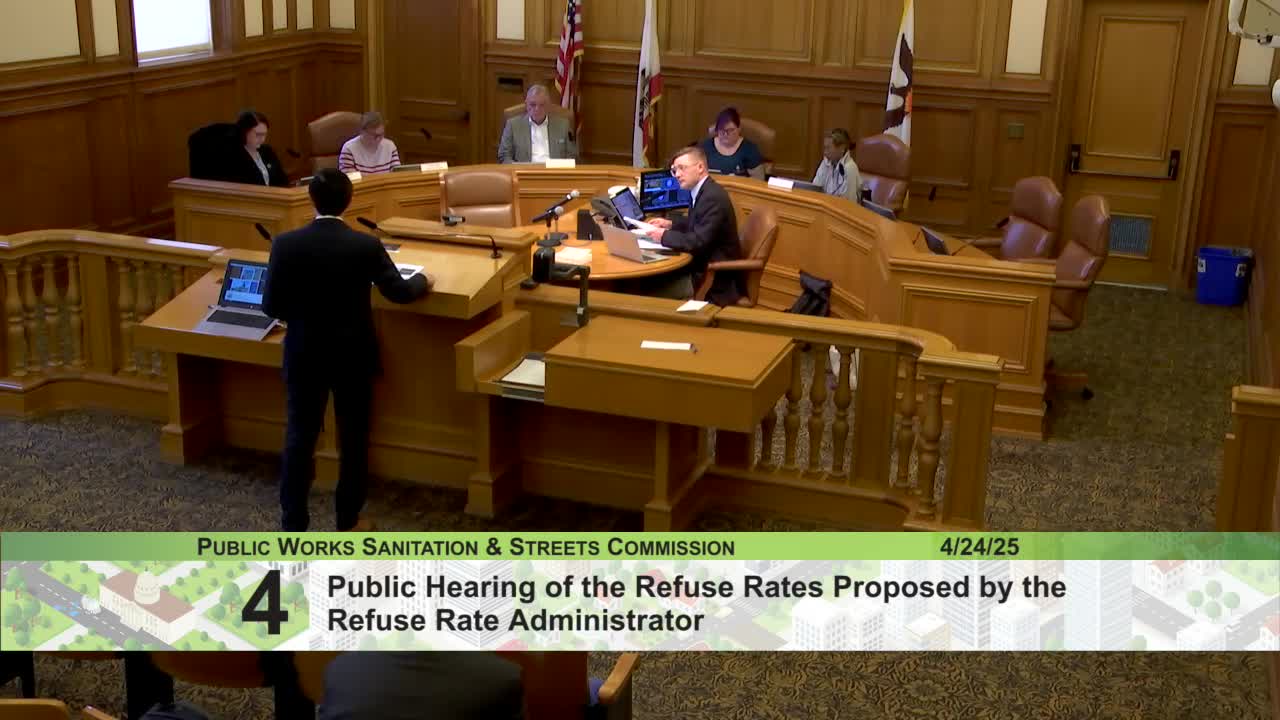
At the Sanitation and Streets Commission meeting on April 24, 2025, Jay Lau, the refuse rates administrator in the Controller’s Office, presented a proposed three‑year rate order for residential refuse service covering rate years 2026–2028 and held the public hearing required by San Francisco Health Code section 290.6(b)(3).
Lau said Recology’s application requested a three‑year increase totaling about 18.18 percent; the Controller’s Office proposal reduces that to 12.59 percent, representing an approximate $50 million savings to ratepayers compared with Recology’s request. Lau said the Controller’s Office proposal would save an estimated $2.63 per month for a single‑family household in the first year compared with Recology’s filing. He told commissioners, “Our increase reduces to 12.59%.”
Lau described three main drivers behind the structural portion of the first‑year increase: lower tonnage and slower downtown recovery since the pandemic, a payroll projection error identified in the prior rate cycle, and higher business tax costs to Recology related to Proposition M. He said roughly 9 percent of the first‑year increase is attributable to those structural adjustments and the Controller’s Office proposal adds about 3.5 percentage points on top of that.
The proposal maintains current service levels for curbside collection and citywide street‑cleanliness programs, and it continues funding to city departments that receive rate revenues, including Public Works and the Department of the Environment. Lau said the proposal includes $13,500,000 in fund balance for procurement of new public trash cans (about $1,500,000 below the department’s original request) and additional funding for abandoned material collection, public receptacle collection, bulky‑item pickup, household hazardous waste and weekend district cleanups. Lau said, “This reduction does not change anything about their ability to procure trash cans,” while noting the Controller’s Office reallocated some funds to lower the overall rate impact.
Contingent trash‑processing facility: Lau said Recology’s application included a contingent schedule for a proposed trash‑processing facility estimated at $35 million; the Controller’s Office removed that contingency from its proposed rate order because of due‑diligence concerns. He said the Controller’s Office did include approximately $400,000 for further study to evaluate whether such a facility is appropriate in a future rate cycle. “Our proposals removed it from…our proposal, but what we've included is about $400,000 to do study,” Lau said.
Regulatory changes: Lau outlined proposed regulatory and monitoring changes intended to improve accountability, including service level agreements that would document Recology’s duties in greater detail, a set of cost‑control tools (cost‑variance review and hard cost caps), baseline operating metrics, and a balancing account intended to maintain Recology’s allowed profit at a 9 percent level.
Timing and next steps: The Controller’s Office plans to publish a rate report and proposed rate order on May 9 and present to the refuse rate board with at least two public hearings (the first scheduled May 27). The rate board (comprised of the city administrator, the general manager of the Public Utilities Commission and a ratepayer representative) will make the final decision; if rates are set as proposed they would take effect Oct. 1.
Public comment: No public commenters addressed the item at the commission hearing. Commissioners asked questions about Recology’s profitability, the payroll error that reduced prior‑year projections, oversight responsibilities among city offices, and the potential inclusion of the $35 million contingent trash‑processing capital schedule.
No vote on rates was taken at the commission meeting; the presentation and public hearing were part of the regulatory record that the Controller’s Office will present to the refuse rate board.