Get Full Government Meeting Transcripts, Videos, & Alerts Forever!
Get email alerts on the State Budget Revenue topic
No spam. Unsubscribe anytime.
DFL legislators, unions urge tax changes to protect Minnesota services amid federal cuts
Summary
DFL state legislators and union members held a State Capitol event urging the Minnesota Legislature to pursue new revenue options — including a fifth-tier income tax, higher corporate rates and closing tax exemptions — to blunt projected federal funding cuts that speakers said threaten health care, education and other services.
Sen. Erin May Quaid, who represents Senate District 56 (Apple Valley, Rosemount and part of Eagan), told a State Capitol event that DFL legislators will resist federal cuts and seek state revenue options to protect schools, hospitals and other services. “We will fight to protect Minnesotans from the chaos, corruption, and destruction from the Trump administration and federal Republicans,” she said.
The speakers said the Legislature faces an unusual budgeting challenge because of recent federal proposals they described as likely to reduce Medicaid, public-health funding and other federal supports that Minnesota relies on. The group urged a set of state-level revenue actions — advanced in bills already introduced or discussed by DFL lawmakers — to mitigate those harms.
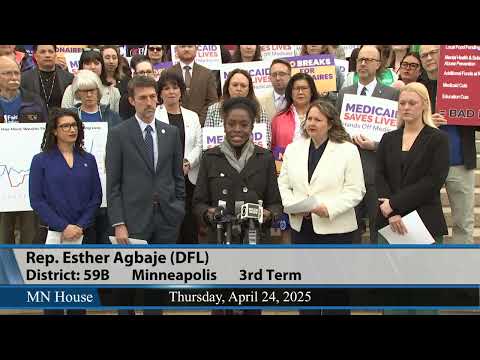
Rep. Esther Agbaje, who represents House District 59B (downtown and North Minneapolis), summarized several options being discussed in the Legislature, including a so-called fifth-tier income tax bill filed by Sen. McEwen that she said “could raise as much as $2.5 billion” and a corporate-rate change she said “could raise another $1,700,000,000.” She also listed closing certain exemptions, such as breaks for second homes and stadium suites, and said legislators have discussed a social-media tax and eliminating some data-center exemptions.
Olivia Dillon, a former epidemiologist at the Minnesota Department of Health, described recent layoffs at MDH and warned of public-health consequences. “On April 1, my world was turned upside down when I was laid off from my epidemiologist position at the Minnesota Department of Health,” Dillon said. She told the gathering she had worked on influenza and other surveillance programs and that the staff cuts will reduce the state’s ability to investigate outbreaks, slow lab results, and reduce support for nursing-home patients and tribal public health.
Union speakers framed the conversation around the effect on low-paid workers and students. A union representative from Service Employees International Union (SEIU) Local 284 said the average hourly school worker in Minnesota “makes less than $17 an hour” and that understaffing reduces services for special-education students. The speaker urged lawmakers to avoid balancing the budget on the backs of low-paid school employees.
Sen. Doron Clark of Minneapolis invoked Minnesota’s political traditions and argued the state has options to protect residents. Rep. Emma Greenman, a South Minneapolis representative and voting-rights lawyer, said state government must act to preserve programs and democratic institutions in the face of federal changes. “We cannot stop much of the corruption, cruelty, and chaos of the Trump regime, at least not alone. But it is our obligation in this body to protect communities and safeguard democratic self governance here in Minnesota,” Greenman said.
Speakers criticized Republican assertions about specific savings from program cuts. According to the presenters, Republicans recently said cutting MinnesotaCare coverage for undocumented immigrants would save as much as $600 million over four years; the DFL speakers said that figure was inaccurate and said the program’s cost to date is far smaller. The event also featured figures given by speakers claiming federal Medicaid cuts could total roughly $3 billion and that some tax exemptions and incentives amount to hundreds of millions in foregone revenue, figures DFL legislators used to illustrate trade-offs before the Legislature.
Organizers said their goal at the event was to put pressure on colleagues and inform the public as budget negotiations proceed. No formal legislative action or votes were taken at the Capitol event; speakers described policy options lawmakers are debating in committee and in bills already introduced. They urged Minnesotans to press their representatives as the Legislature prepares a budget and as federal decisions continue to unfold.
The event combined legislative remarks and testimony from state employees and union representatives. Speakers repeatedly framed the issue as one of choices about who pays and what services are protected, and they emphasized the uncertain timing and scale of federal actions that could affect Minnesota’s 2025 budget.