Get Full Government Meeting Transcripts, Videos, & Alerts Forever!
Get email alerts on the Nonresident Waterfowl topic
No spam. Unsubscribe anytime.
Commission agrees to further study nonresident waterfowl restrictions after legislative veto
Summary
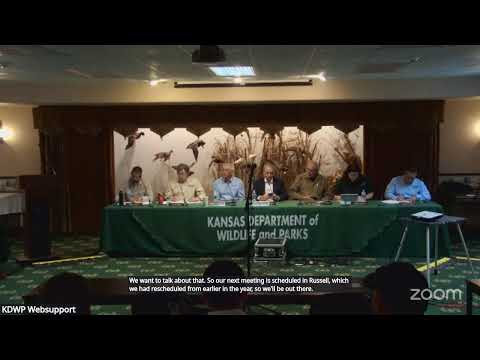
Commissioners and department staff agreed to revisit nonresident waterfowl restrictions after the legislature and governor previously considered and vetoed statutory changes. Commissioners asked staff to compile what neighboring states have done and to present options for public workshops at a future meeting.
The Kansas Department of Wildlife & Parks Commission discussed next steps on nonresident waterfowl restrictions after state legislation addressing nonresident access was vetoed by the governor. Commissioners and staff agreed to continue studying options, request comparisons with other states and present the topic at future meetings for public input.
Commissioners recalled a multi-year process that led to proposed regulatory changes and later legislative proposals. Commissioner Will Carpenter said the legislature had acted but the governor vetoed the statute; he urged a strategy that would produce a bill the legislature and governor could accept. Several commissioners asked staff to prepare research on other states’ approaches (including draws, special permits, fees and entry-time restrictions), to compile the earlier work and to present a schematic of options.
Public commenters urged the commission to act. Former commissioner Troy Sporer and others described increased nonresident pressure on public wetlands and urged the commission and department to continue the effort. Multiple commenters described crowded wetland parking areas and impacts on hunter experience and waterfowl behavior. Staff and commissioners discussed whether regulatory changes or legislation would be the most effective pathway, and noted that new state economic-impact rules (HB 2648) affect the ability to adopt some regulatory approaches without further steps.
Department leaders said staff would prepare a timeline and a recap of the prior multi-year review, outline the options other states use, and include likely economic-impact considerations for each alternative. Commissioners indicated they want a public forum and educational materials for the legislature prior to next session.
Why it matters: Nonresident hunter pressure on limited public wetland acres is a persistent management and political issue in Kansas. The commission’s next steps will shape whether changes are pursued through regulation, the legislature or a hybrid strategy.
What’s next: Staff will compile prior analysis, survey other states’ approaches, assess economic impacts under HB 2648 and bring options to the commission for workshops and public hearings ahead of the next legislative session.