Get Full Government Meeting Transcripts, Videos, & Alerts Forever!
Get email alerts on the Fourth Of July Venue Parade topic
No spam. Unsubscribe anytime.
Bristol council denies petitions to fix Fourth of July concert venue and parade route after safety debate
Summary
After an extended public debate and presentations from the police and town administration about safety and crowd-control challenges, the Bristol Town Council voted to deny two citizen petitions that would have set Independence Park as the permanent concert venue and locked the parade route into ordinance.
The Bristol Town Council on April 23 voted to deny two citizen petitions that sought to (1) designate Independence Park as the permanent venue for the town's Fourth of July concert series and (2) fix the parade route by ordinance. The motion to deny both petitions was made by Councilor Tony and seconded by Councilor Mary; the council approved the motion by voice vote.
The petitions reached the council after petitioners collected the signatures required to place their proposals before the body. Town Solicitor explained the petition process under the town charter section 503, saying petitioners first must present at least 150 signatures for council consideration and, if the council declines, may collect 1,000 signatures to force the question before voters. The solicitor told the council it must decide within 40 days after receipt.
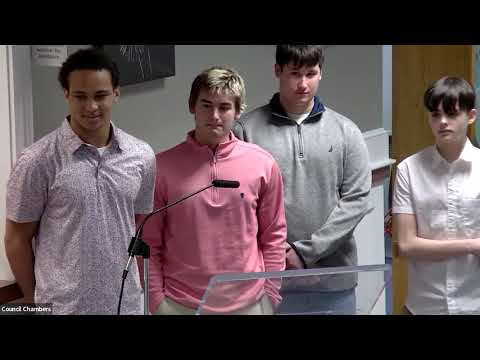
Petitioners said Independence Park is the traditional, centrally located venue that draws residents downtown and supports local businesses. Anne Marie LaRoche read a letter from petitioner Lisonbee Borges saying the petition had attracted more than 1,900 signatures and raised about $20,000 in fundraising, and urging the council to adopt ordinances that would give voters the right to change venue only through a public vote. "Independence Park is a beautiful and centrally located venue in the heart of town within walking distance to many residents' homes, local businesses, the bike path, bringing the entire community together," the letter read.
Police officials and the town administrator urged caution. Chief (Bristol Police Department) described an after-action review of the 2024 concerts and identified recurring safety and crowd-control issues when attendance grew beyond the park's footprint. "Prior to any major event . . . the Bristol Police Department prepares a comprehensive safety plan. We look at traffic. We look at estimated crowd size. We look at issues with parking. We look at vehicle-borne threats," the chief said. Captain Steven St. Pierre, who authored the department's after-action report, described operational problems in 2024 when crowds spilled into roadways and limited access for emergency response.
Town Administrator (title used in meeting) also supported the police assessment, saying the combination of ungated, high-attendance concerts and limited ingress/egress raises hazards that would be difficult to mitigate by ordinance alone. He noted alternatives such as gated ticketed events or more robust crowd-control measures but emphasized that the volunteer Fourth of July Committee and town departments need flexibility to respond to safety findings.
Members of the Fourth of July Committee and other residents opposed locking the venue into law. Patty Nena, who identified herself as chair of the concert effort, said volunteers raise the money and organize the event and expressed frustration that petitioners did not consult committee leadership before launching the effort: "We didn't take moving this lightly. We didn't think about it and go, 'yeah, let's do it tomorrow.' We had a very strong discussion." Committee members and other speakers stressed that some bands and some crowds in the past have produced behavior the committee judged unacceptable and that the volunteers must be able to manage lineup and logistics.
After more than an hour of presentations and public comment, Councilor Tony moved to deny both petitions; Councilor Mary seconded. The council approved the motion by voice vote. The meeting record shows the motion passed; no roll-call tally was recorded in the transcript.
Under the process the solicitor described, petitioners who nonetheless wish to pursue a binding public ballot on the matter may return to collect 1,000 valid signatures from qualified electors. The solicitor said if petitioners secure those signatures the matter would go before voters as a ballot question with a title and summary prepared for the electorate.
The council's action preserves the town's ability to permit concert venues or route changes administratively or by committee recommendation rather than by ordinance, leaving flexibility to adapt plans based on public-safety needs, infrastructure constraints, and committee input.