Get email alerts on the Education Middle School Curriculum topic
No spam. Unsubscribe anytime.
Springfield Township SD presents revised middle school curriculum guide, new scheduling and annual math-placement process
Summary
Springfield Township School District staff on April 23 presented the final middle school curriculum guide to the Academic Affairs Committee, outlining schedule changes, a new annual math-placement review and updates to STEM, music and special-area programming for the coming school year.
SPRINGFIELD TOWNSHIP, Pa. — Springfield Township School District staff on April 23 presented the final middle school curriculum guide to the Academic Affairs Committee, outlining schedule changes, a new annual math-placement review and updates to STEM, music and special-area programming for the coming school year.
The guide, presented by Dr. Mangano, Jason Payne and Karen Brady on behalf of the middle school team and introduced by Assistant Superintendent Damien Johnston, is intended to combine the district’s stated vision and goals with practical changes to daily scheduling and course offerings. “We saved the best for last with the middle school,” Dr. Mangano said, adding later that the guide aims to make explicit “who we are” as a school.
District officials said the guide emphasizes three linked priorities: clearer expectations for families about programming and supports; deeper advisory and multi-tiered supports for students; and flexible course placement that adapts each year to students’ changing needs. “It’s all means all,” Dr. Mangano told the committee, describing the team’s emphasis on inclusive, individualized supports.
Major changes and what they mean
- Scheduling and specials: The middle school will move from a six-day rotation to a semester-based model with a two-day rotation for specials. Staff said the semester model simplifies the current cycle and is intended to provide clearer, protected rehearsal and class times for music (band and chorus), allow sixth- and seventh-grade students to take health and PE on a semester every-other-day schedule, and give eighth graders more pathway choices.
- Student choice and extensions: Sixth and seventh graders will be able to select one extension area to explore more deeply; eighth graders will have more pathway choices, including level-1 world language or broader exploration of specials. Staff said preference sheets will be collected from students to inform scheduling and future program development, and that the district will not guarantee every student their top choice in this transition year.
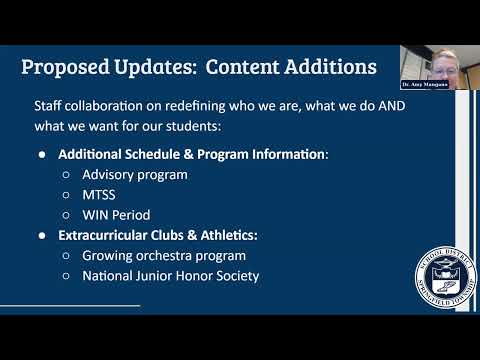
- Music and extracurriculars: Band and chorus will be embedded consistently into the school day for grades six through eight to provide protected rehearsal time; staff highlighted growth in orchestra and noted the addition of a National Junior Honor Society chapter.
- Advisory, MTSS and “win period”: The guide calls for deeper advisory work and continued development of a building-level data team using MTSS practices. Staff described a closing-of-day period — referred to in the presentation as a “what I need” or “win” period — intended for targeted intervention and enrichment based on data from benchmarks, attendance and behavior.
- Math placement: Jason Payne summarized a new annual placement review. Middle school student placements will be reevaluated each year using multiple data points (benchmark assessments, PSSA scores, attendance and other indicators) with reviews in January–February and again in June; families will receive a math-placement recommendation by July. Payne said the approach is designed to allow flexibility rather than a fixed multi-year track and to populate courses based on the cohort in each year.
STEM and special areas
Sarah Nose, the middle school STEM teacher, presented course overviews for grades six through eight. Sixth grade will emphasize robotics and the engineering design process; seventh grade will include a Shark-Tank–style invention project with prototyping and planned use of 3D modeling and 3D printing equipment; eighth grade will include a student-run news program (“Spartan spotlight”) and a career-exploration component intended to help students plan high-school course pathways. “One of the biggest themes that I focus on is the engineering design process,” Nose said.
Staff noted the STEM courses are intentionally open-ended to prioritize design thinking over particular hardware, and they plan to bring elementary STEM course overviews at the committee’s next meeting.
Assessment and other district initiatives
Administrators updated the committee on spring testing timelines and recent changes: the state science PSSA administration shifted from fourth grade to fifth grade this year, meaning the same cohort of students took a related test in consecutive years; AP exams are being delivered online this cycle and district technology staff have been supporting practice runs. The district is covering AP exam fees for students at a cost “under $40,000,” Damien Johnston said. Keystone exams in Algebra, Literature and Biology are scheduled later in the spring window explained by staff.
High-school planning topics were discussed at a summary level: the Pennsylvania Department of Education has authorized a half-credit personal finance requirement to be in place by 2030 and districts must decide how to schedule it by 2026–27; district staff described options including a standalone personal finance course, a retitled financial-literacy course or combining economics and personal finance into a pathway. The high school is also expanding computer science and dual-enrollment offerings in partnership with Pitt.
Implementation notes and next steps
Staff emphasized that next year is a transition year: many of the scheduling changes reorganize frequency and rotation rather than substantially altering core course content, and administrators said they will use next year to collect preference data and refine electives for 2026–27. The district plans parent communications tied to transitions and a parent night scheduled for the 30th (date given in the presentation). The committee was told the next Academic Affairs meeting is likely May 12 at 4:00 p.m. in a hybrid format.
Committee questions and concerns
Board members asked about staffing and capacity to offer expanded elective choices; administrators said they are building teacher capacity internally and using coaching and professional development to support new offerings. Committee members also asked how popular courses will be managed; staff said the transition year will provide data on student preferences and that while not everyone will receive their top choice, the district will use demand data to plan future offerings.
The presentation was informational; no formal committee votes or motions were recorded during the discussion.
Springfield Township School District staff said they will return to the committee with additional curriculum and course-overview materials (elementary STEM, technology and high-school proposals) at upcoming meetings.
AI generated
The text on this page is AI generated. Summaries, highlights, analysis, and video transcripts are all produced from the original source material.
AI can make mistakes, so if you spot one, and we will fix it for everyone.
Note: the source content is unaltered by us. Any content source we link to, be it a video, an audio recording, or a document, is presented exactly as its publisher released it. That publisher is usually a government body, sometimes an individual official or another organisation.