Get Full Government Meeting Transcripts, Videos, & Alerts Forever!
Get email alerts on the Ab218 Local Liability topic
No spam. Unsubscribe anytime.
FCMAT report and LA County testimony warn AB 218 liability surge could force deep local cuts or borrowing
Summary
A state's fiscal analysis and testimony from Los Angeles County officials at an Assembly subcommittee hearing detailed the fiscal strain created by AB 218’s extension of the statute of limitations for childhood sexual‑assault claims and recommended data collection, financing options and prevention measures.
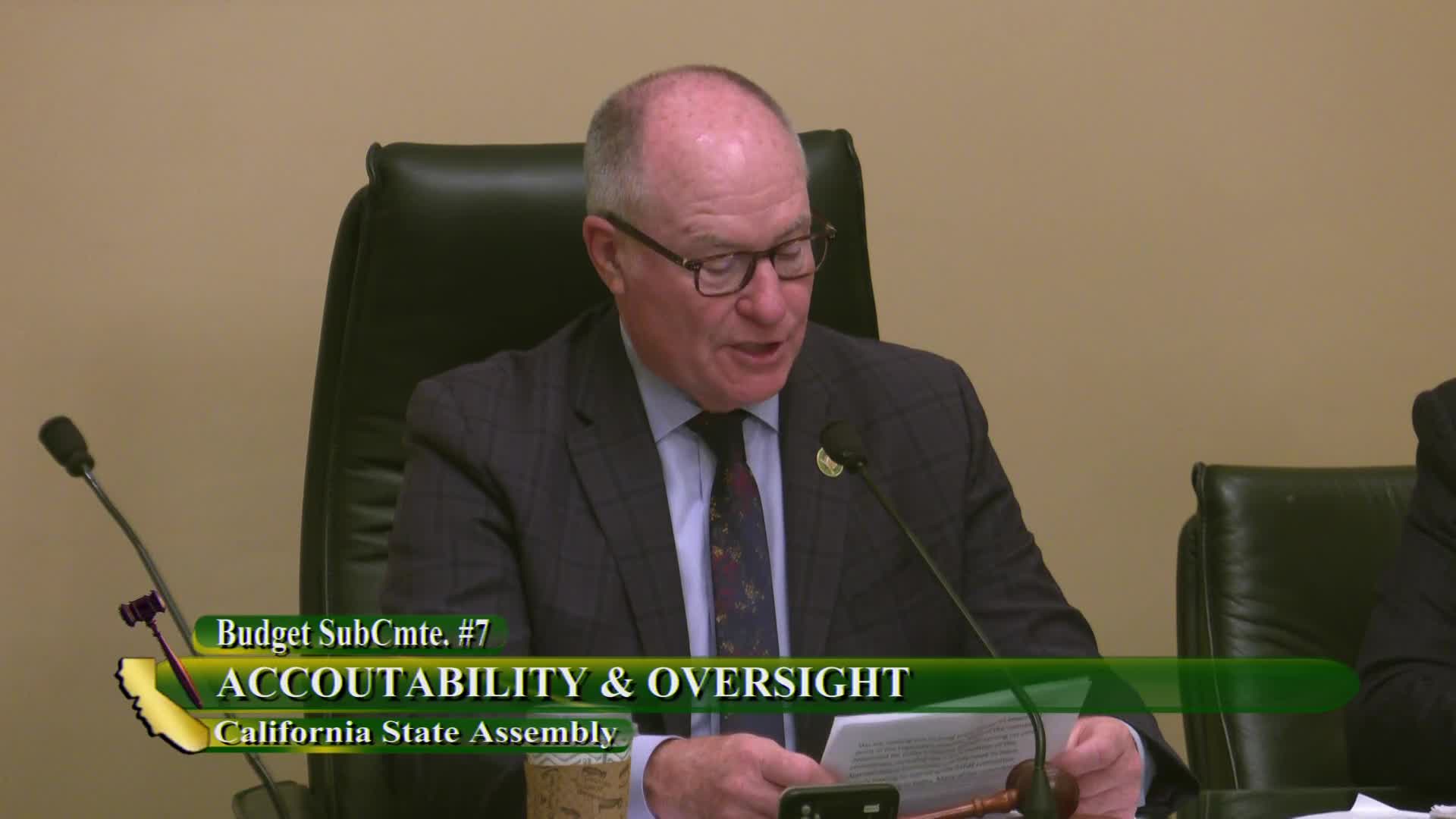
The Assembly Budget Subcommittee on Accountability and Transparency heard testimony that California’s recent expansion of the statute of limitations for childhood sexual‑assault claims under AB 218 has created a large and growing fiscal liability for local governments, school districts and nonprofit providers, and that state and local officials need financing mechanisms and stronger prevention measures to manage obligations to survivors without collapsing public services.
Michael Fine, chief executive officer of the State’s Fiscal Crisis and Management Assistance Team (FCMAT), presented a report the team issued after six months of study. The report, published Jan. 31, offers 22 recommendations across four themes: data collection, financing mechanics, a study of a victims’ compensation fund, and prevention measures.
Why it matters: AB 218 extended the window for some survivors to bring civil claims, exposing local public agencies to settlements and judgments that FCMAT and county officials said could be large enough to jeopardize budgets and services if handled only through existing local insurance and reserve mechanisms.
FCMAT findings: financing, data and prevention
Michael Fine summarized the report’s core conclusions: public agencies’ fiscal exposure is difficult to quantify because data are inconsistent, insurance arrangements and historical coverage vary widely, and some claims reach back to periods for which no commercial insurance records remain. The report “assumes we’re to pay the victims and compensate them,” Fine said, and therefore focuses on “how do we do that without bringing our local public agencies into fiscal ruin.”
FCMAT’s recommendations prioritize financing steps (recommendations 3–11) that smooth timing challenges created by judicial processes and allow municipalities to access payment mechanisms without immediate insolvency. The report also proposes a study of a first‑resort, full‑service victims’ compensation fund for future claims (recommendation 12) and a series of prevention recommendations (13–22) intended to reduce future offenses.
Fine stressed two practical points the committee underscored: many public entities belong to joint risk pools that self‑insure initial coverage layers and purchase reinsurance for higher layers; those pools can issue retroactive assessments to members for prior years’ shortfalls; and where historical commercial insurers no longer exist, retroactive settlement costs can fall on current members and local budgets.
Los Angeles County: tentative $4 billion settlement and fiscal plan
Fisia Davenport, chief executive officer for Los Angeles County, told lawmakers the county faces a tentative $4,000,000,000 settlement related to AB 218 claims. If approved by the Board of Supervisors, the county plans to meet the obligation with reserves, draws from its rainy‑day fund and borrowing, she said, and she told the committee the county expects to pay “hundreds of millions of dollars annually through 2030.” Davenport said the settlement plan will likely add hundreds of millions of dollars of debt service in later years and force curtailments; the county’s recommended budget already included nearly $100,000,000 in targeted reductions to avoid layoffs.
Davenport said the settlement is “unprecedented and by far the costliest in the county’s history” and warned that the county is watching related legislation in the Legislature — including Senate Bill 577 (author Senator John Laird) and SB 832 referenced by staff — that could provide tools for public agencies to manage liabilities.
Local providers and school officials describe market impacts
Public commenters and sector groups appearing after the panels told the committee that insurers and foster‑care and nonprofit providers are being directly affected. The California Alliance of Child and Family Services reported that about 220 foster family agencies could close and that many providers are seeing premium increases that in some cases exceed 300%, adding roughly $300,000 in annual insurance costs for affected agencies.
School business and governance groups supported the FCMAT recommendations. Chris Riefe of the California School Boards Association and Sarah Petrovski of the California Association of School Business Officials told the committee they seek solutions that allow survivors to be compensated while preserving service capacity for the state’s 5.4 million schoolchildren.
Next steps and legislative response
Fine said his team’s top priorities are (1) identify and standardize data on claims through a statewide repository, (2) smooth timing and judicial validation hurdles to enable financing solutions, and (3) evaluate a victims’ compensation fund and prevention measures. He said the Senate Education Committee was already considering prevention proposals aligned with FCMAT’s recommendations.
Davenport urged that any solution ensure victims are compensated but not at the cost of the county’s core safety net. No formal votes were taken at the hearing. Lawmakers and FCMAT staff indicated they will pursue follow‑up work on data collection, financing mechanics and the proposed victims’ compensation study.
The hearing included multiple public‑sector and nonprofit commenters who urged the Legislature to consider measures that protect both survivors’ rights and local government solvency.