Get Full Government Meeting Transcripts, Videos, & Alerts Forever!
Get email alerts on the Federal Budget And State Revenue topic
No spam. Unsubscribe anytime.
Lawmakers warn federal enforcement and grant cuts are already straining California tax revenue, UC research and local public health
Summary
At a California State Assembly Budget Subcommittee hearing, state and university officials told lawmakers that federal reductions in tax enforcement staff and recent federal grant terminations are beginning to affect California’s tax collections, university research funding and local public‑health programs.
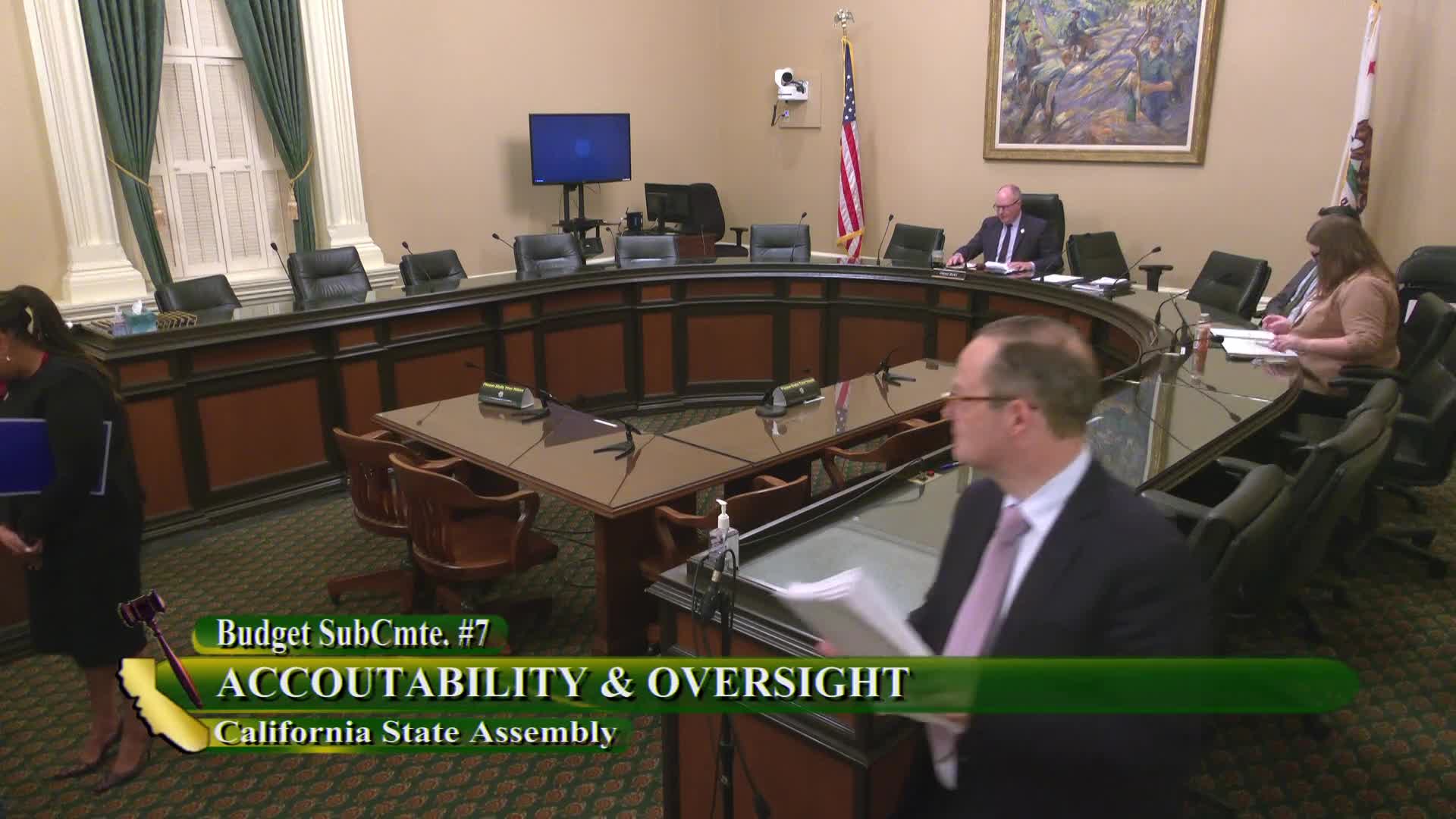
At a California State Assembly Budget Subcommittee on Accountability and Transparency hearing, state and university officials told lawmakers that federal reductions in tax enforcement staff and recent federal grant terminations are beginning to affect California’s tax collections, university research funding and local public-health programs.
The comments came as Roger Lackey of the Franchise Tax Board described how the FTB depends on federal tax processes and information sharing to prepare and verify state returns and carry out compliance work, and as University of California provost Katherine Newman and Department of Finance official Mary Halterman outlined cuts to federal research and appropriations that have already affected California institutions.
Why it matters: State income and corporate taxes are California’s largest revenue sources, and officials warned that even modest declines in federal enforcement and in federal grant flows can have outsized effects on the state budget, higher-education research pipelines and local health services.
Franchise Tax Board operations and revenue risk
Roger Lackey, speaking for the Franchise Tax Board, explained the operational links between federal and state tax administration. He said the state builds its return forms and the tax‑software schema after federal changes are finalized, and that about “95% of taxpayers actually file electronically.” He added that most of the returns the FTB receives—“99% of tax returns that are received by [the] Franchise Tax Board are from professional tax software”—depend on timely federal schemas and information reporting.
Lackey described several federal–state partnerships the FTB relies on: fraud prevention with the IRS and tax-software vendors; offsets that allow state and federal liabilities to be reconciled against refunds; participation in IRS-led information‑reporting channels for information returns; and the receipt of audit results and revenue-agent reports from the IRS to support state compliance work.
Several committee members pressed Lackey on the FTB’s ability to compensate if the IRS reduces auditing capacity. Chair Hart said the committee is “extremely concerned” about IRS staffing reductions and urged the FTB to consider contingency options; Lackey replied that the FTB builds yearly compliance programs that adapt to current conditions and that the agency will adjust its workstreams when federal information is delayed.
University of California: research, students and patient care affected
Provost Katherine Newman told the panel the UC system has already lost federal research awards and that continuing federal policy changes are disrupting current grants and prospective award cycles. “UC has already lost hundreds of millions of dollars in federal funding,” she said, describing a combination of award terminations, policy changes that reduce grant indirect‑cost (F&A) recovery, and scaled‑back future competitions.
Newman cited federal actions at multiple agencies. She said a U.S. Department of Energy F&A policy flash and related steps at the National Institutes of Health were temporarily enjoined by federal courts, but stressed those court orders are “temporary” and do not resolve the longer‑term risk. She told the committee the NIH F&A change, if implemented, “would lead to the loss of over $600,000,000 for the University of California.”
Newman described how grant reductions ripple beyond faculty: graduate student researchers are paid from grants and are losing support; undergraduate fellowship and training programs have been cut; international students face visa cancellations and increased monitoring; and UC’s hospitals would be vulnerable to Medicaid changes. She noted UC received nearly $4,000,000,000 in federal research grants in the 2023–24 year, that “there are 36,000 international students at the University of California,” and that UC students receive about $500,000,000 in Pell Grants annually.
Department of Finance overview of federal budget actions
Mary Halterman of the Department of Finance summarized the recent federal continuing resolution (CR) and the federal budget process still in progress. She said the CR extended funding at fiscal‑year 2024 levels, eliminated roughly $940,000,000 in earmarks for California projects and reduced domestic discretionary spending while increasing defense spending. She warned that reconciliation and later budget actions could propose deep cuts: congressional proposals discussed in the hearing referenced multi‑hundreds of billions of dollars in mandatory‑spending reductions over 10 years, including items under Energy and Commerce that affect Medicaid.
Halterman told the committee the president’s budget and a “skinny budget” were expected in May and that Finance would continue to monitor federal developments to assess impacts on funds the state receives.
Local public health and other partners report immediate effects
Public commenters and sector representatives told the committee that federal termination of pandemic‑era grants has already harmed local public health. Jack Anderson of the County Health Executives Association of California said 61 local health departments lost nearly $400,000,000 in multi‑year federal funding when HHS ended certain awards; he said the cuts have threatened positions for epidemiologists, lab staff and infectious‑disease nurses and could force reductions in school vaccine clinics and shelter support.
What the committee will do next
Lawmakers on the subcommittee asked the FTB to report back with follow‑up statistics—among them the number of ITIN filers and trends in filings—and requested the department and agencies continue to monitor the fast‑moving federal landscape. Chair Hart and several members urged the FTB and Finance to be proactive in identifying options, including potential state investments in compliance capacity, rather than waiting to see whether federal audit capacity rebounds.
The hearing produced no formal votes. Officials said they will supply requested data and further brief the committee as the federal budget and litigation unfold.