Get Full Government Meeting Transcripts, Videos, & Alerts Forever!
Get email alerts on the Economic Development topic
No spam. Unsubscribe anytime.
New Columbus Partnership CEO Jason Hall emphasizes coalition-building, equity and action on housing and workforce
Summary
At a Columbus Metropolitan Club forum, Jason Hall outlined priorities for the Columbus Partnership including inclusive coalition-building, translating civic collaboration into action on housing and workforce, and supporting major infrastructure and barrier-reduction investments already underway in the region.
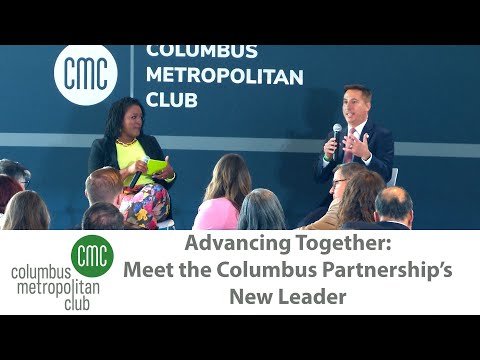
Jason Hall, the newly appointed chief executive officer of the Columbus Partnership, told a Columbus Metropolitan Club forum that his priorities are building broader, more inclusive civic coalitions and turning collaborative planning into concrete action on housing, workforce and major infrastructure projects. Hall spoke about the priorities and his leadership approach at the Jane Scott Legacy and Civic Engagement Forum hosted by the Columbus Metropolitan Club.
Hall said he intends to "build that bigger tent" and to "bring people together in common cause and in common purpose" so the civic sector can translate momentum—and sizable investments—into results that reach more residents. He cited the Columbus Promise, a major public‑private effort to reduce barriers to opportunity, new airport work and recent public commitments such as a half‑billion dollar city affordable‑housing announcement as examples of work he expects the Partnership to help align with community needs.
Why it matters: Hall framed his approach around the city’s existing civic culture, which he called the "Columbus way," and the need to make that culture more inclusive as the region grows. He said Columbus is at an "historic inflection moment" with large projects and rapid population growth creating both opportunity and pressure on social services, nonprofits and workforce systems.
Hall described his leadership style as curiosity‑driven, people‑centered and action‑oriented. "You lead by example," he said, adding, "it's not to talk in technical jargon terms. It's to change real people's lives." He pressed for a civic environment that allows risk‑taking so the region can "go further, faster" while learning from mistakes.
Drawing on his experience in St. Louis, Hall described coalition strategies he brought to large federal and private projects there. He said organizers worked to ensure historically excluded institutions, including an HBCU in the region, were included on day one of major project planning so benefits would flow into the neighborhood rather than be imposed on it. He credited that approach with creating local education and workforce pathways tied to a large headquarters project and for helping secure a competitive federal Build Back Better award for targeted, inclusion‑focused regional investment.
Hall also discussed the role of corporate partners and philanthropy. He credited business leaders and organizations for civic investment and urged more corporate citizenship to meet growing community needs, saying "we need more corporate citizenship right now. We need more investment in our community right now, and ultimately, more jobs." He described nonprofits as employers and urged treating them as partners in planning rather than as outside or secondary actors.
On identity and allyship, Hall explained why he has worn a small Israeli flag pin at public events since the October attack by Hamas, saying he adopted the visible symbol "as a sign of my allyship until the last hostage comes home," and framed that act as consistent with standing with communities facing threats. He also recounted barriers he faced earlier in his career, including a public confirmation hold when he served in Missouri state government, and said those experiences shape his commitment to pay forward opportunities.
Audience members asked about concrete priorities. Hall said his immediate tasks include ongoing listening and learning (he noted he was still within his first 100 days), framing the major questions the region must answer, and coordinating partnerships to maximize impact of simultaneous, large efforts. He repeated an estimate he had heard that the region could add roughly "a million more people" over the coming decade or two and warned that the scale of growth will require bold, inclusive policy and investment choices.
Hall declined to promise quick fixes. He emphasized partnerships with nonprofit, public and private sectors, technology solutions such as a community information exchange, and the need to sustain civic culture while adapting tactics. "We can do that even more boldly," he said of including grassroots voices in the region’s economic story.
The panel included Sofia Pfiffner, president and CEO of the Columbus Metropolitan Club, and several local civic and business leaders who asked questions about scenario planning, nonprofit sustainability and how the Partnership will engage human‑services organizations during a period in which one‑time federal funds are phasing out.
Hall concluded by urging urgency and ambition, saying the region should be thinking on a national and international scale rather than only in comparison to other Ohio cities: "What's London doing? What's Paris doing? What's Tokyo doing? That's the way we need to start thinking about ourselves here."