Get Full Government Meeting Transcripts, Videos, & Alerts Forever!
Get email alerts on the Education School Governance topic
No spam. Unsubscribe anytime.
Senate approves bill allowing state intervention, expanded vouchers and charter options for struggling Shelby County schools
Summary
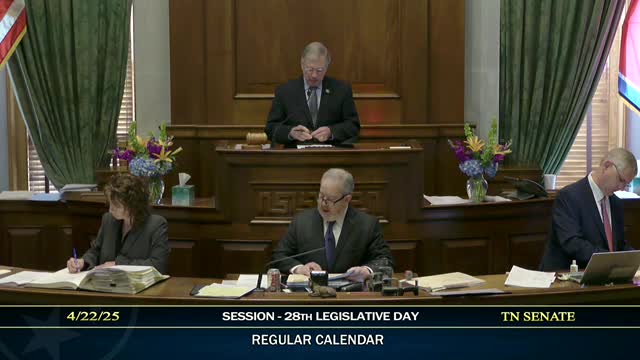
After hours of debate, the Tennessee Senate passed a bill that creates a tiered intervention process for chronically underperforming school districts, expands eligibility for Education Savings Accounts (ESAs) in qualifying districts and authorizes an oversight board with powers to review contracts and recommend removals of local officials.
The Tennessee Senate on the floor approved legislation that creates a stepped intervention framework for chronically underperforming school districts, expands Education Savings Account eligibility in qualifying districts and creates an oversight/advisory board with review powers over school contracts and governance.
Senator Taylor moved Senate Bill 714 (conform and substitute to House Bill 771 on the floor) on third and final consideration; the motion passed, Ayes 26, Nays 6. The bill defines a "challenge" school district by a three-part test — at least 50% economically disadvantaged students, failure to meet math and English expectations, and presence of at least one school on the state priority list for five consecutive priority-list publications — and authorizes a cascade of interventions when a district meets those criteria.
Under the bill, the commissioner of education, with the State Board of Education's concurrence, may remove the director of schools and recommend removal of elected board members; removed officials would be replaced as described in the bill. The measure also removes the income cap for ESA eligibility in qualifying districts so families meeting the district criteria would be eligible regardless of income. The legislation expedites charter opportunities in designated districts and authorizes the commissioner to recommend charter conversion for certain schools.
The bill requires creation of an oversight board of up to nine members (three gubernatorial appointees, two appointed by the lieutenant governor, two by the speaker of the House, plus the county mayor and city mayor or designee in affected counties). That board would be paid the same as an elected school board member and be provided three staff positions funded by the county commission. Duties given in the bill include producing a comprehensive needs assessment, a transformation plan, reviewing school-board agendas and contracts over $50,000 and providing comments to be read into the public record at school-board meetings.
The sponsor, Senator Taylor, framed the bill as an intervention for a decades-long problem in Shelby County, saying the district "has more than $1 billion of deferred maintenance," that proficiency rates remain low and that "we have to do something." He said the bill is intended as an intervention and not a takeover and noted an attorney general opinion from 1995 he said supports state authority for some removals.
Opponents said the measure is overbroad and constitutionally suspect and argued it targets Memphis. Senator Lamar said the bill “is not the way to do it,” arguing local voters and local governance deserve deference and warning it shifts responsibility from state lawmakers to local residents. Senator Yarbrough questioned whether the measure would create unequal treatment across the state and raised concerns about the effect on local control and on voters’ choices.
Senator Akbari and others warned the bill injects the state into local personnel and contract decisions and could produce uncertainty in communities. Supporters, including Senator Wally and others from non-urban districts, said the bill provides tools and resources for chronically struggling systems and emphasized the measure has statewide application — not only Shelby County.
The bill passed third and final consideration with a 26-6 vote. The motion to reconsider was tabled.
What the bill does and does not do: it expands ESA eligibility for districts that meet the bill’s criteria (removes the ESA income cap for those districts), authorizes the commissioner and State Board to remove and replace local leaders in specified circumstances, expedites charter options and creates an oversight/advisory board with specified duties. The bill delegates some appointment and staffing duties to local governments and requires local funding for the advisory board staff.
What proponents say: the bill’s sponsor argued it is a targeted intervention that pairs local responsibility with state oversight where a long record of underperformance has persisted.
What opponents say: critics called the bill punitive, said it risks constitutional and statutory conflicts over powers to remove elected local officials and said it may be an unfair, targeted action against Shelby County rather than a constructive statewide policy.
Next steps: The bill passed the Senate and will proceed per legislative procedures to the other chamber or to enrollment as provided by session rules. The law’s implementation details — notably who will serve on the oversight board and how local funding will be provided for staffing — will follow if the measure becomes law.
Votes and key figures: The final roll-call on the Senate floor read Ayes 26, Nays 6. The recorded debate included extended questioning on constitutionality, ESA mechanics and local fiscal impacts.