Get Full Government Meeting Transcripts, Videos, & Alerts Forever!
Get email alerts on the Urban Services Framework topic
No spam. Unsubscribe anytime.
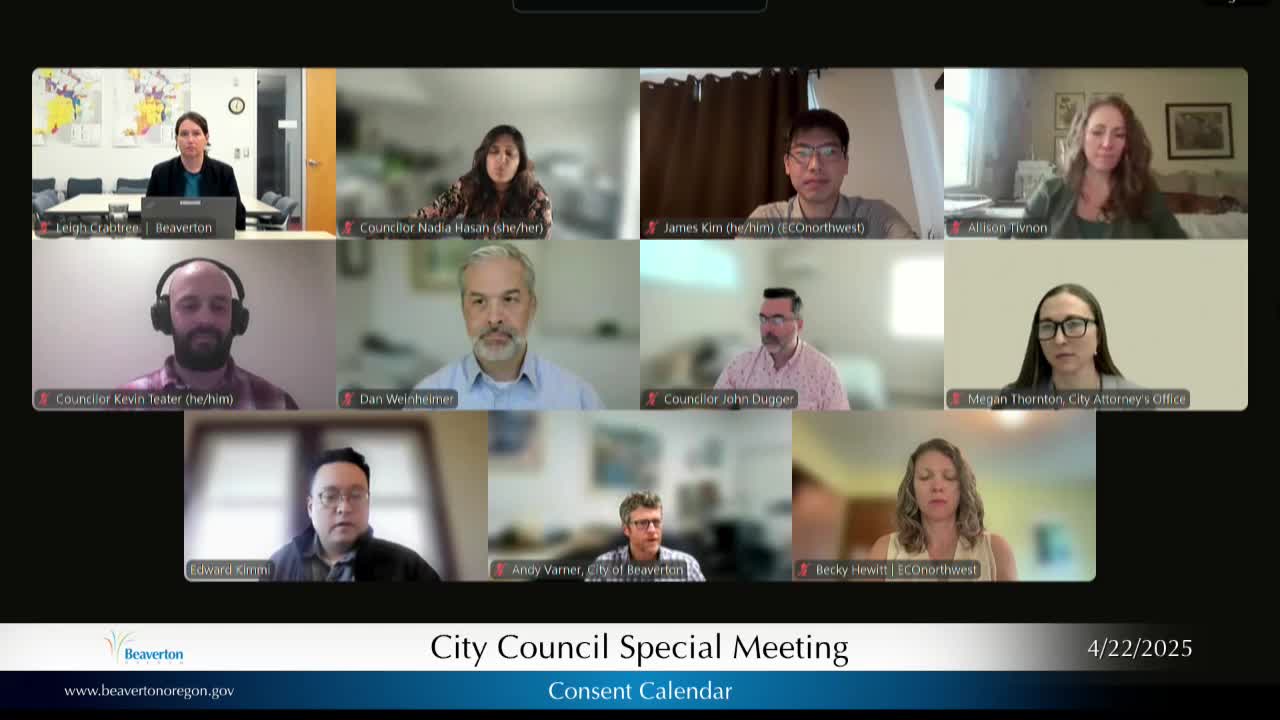
Beaverton council hears county-led Urban Services Framework study; consent agenda approved
Summary
Washington County and consultant teams presented a technical Urban Services Framework to Beaverton councilors, who asked for clearer fiscal analysis, delineation of county vs. city responsibilities, and annexation implications. The council approved the consent agenda by roll call (5 yes, 2 absent).
At a Beaverton City Council work session, Washington County and consultant teams described a technical Urban Services Framework study aimed at documenting who provides urban services in the county's urban unincorporated areas and modeling scenarios for funding and service delivery. Councilors asked for clearer fiscal comparisons, a delineation of responsibilities between the county and cities, and practical guidance on annexation and incorporation.
The project team said the study will inventory existing assets and providers, analyze costs and revenues, and evaluate legal and policy steps required to change service arrangements. "The project will develop background information and findings that can be used to inform future action by leadership and elected officials at the county, cities, and special service districts," Lee Crabtree, assistant director of community development for the City of Beaverton, told the council. The team highlighted that about 115,000 people live in the county's urban unincorporated area'roughly one-third of Washington County's residents and more than double Beaverton's population.
Councilors focused on finance and implementation. Mayor Beatty asked why county funds should be used to "teach unincorporated people how to be their own city" when urban planning area agreements (UPAAs) already map future jurisdictions; she said she was "uncomfortable" with a study that could be read as a how-to guide for incorporation. Becky Hewitt, a project director with Echo Northwest, said the study is a technical fact-finding exercise intended to lay out the statutory steps and financial implications for all options, not to carry out annexations.
Several councilors asked for specific analytic products. Councilor Duggar asked that the study identify services that only the county can provide and clarify legal limits such as water-right transfers. Councilor Teeter asked the team to analyze whether processes could be consolidated to create a "one-stop shop" for permitting and to examine incentives that could encourage annexation. Councilor Hassan asked the study to include all special districts and to clarify overlap or duplication of services; a councilor also noted the need to explain differences between sheriff's office responsibilities and municipal police under state law.
Project scope and case studies: the consultants said they will analyze six case-study areas chosen with Beaverton and Tigard to represent different conditions and fiscal impacts. For Beaverton the case studies named in the presentation are Bethany, City Hills West, Garden Home and Raleigh Hills. The team described three scenario categories they will evaluate: status quo (current providers and funding), boundary changes (who provides services), and alternate funding (new revenue tools or service districts without boundary changes). The presentation noted that existing agreements are in place with Tigard, Hillsboro, and King City, and that Beaverton's urban service agreement has expired.
Timeline and engagement: the team said it will gather data through the spring, perform technical analysis through the fall, synthesize results in winter, and brief staff and elected bodies before a public work session in February 2026; the final report is expected in summer 2026. Presenters emphasized this is a technical study and does not include formal public engagement as part of the contract, though staff briefings and meetings with community groups can be arranged.
Votes at a glance: the council approved the consent agenda on a roll-call vote, moved by Councilor Hassan and seconded by Councilor Duggar. The city recorder announced a tally of five yes votes and two absences; the motion carried.
The council members who spoke repeatedly requested the study return with concrete, actionable fiscal comparisons and, if possible, recommended pathways for any jurisdictional or funding changes so elected officials would have options to consider rather than a strictly informational report. The presenters said the analysis is intended to provide that foundational information for future decisions by the county, cities and special districts.