Get Full Government Meeting Transcripts, Videos, & Alerts Forever!
Get email alerts on the Marine Mooring Field topic
No spam. Unsubscribe anytime.
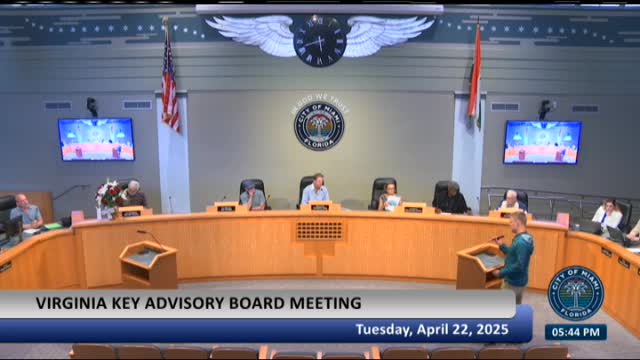
City staff says mooring-field design still in progress; stakeholders press for more consultation
Summary
City staff reported designers are revising mooring-field drawings for the Marine Stadium basin to address rowing-club concerns; stakeholders urged earlier and broader meetings with consultants and raised questions about the number and placement of buoys and anchors.
City of Miami staff told the Virginia Key Advisory Board that consultants are still revising drawings for a proposed mooring field in the Marine Stadium basin and are trying to incorporate feedback from stakeholder groups, particularly the Miami Rowing Club.
The update came from Andrew Frey, who said the consultant team "are still working on the drawings, trying to incorporate feedback particularly that was received from, I guess, the rowing club, specifically talking about the perimeter perimeter, marker buoys." Frey said the consultants are discussing options with state and county authorities and will produce revised plans once they have answers to those questions.
Board members and public speakers pressed for clarity on several operational and legal points. Roger Bernstein, speaking as a city resident and on behalf of the Virginia Key Alliance, noted pending state legislation and the board's earlier recommendation on a lower cap. Bernstein said, "the Florida legislature in house bill 481, which was passed a hundred and 5 to 0, has decided if it's passed by the senate and signed that the perimeter exclusion around the mooring field will increase" from 100 feet to 300 feet; Frey responded that the team is designing to current law and will reassess if the law changes.
Frey said the city is treating 75 buoys as the practical cap after the city commission settled on that number, while the advisory board had previously voted to request a 50‑buoy maximum. He explained the plan for the project includes installing more anchors on the seafloor than buoys, which would allow the city to move buoys among anchors for different events. "We'd only attach 75 buoys to to those anchors," Frey said, adding that having more anchors than buoys would provide configuration flexibility for concerts, regattas and other events.
Board member Lynn Lewis asked whether the design assumes one vessel per buoy; Frey said that is an "engineering standard" and the design assumes one boat per buoy. The board and public also asked how operators would handle events that require clearing the basin. Frey described existing practice under Coast Guard temporary vessel exclusion permits and said one benefit of a formal mooring field will be better registration and contact information for mooring permit holders: "When we establish a mooring field, anyone that wants to anchor in that area will immediately have to register ... their contact information, their boat insurance, credit card information," which would make notifying users for events more orderly.
Several speakers asked for more direct engagement between stakeholders and the consultants before work is finalized. Frey said the city has already met with stakeholders on early drafts and intends to continue iterative reviews: "when we have new work product from the consultants ... take it again to certain stakeholder groups for meetings and additional feedback." Roger Bernstein and others urged the city to arrange meetings with the consultants before finalizing plans to avoid costly rework.
No formal decision or vote occurred at the meeting. Staff said the consultants will return with revised drawings after further consultations and technical follow-up.