Lifetime Citizen Portal Access — AI Briefings, Alerts & Unlimited Follows
Michigan court hears Senate bid to compel House to present nine enrolled bills to governor
Loading...
Summary
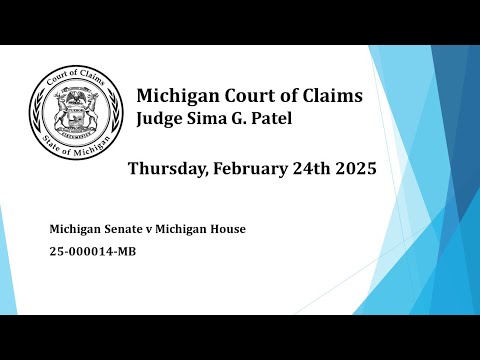
The Michigan Court heard oral argument in Michigan Senate v. Michigan House over a plaintiff motion for mandamus seeking to force the House of Representatives to present nine enrolled bills to the governor.
The Michigan Court heard oral argument in Michigan Senate v. Michigan House over a plaintiff motion for mandamus seeking to force the House of Representatives to present nine enrolled bills to the governor.
Plaintiff counsel Mark Brewer told the court the Senate is entitled to mandamus because Article IV, §33 of the Michigan Constitution requires that "every bill passed by the legislature shall be presented to the governor," and that constitutional text, historical constitutional-convention debate, and state practice create a ministerial duty the clerk must perform. "These bills were enrolled. They were ready to be presented," Brewer said, adding that "but for the unconstitutional order of the speaker, they would have been presented on or before January 8." Brewer told the court the Senate alternatively seeks a declaratory judgment and permanent injunction if mandamus is denied.
Defense counsel Kyle Asher, representing the House of Representatives and the Clerk of the House, argued the relief sought is historically unprecedented and would intrude on separation-of-powers principles. Asher told the court mandamus cannot lie where "there are disputed facts," where the constitutional provision does not specify who must present bills or when, and where courts would be forced to impose judge-made timing rules or assess legislative reasonableness. "To issue the relief the Senate asked for ... this court would have to extend that duty to find that someone in the new legislature has this duty to present bills that the new legislature was never involved in," Asher said.
The parties clashed over legal and factual points the court identified as central: whether Article IV, §33 imposes a duty specific enough for mandamus; whether the duty (if one exists) devolves to the clerk of the house where a bill originated; whether enacted bills passed by a prior legislature are obligations of a newly convened legislature; and whether any timing requirement (prompt or immediate presentment) can be read into the constitutional text. Brewer relied on historical convention debate and precedent he said interprets "shall" as mandatory and cited Michigan and out-of-state authorities discussed in the briefs; defense counsel relied on cases from other states and treatises arguing that presentment timing can be discretionary when the constitution is silent.
On factual points, Brewer said the clerk's office presented many bills on January 8 except for these nine, and that the clerk had been instructed on December 23, 2024, to present them. Defense counsel disputed some of those factual points and emphasized affidavits in their record saying no presentations occurred after the new legislature convened. The defense also pressed that mandamus is an extraordinary remedy with high standards—that a duty must be "set forth with such precision and certainty as to leave nothing to the exercise of discretion or judgment"—and argued the Senate's requested relief is functionally an order compelling a new legislature to perform the prior legislature's business.
Counsel for both sides cited multiple precedents during argument (as reflected in the parties' briefs), including Anderson v. Atwood, Cotton v. Banks, Campaign for Fiscal Equity v. Marino, Brewer v. Burns (Arizona), Gilbert v. Gladden (New Jersey), and other authorities discussed in the briefs. The defense also raised constitutional privileges and service issues concerning the Speaker, arguing the Speaker's office is subject to privilege from civil process while the legislature is in session.
The judge questioned both sides about justiciability, the political-question doctrine, how a court could define any timing requirement, and whether requiring the current legislature to present bills passed by its predecessor would create judicially unworkable standards. The court kept the parties' briefing schedule in place (the House's response technically remained due the next day, and the court noted it would not issue an order that day), and said it would issue an opinion as soon as possible. No final ruling was made at the hearing.
The dispute centers on nine enrolled bills that the Senate says were ready for presentment on January 8 and on whether a court may use mandamus or alternative equitable relief to compel presentation. The court did not resolve the factual disputes or the legal question at the hearing; it took the matter under advisement and said an opinion will follow.
The hearing record shows concentrated argument from both sides and multiple questions from the bench; the parties were given an opportunity for rebuttal. The matter remains pending before the court.