Get Full Government Meeting Transcripts, Videos, & Alerts Forever!
Get email alerts on the Rail Safety topic
No spam. Unsubscribe anytime.
Committee hears bill to require more wayside detectors, cap long trains and clear blocked crossings
Summary
SB 667 would require wayside detector coverage for California rail lines, impose a 7,500-foot cap for certain trains originating or reconfigured in-state, and require crossings be cleared for emergency-vehicle access; sponsors cite new studies linking train length to derailment risk.
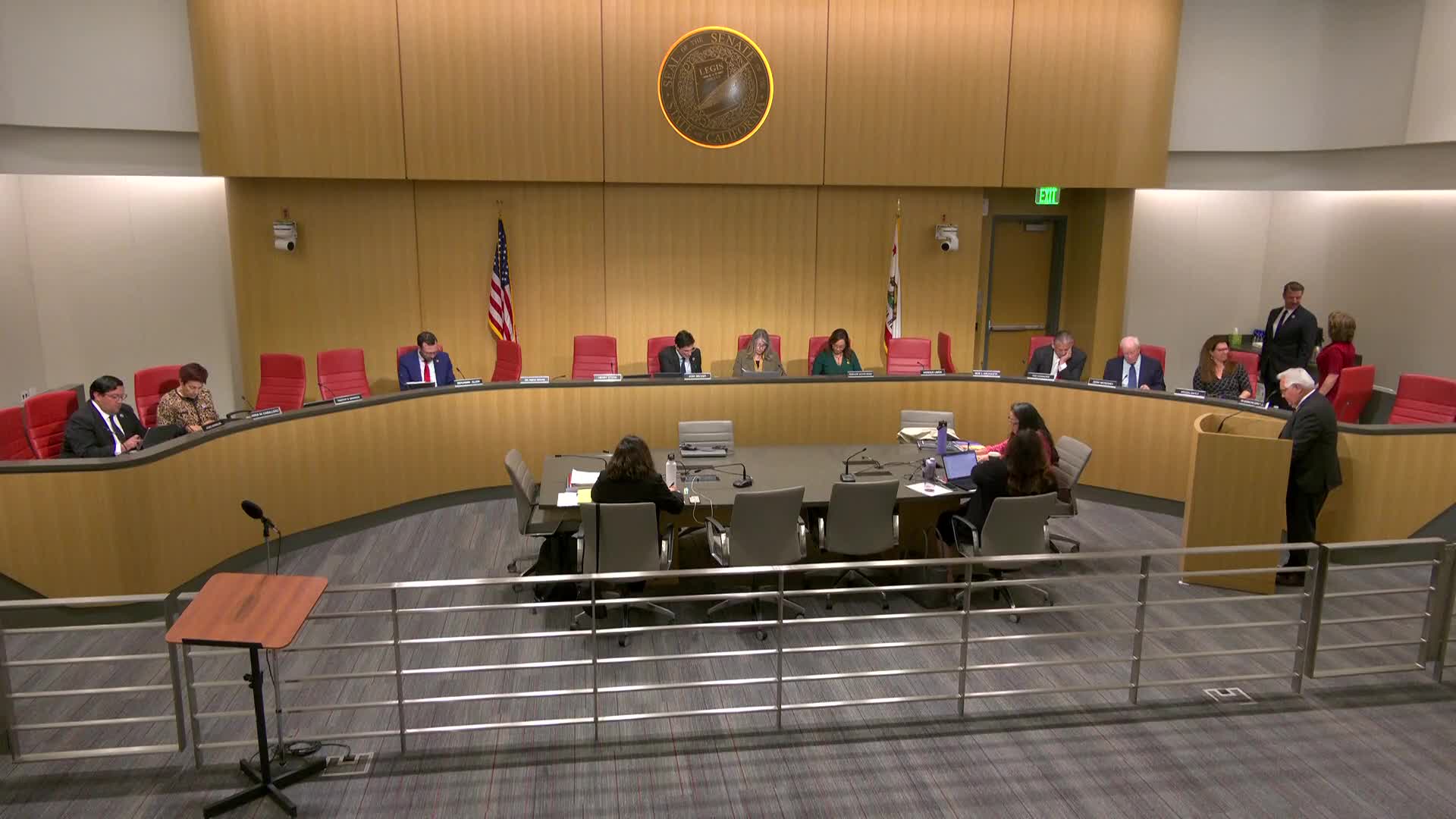
Senators heard testimony on SB 667, the California Railway Safety Act, which aims to strengthen rail-safety rules by expanding wayside detector systems, limiting the maximum length of certain trains operating in California to 7,500 feet, and requiring trains that block grade crossings to be split, moved or otherwise adjusted to allow emergency vehicles to pass.
Author Sen. Lena Archuleta said the bill responds to a series of recent derailments in California and national studies showing longer manifest trains have higher derailment risk. "This bill addresses critical safety gaps in California's rail system by implementing targeted measures informed by recent derailments," Archuleta told the committee.
Representatives of rail labor urged the committee to act. Ryan Snow, chairman of the California State Legislative Board for the Brotherhood of Locomotive Engineers and Trainmen, pointed to 2024 reports from the National Academies and the Society for Risk Analysis that, he said, validated long-standing rail-worker concerns that very long trains increase dynamic forces that raise derailment probabilities.
Sponsors argued the measure is narrowly tailored: it would apply to trains whose travel originates in California or that stop to add or remove cars in the state before continuing. They also said the bill is consistent with the 1970 federal framework that leaves room for state regulation when the federal government has not adopted a specific national safety standard.
Industry witnesses and freight operators were not represented at the committee panel in force; the bill’s sponsors emphasized the measure would preserve commerce while increasing safety. The bill also would require railroads to maintain wayside detection coverage on or adjacent to track where practical and to adopt communications protocols for detection alerts.
Senators asked questions about federal preemption, detector costs and operational impacts. Sponsors cited prior state rail safety regulations (for example, a 2015 law requiring two-person crews in locomotive cabs) and court outcomes to argue the state has some authority to adopt new safety requirements where federal rules are absent.
No formal vote was taken on the bill during this hearing; the author and sponsors said they will work with stakeholder groups and rail operators on technical definitions and implementation details before returning for committee action.