Get Full Government Meeting Transcripts, Videos, & Alerts Forever!
Get email alerts on the Transportation topic
No spam. Unsubscribe anytime.
Capital Southeast Connector JPA outlines multi-decade expressway, 34-mile bike path and habitat mitigation plan
Summary
Derek Menema, executive director of the Capital Southeast Connector Joint Powers Authority, told the Sacramento County Sustainability and Environmental Commission the long‑planned regional project will build a four‑lane expressway connecting I‑5, Highway 99, State Route 16 and Highway 50, add a 34‑mile Class I bike path, and is currently 11 miles complete with nine miles in final engineering.
Derek Menema, executive director of the Capital Southeast Connector Joint Powers Authority (JPA), told the Sustainability and Environmental Commission that the long-running regional roadway project is designed as a four-lane expressway linking Interstate 5 with Highway 99, State Route 16 and Highway 50 and will include a continuous Class I bike path.
"The Joint Powers Authority is a collection of five agencies," Menema said, adding the JPA formed in February 2006 to advance the Capital Southeast Connector project. He described the project’s core corridors as Cameron (in Elk Grove), Grant Line Road (the backbone of the program) and White Rock Road (north toward Silva Valley Parkway), and said the full project is planned to include a 34-mile Class I bike path.
Why it matters: the project is a regional connector crossing multiple cities, counties and Congressional and supervisorial districts; Menema said it is intended to improve safety and freight mobility, and to shift some traffic off congested state highways. The corridor also is fully inside the South Sacramento Habitat Conservation Plan (HCP), and Menema said the JPA has secured a 50-year permit from the U.S. Fish and Wildlife Service and the U.S. Army Corps of Engineers to proceed within that habitat-permit framework.
Project scope, costs and schedule Menema said roughly 11 miles are complete and open to traffic, representing about $200 million of construction work, and that nine additional miles are in final engineering and right‑of‑way phases. On total program cost he gave a working figure of about $500 million but warned estimates can change as interchanges and structures are expensive. "The project's been well underway. We've completed approximately 11 miles of the project, and we're underway right now at 9 more miles of final engineering and design," he said.
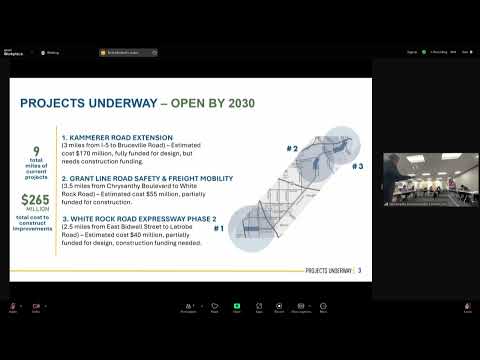
He described current priorities as three projects the JPA board has identified: a three‑mile extension of Cameron Road (greenfield work in Elk Grove), a safety and freight mobility reconstruction of Grant Line Road (two-lane reconstruction with Class I bypass in sections), and White Rock Road Expressway Phase 2 (roughly nine miles crossing Folsom, Rancho Cordova and Elk Grove). Menema said parts of the project are intentionally being advanced as two‑lane reconstructions with a longer‑term plan for four lanes, both for fiscal prudence and to make staged grant applications more competitive.
Funding and permitting Menema outlined the JPA’s funding mix and permitting history: the project was included in a 2004 countywide sales tax measure (Measure A), which the speaker said passed with about 74.6% of the vote; the JPA later received state and federal awards, including a $25 million federal grant from the Bipartisan Infrastructure Law for Grant Line Road and multiple awards under California’s Road Repair and Accountability Act (Senate Bill 1). He said acquiring right of way is a major schedule and funding risk: "A 34-mile long project is actually 68 miles of frontage," he said, noting the number of affected property owners and the cost uncertainty when interchanges or bridges are needed.
Safety, freight and multimodal elements Menema emphasized safety as a priority: much of the existing roadway dates from earlier eras and lacks shoulders or modern geometry. He said reconstruction will add clear recovery zones, standard shoulders and improved drainage to reduce hydroplaning and run-off-the-road collisions. On freight, Menema said Grant Line Road carries heavy aggregate and landfill-related truck traffic and the project has been targeted for Trade Corridor Enhancement Program funding because of that freight function.
On multimodal access, Menema said the JPA plans a continuous Class I multiuse path along the corridor: "We're gonna build a 4 lane facility around the Southeast County. We're fully integrated into the South Sacramento Habitat Conservation Plan," he said. He also told commissioners that, to date, the cities operating and maintaining segments will determine some amenities; he said no restrooms or water stations are currently planned along the bike path but called the suggestion "wonderful." He noted that most new Class I trail segments are provided on the "developed side" of the alignment and that many connections and additional facility details will be implemented by the cities as adjacent development occurs.
Timelines and next steps Asked about schedule, Menema said funding remains the biggest constraint: "Absolutely" when asked whether funding was the largest limitation. He said, under current priorities, it would take a minimum of five years before the program could begin work on the remaining 14 miles beyond the nine in final engineering, while acknowledging that a major federal or state earmark could accelerate that timing.
Habitat mitigation and land conservation Menema described the program’s mitigation approach: the JPA purchases conservation acreage and places easements into the South Sacramento Conservation Agency, which holds an endowment for perpetual management. He gave an example of a 160-acre mitigation purchase at the corner of Jackson Road and Grant Line Road that is now managed as grazing land under conservation easement.
Where to get more information Menema directed commissioners to the JPA’s website for maps, the program status report and project details: "If you'd like to read more about the status of our project and, you know, really get into the details, last year in September, we wrote a comprehensive project status report," he said, and supplied the JPA website (connectorjpa.com) as the repository for reports and maps.
Ending: The commission followed Menema’s briefing with a multi‑topic Q&A on expressway design, multimodal connections, funding programs and trail gaps; Menema said the project will continue to pursue state and federal grants and collaboration with the Sacramento Area Council of Governments (SACOG) and local jurisdictions.