Get Full Government Meeting Transcripts, Videos, & Alerts Forever!
Get email alerts on the Energy Storage Safety topic
No spam. Unsubscribe anytime.
Senate advances bill setting statewide safety rules for utility-scale battery storage
Summary
Senate committee advanced SB 283, which would require utility-scale battery storage to meet NFPA 855 standards, deepen local fire-agency review and inspections, and prohibit indoor installation of large-scale combustible battery arrays.
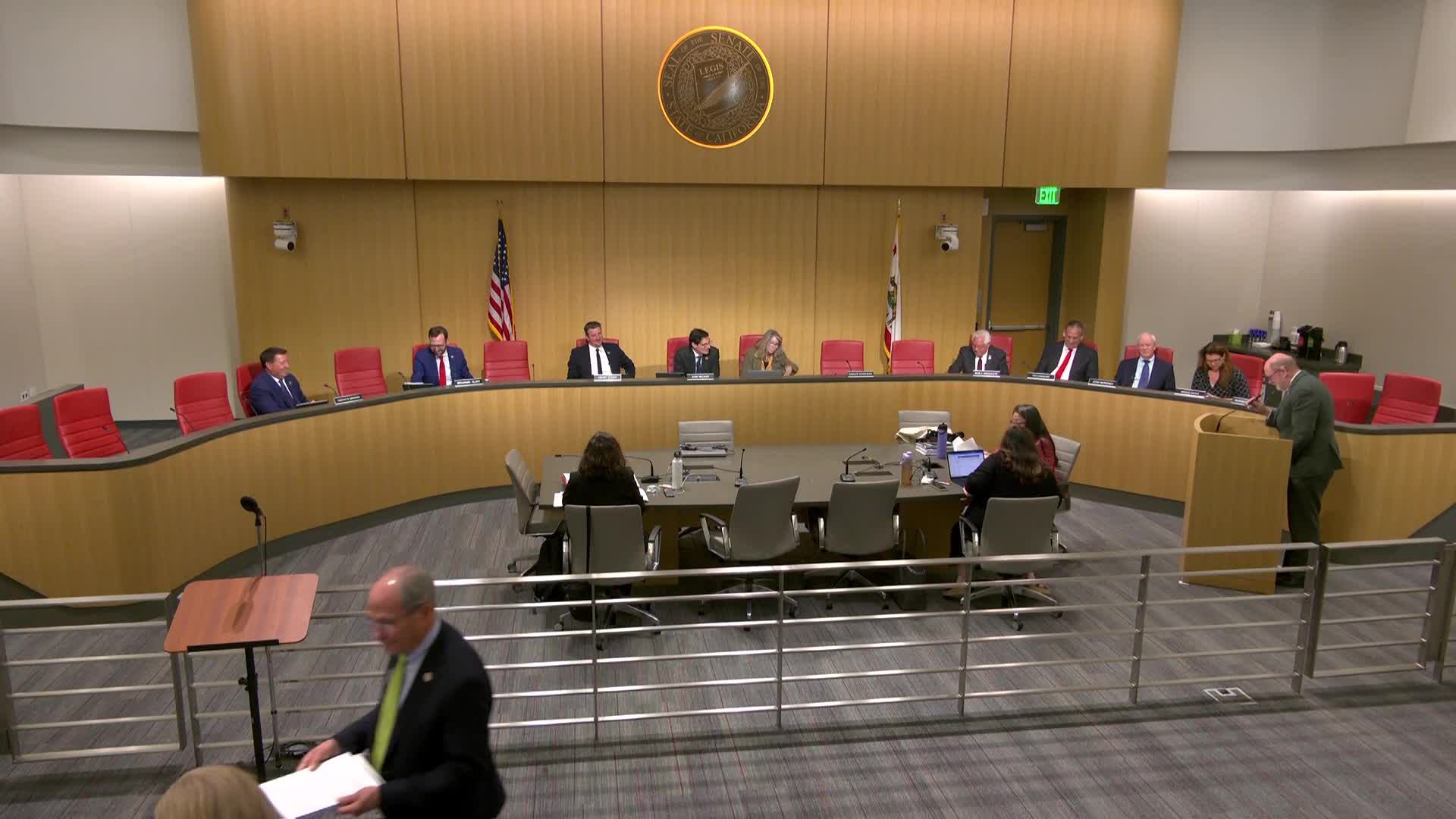
The Senate Committee on Energy, Utilities and Communications on Tuesday advanced SB 283, the Clean Energy Safety Act of 2025, which would require utility-scale battery storage projects to follow National Fire Protection Association (NFPA) 855 standards, require pre-application coordination with local fire authorities and require inspection before a facility goes into service.
The bill’s author, Sen. John Laird, said the measure responds to high-profile storage fires — including a multi-day blaze at the Moss Landing facility — and to rapid growth in battery capacity in California. "If we're going to have battery storage, it needs to be safe for the people around it and for those in the state," Laird told the committee.
A coalition of firefighter and electrical-worker representatives urged the committee to approve the bill. Doug Supers of the California Professional Firefighters, a cosponsor, said local fire agencies must be included from project design through inspection. "When battery storage systems are on fire, they are complex and difficult to extinguish," Supers said, adding the bill's inspection and coordination requirements would reduce risk and allow fire agencies to plan responses.
Scott Wetsch, with the State Association of Electrical Workers, told the committee the change would put California ahead of other states by applying NFPA standards and ensuring inspections include fire and life-safety review rather than only interconnection checks by utilities.
Supporters including county governments, community-choice aggregators, utilities and labor unions signaled backing subject to narrow technical fixes; several parties asked the author to refine definitions so the bill does not unintentionally apply to behind-the-meter or electric-vehicle storage.
The committee amended the measure and voted to pass SB 283 to the Senate Local Government Committee. The committee recorded an 11–0 vote to advance the bill.
If enacted as written SB 283 would: - Require new utility-scale battery energy storage systems to meet NFPA 855 and follow documented safety and inspection protocols; - Mandate pre-application meetings between developers and local fire authorities to address design and site-specific safety measures; - Require a fire inspection before a facility goes online, with the owner responsible for inspection costs; - Prohibit indoor combustible battery installations at utility scale to prevent incidents like those at containerized storage sites.
Supporters said the bill is strictly targeted at utility-scale installations and not household or vehicle batteries. Opponents and some industry groups sought clarifying language on the definition of "utility-scale" and exceptions for behind-the-meter systems. Laird said he would work with stakeholders on definition refinements before the next committee.
The bill now moves to the Local Government Committee for further consideration.