Get Full Government Meeting Transcripts, Videos, & Alerts Forever!
Get email alerts on the Civil Rights topic
No spam. Unsubscribe anytime.
Advocates press council to require expertise and transparency for Howard County Human Rights Commission
Summary
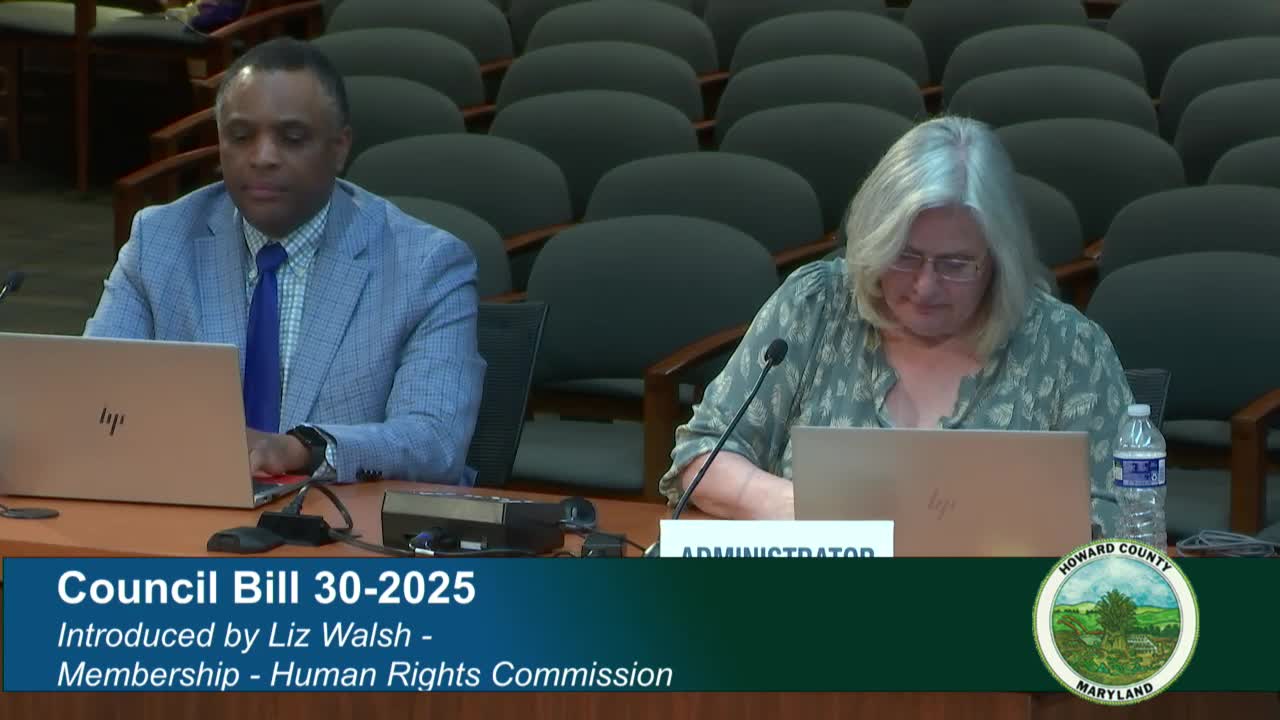
Advocates, students and human‑rights organizations told the Howard County Council at its April legislative public hearing that the Human Rights Commission needs stronger qualifications, mandatory training and a more transparent, independent appointment process.
Advocates, students and human‑rights organizations told the Howard County Council at the April legislative public hearing to strengthen the county's Human Rights Commission by requiring relevant expertise for commissioners and by improving appointment transparency and response procedures.
Andrea Lane, a student and steward at Howard Community College, said the current appointment process is too heavily influenced by political connections and urged the council to require commissioners to have "relevant experience in areas like civil rights, conflict resolution, or human rights law." Hina Zubairi of Justice for All supported the bill's mandatory training provisions and called for an independent, transparent appointment process to ensure the commission responds to credible community complaints. Zubairi said local human‑rights bodies historically played a key role when federal protections lagged.
Several speakers described recent local examples that motivated reforms. Ayesha Khatib, who said she grew up in Howard County, described a student protest she said was treated unfairly by Howard County Public School administration and said commission follow‑up was inadequate after students raised concerns about censorship and alleged discriminatory treatment. Human rights advocates also pointed to earlier complaints about conditions tied to the county's ICE contract and said the commission's lack of timely public response undermined trust.
Supporters asked the council to adopt CB 30‑20‑25 and to consider additional amendments to ensure an independent appointment process, faster complaint response mechanisms and publicly available annual reports. The council did not take a final vote on the bill at the hearing; sponsors said they would consider amendments and next steps in the council's legislative process.