Get Full Government Meeting Transcripts, Videos, & Alerts Forever!
Get email alerts on the Building And Energy Codes topic
No spam. Unsubscribe anytime.
Howard County delays vote on 2024 building, plumbing and energy codes after public push for electrification
Summary
At an April legislative public hearing, county officials introduced updates to the 2024 model building, plumbing, property‑maintenance and fire codes but agreed to postpone final action after dozens of residents and professionals urged stronger electrification and other climate measures.
Howard County Council heard hours of testimony on proposed updates to local building, plumbing, property‑maintenance and fire prevention codes during its April legislative public hearing, but the council and administration agreed to delay final action and hold a work session in June to consider amendments, including electrification measures.
The county's director of inspections, licenses and permits, Bob Francis, told the council the packages before them are the standard triennial updates to the International Code Council and related standards. "My intent is and has always been, to adopt the codes with as few local amendments as possible," Francis said. The package includes the International Building Code, the International Residential Code, the International Mechanical Code, the International Energy Conservation Code (IECC), the International Swimming Pool and Spa Code, the International Property Maintenance Code and the International Plumbing Code together with NFPA 54 (the National Fuel Gas Code).
Supporters of stronger local requirements urged the council to go beyond the model codes. River Hill High School juniors Maria Ibrahim and Henry Armas testified that the council should adopt amendments requiring or strongly encouraging full building electrification. Armas told the council, "We only get one chance to build something new, and every gas furnace or water heater installed today locks in fossil fuel pollution for decades." Betsy Singer, representing the Jewish Community Relations Council, said electrification would advance county and state climate goals and protect public health: "About 11% of greenhouse gas emissions in the county are produced by the direct combustion of fossil fuels in homes and other buildings." Mechanical and fire‑safety professionals also testified in favor of electrification and model‑code amendments. Ben Rausch, a mechanical and fire protection engineer who chairs the Maryland Green Building Council, told the council, "Heat pumps work now" and said model‑code appendices exist that local governments can adopt to require all‑electric construction.
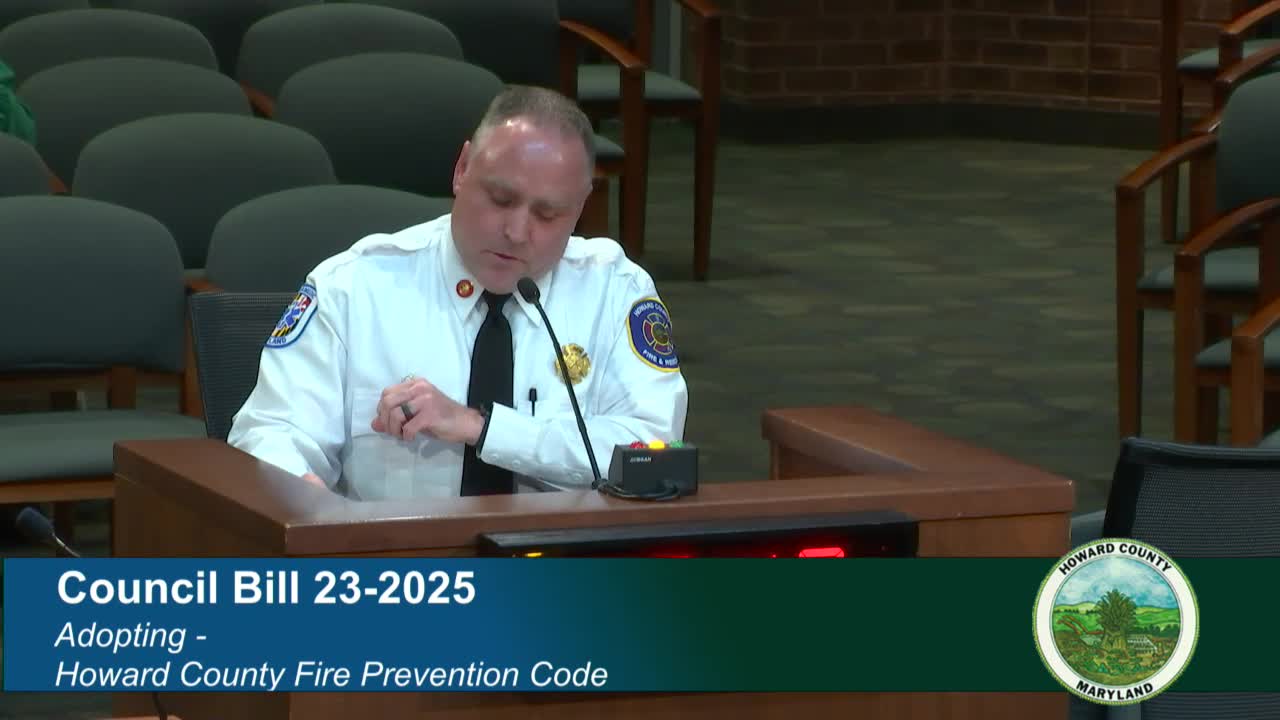
County fire officials described local amendments included or proposed with the 2024 NFPA 1 update. Battalion Chief Robert Ferguson, speaking for the Office of the Fire Marshal, said the county revised more than 300 lines of local amendment language and added provisions to address lithium‑ion battery fire risks and construction safety. Among the changes he described: requiring multifamily buildings to offer fire‑protected charging areas for e‑bikes and e‑scooters (an option, not a prohibition on charging in individual units), new documentation requirements for off‑cycle repairs to fire protection systems, additional worksite lighting and stair access requirements for construction sites, and the potential for early smoke detection in parking garages with EV chargers.
County staff and the administration emphasized that the proposed IECC 2024 adoption will increase energy efficiency locally (Francis said the 2024 IECC would increase energy efficiency about 7.8% over the 2021 edition) and that the administration intends to keep local amendments narrow to preserve clarity for builders. Francis also noted the International Swimming Pool and Spa Code is now required by state law and is included for the first time in Howard County's adoption.
After extended public comment and questions from council members about electrification and timing, the administration indicated it would not block a council table or postpone, and council members agreed to schedule a dedicated work session in June to examine amendments, including options for mandating or incentivizing electrification. Council staff stated that the council will need to extend the life of the introduced bills at the next legislative session if the council wishes to delay final consideration.
The council did not take a final vote on the code adoptions during the hearing. Council members instructed staff to schedule a June work session and to provide materials and possible amendment language for further review.