Get Full Government Meeting Transcripts, Videos, & Alerts Forever!
Get email alerts on the Accommodation School Budget topic
No spam. Unsubscribe anytime.
Cochise County accommodation school superintendent reviews budget, student services and residency limits
Summary
At a Cochise County Board of Supervisors work session, Dr. Jackie Clayton presented the annual budget briefing for the county-run accommodation school, outlining student counts, funding sources, contracted teaching services, jail education and limits on verifying student residency for tuition enforcement.
Dr. Jackie Clayton, Cochise County school superintendent, presented the annual budget review for the Cochise County Accommodation School during a Board of Supervisors work session, describing current enrollment, funding arrangements, staffing models and program priorities.
The briefing matters because the accommodation school serves opportunity youth who have dropped out of traditional schools, offers instruction to students who are incarcerated, and affects school accountability metrics and district funding. Clayton said the presentation was required by state law and framed the program as both educational and remedial for students ages 16–22.
Clayton opened by saying the accommodation school “is an actual school” and described its mission: “Our mission is 16 to 22 year olds. We provide motivation, direction, and purpose.” She told the board the program is primarily funded through state per‑student revenue and grant income, and that the office acts as fiscal agent for several small districts in the county (all districts except Sierra Vista, she said). She asked the board to consider only salary increases that align with any countywide adjustments; she did not request an overall program budget increase.
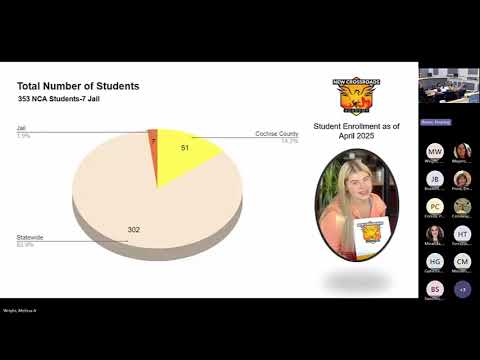
On enrollment, Clayton gave several figures during the presentation. She said Cochise County serves a relatively small cohort of students, reporting roughly "54" students countywide and noting that seven students are currently housed in the county jail and receiving instruction there. She also cited a statewide total of about 302 students in similar programs. Clayton said the accommodation school’s students are primarily juniors and seniors and that the program prioritizes returning dropouts to credited enrollment so their originating schools do not lose accountability points.
Clayton explained the school’s instructional model relies on contracted services. She said the program uses an online learning platform (referred to in the meeting as Ingenuity) and contracts with a staffing/vendor entity identified in the presentation as GradSolutions to provide certified teachers and mentoring. Clayton described payment splits between the accommodation school and GradSolutions during the session but gave differing percentage figures at different points; she did not provide a single, definitive contract percentage during the briefing. She emphasized that the contracted teachers are certified and that the county school office retains a principal and a business manager while contracting out some special‑education services.
On facilities and student supports, Clayton said the school has an outdoor learning space built with ESSER (Elementary and Secondary School Emergency Relief) funding, satellite sites and local business partnerships that host campus space for students in towns such as Douglas and Willcox. She noted a donated vehicle from Freeport‑McMoRan that functions as a mobile testing/computer lab and said the vehicle is used to reach students who cannot travel to campus locations.
Clayton said the accommodation school does not provide regular transportation; board members repeatedly raised transportation and geographic access as concerns for students in outlying towns. Clayton characterized providing county‑operated transportation as a significant additional liability and cost, and said the program currently relies on satellite campuses, local business partners and student self‑transport where possible.
Board members pressed Clayton on residency and cross‑border enrollment. The discussion addressed whether districts pursue tuition from students who live outside district boundaries (the presentation referenced a $4,000 tuition figure for out‑of‑district enrollment raised by a supervisor). Clayton told the board that legal limits constrain administrators’ ability to police addresses and that state and federal rules govern verification; she said the office advises superintendents to “red flag” suspicious concentrations of enrollments at a single address but that the district’s ability to enforce tuition assessments is limited by statute and guardianship verification processes.
Clayton identified programmatic priorities for the coming year: hiring a full‑time mentor to conduct in‑person outreach (including work with McKinney‑Vento students experiencing homelessness), strengthening satellite campus operations, and ensuring credits earned while students are incarcerated transfer to other Cochise County schools. She told the board the goal is to help students graduate with a regular high‑school diploma and to connect graduates with Cochise College or other career and technical education (CTE) options.
Questions from supervisors touched on software licensing and operating costs. Clayton said many software licenses are covered by county IT and that some program‑specific leases and subscriptions are paid from grant or program funds rather than the county general fund. She described the accommodation school’s fiscal relationship with the county as one in which the school leverages county services (IT, fleet) and external grants to minimize direct county general‑fund expenditures.
The presentation concluded without any formal vote or board action. Clayton thanked the supervisors for their support and said she would return with budget discussions as the fiscal year planning proceeds.