Get Full Government Meeting Transcripts, Videos, & Alerts Forever!
Get email alerts on the Agrivoltaics Pollinator Solar topic
No spam. Unsubscribe anytime.
Senate panel reviews agrivoltaics, pollinator‑friendly solar and proposed specialty license plate funding (SF2653)
Summary
Witnesses described agrivoltaics and Minnesota's Habitat Friendly Solar program and supported Senate File 2653, which would add an agrivoltaics definition and create a voluntary specialty license plate to fund habitat monitoring and incentives administered by the Board of Water and Soil Resources.
Senate File 2653, an informational proposal that would clarify a statutory definition of agrivoltaics and create a voluntary solar pollinator specialty license plate to fund the Habitat Friendly Solar Program, was presented April 21 to the Senate Agriculture Committee.
Senator Sarah Kopec (presenting the bill) said Minnesota's 2016 pollinator‑friendly solar statute and the Board of Water and Soil Resources' (BWSR) program produced measurable benefits: she cited a "five‑year longitudinal study" showing roughly a 20‑fold increase in native bumblebees and other pollinators at sites managed under the standard. Kopec said the program lacks a dedicated funding stream and that the proposed specialty plate would provide voluntary, user‑sourced support for monitoring and technical assistance.
Rob Schultz of Audubon Upper Mississippi River Region described Audubon's support for multi‑benefit solar projects and said the organization backs both the agrivoltaics definition and the license plate funding mechanism. Schultz called for "solutions that avoid, minimize, offset, and monitor impacts on birds" and noted Audubon's goal to support deployment of renewable energy while protecting wildlife.
Industry and developer representatives also testified in favor. Sarah Webbie of the Minnesota Solar Energy Industries Association said agrivoltaics—growing crops, raising livestock or establishing pollinator habitat under and between panels—creates opportunities for dual land use and new local economic activity without mandates. Colleen Hollinger of Natural Resource Services described the success of the 2016 Habitat Friendly Solar standard in restoring native prairie under arrays and supported the voluntary plate as a way to fund ongoing monitoring and technical assistance by BWSR.
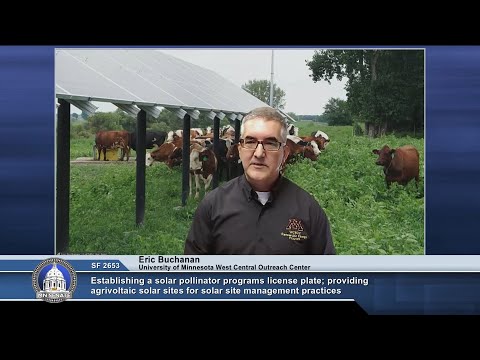
Research testimony highlighted operational examples and potential farmer benefits. Eric Buchanan of the University of Minnesota West Central Research and Outreach Center described arrays raised high enough for dairy cows to graze, said shade reduced heat stress for cattle, and said agrivoltaics can keep farmland productive while generating a stable income stream for farmers.
Supporters emphasized the voluntary nature of the program and that the specialty plate would not draw on the general fund. Several testifiers referenced pilot projects where incubator farms used land under panels with longer‑term leases and infrastructure (well irrigation) that improved land access for emerging farmers.
The committee heard questions about siting, agricultural compatibility and CREP land; members were told the approach could broaden options for farmers and help meet renewable energy and pollinator‑habitat goals. The hearing was informational and no bill action occurred.