Get Full Government Meeting Transcripts, Videos, & Alerts Forever!
Get email alerts on the Sidewalk Ordinance topic
No spam. Unsubscribe anytime.
Colfax council delays sidewalk-repair ordinance, asks staff to clarify tree and city-responsibility language
Summary
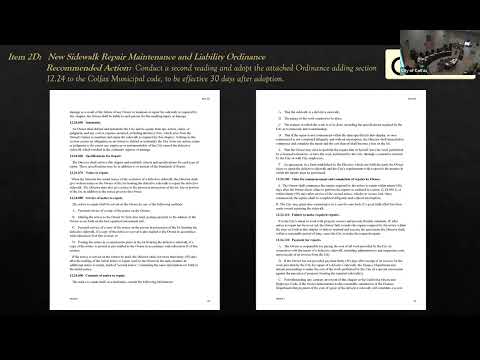
Council pulled proposed municipal-code changes on sidewalk maintenance (item 2d) for more staff review after residents asked who would be liable for damage from trees and questions about ADA requirements; council directed staff to draft a version distinguishing city-owned trees from private trees and to check state law limits.
Colfax City Council on Jan. 22 pulled proposed amendments to the municipal code that would formalize property owners' duty to repair defective sidewalks and instead directed staff to return with clarifying language.
The council removed the sidewalk-maintenance ordinance (agenda item 2d) from the consent calendar after multiple residents and council members pressed for clearer definitions of “defective sidewalk,” the scope of owners’ liability, and how tree roots and city-planted trees would be treated under the code.
Why it matters: The amendment under consideration added a section (listed in the agenda packet as 12.24.030) describing an owner’s duty to repair defective sidewalks. Residents said uneven sidewalks, old walkways narrower than modern code and tree-root damage are common in Colfax and worried they would be put on the hook for costly upgrades. Council members also raised the prospect that state law could limit local changes.
City staff and council offered legal-language details during the discussion. A staff member identified in the meeting as Connor pointed council and the public to the proposed code sections in the packet, noting the draft includes definitions of “standards of repair” and “defective sidewalk.” “Section 12.24.030 … describes an owner's duty to repair a defective sidewalk,” Connor said during the hearing.
Residents asked several practical questions: whether very old sidewalks built to earlier, narrower standards would be considered “defective” under the new text; whether homeowners would be required to remove snow or face liability; and how the city would determine whether a tree was city‑planted or privately planted when tree roots contributed to damage.
One resident asked whether she would be obligated to upgrade a narrow, century-old walkway at substantial cost; another asked whether the city keeps records that would show who planted a tree. Council members and staff repeatedly pointed to the ordinance’s definitions and notice provisions as the place to resolve those distinctions.
Council discussion and direction: Several council members said they expected a distinction between damage caused by city property (for example, trees planted in the public planting strip or damage caused by city equipment) and private trees. Council member Caroline McAuley and others explicitly asked that the revision include language differentiating city-owned trees from trees on private property.
The council made two specific directions to staff: to return with a revised draft that distinguishes between city-owned trees and privately owned trees in the duty-to-repair provisions, and to confirm whether state law constrains local adjustments. The council left the ordinance pulled from the consent calendar; no final vote to adopt the code change occurred on Jan. 22.
What remains unresolved: The draft in the packet references notice and payment procedures (the council was pointed at 12.24.090 for the contents of a required notice and at 12.24.030 for the duty to repair). Staff said the director of public works has discretion about when to impose full cost on an owner, and the director may grant permission to cut roots after consulting an arborist. The council asked city staff to give property owners a clearer estimate of costs should the city need to do repairs at prevailing wage, as a comparison for owners considering making repairs themselves.
Next steps: Staff (Kathy, city planning/staff) will revise the ordinance language and return to the council for further consideration. The council asked staff to confirm any applicable state-law barriers before returning the draft.
Ending note: The conversation combined public comment, staff legal clarification, and council direction; the council emphasized the need for case‑by‑case review in the ordinance text while seeking clearer standards and procedural notices for affected property owners.