Get Full Government Meeting Transcripts, Videos, & Alerts Forever!
Get email alerts on the Camp Ramah Cup Modification topic
No spam. Unsubscribe anytime.
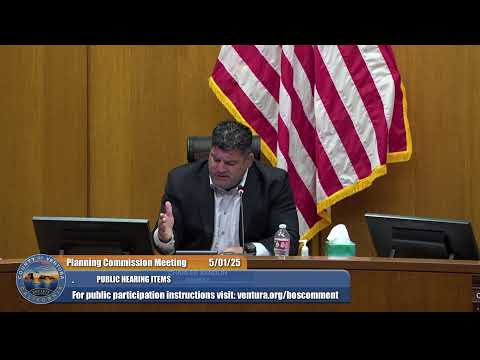
Ventura County planning commission approves Camp Ramah permit modification, grants unlimited term and raises overnight cap to 1,040
Summary
The Ventura County Planning Commission voted 4-0 on May 1 to modify Camp Ramah’s conditional use permit, adopt a mitigated negative declaration, authorize limited tree removals, approve a variance to historic summer populations, and impose noise, fire‑safety and other mitigation measures.
The Ventura County Planning Commission on May 1 approved a suite of permit changes for Camp Ramah, an established nonprofit camp at 385 Fairview Road in unincorporated Ojai, including a modification to its conditional use permit (CUP), adoption of a mitigated negative declaration under CEQA, authorization to remove four protected coast live oak trees (with construction encroachment into the root protection zone for four others), and a variance allowing higher overnight summer populations. The commission approved the motion, including an unlimited CUP term and an amended overnight limit of 1,040, by a 4-0 vote with one commissioner noting concerns on the record.
The action clears the way for construction of the proposed Goldstein Mahone Village, a cluster of new cabins, a central gathering structure and related site improvements on about 1.7 acres inside the larger camp property, while incorporating approximately 348 acres of adjacent open‑space parcels into the CUP boundary for permanent protection. County staff recommended a 50‑year CUP term but the commission granted the unlimited term requested by the applicant.
Staff said the project avoids significant environmental impacts after mitigation. Planning Director Dave Ward told commissioners the project’s mitigations include 14 measures summarized in the staff report—nine biological protections, one cultural resource condition and four noise controls—and that the county recirculated the mitigated negative declaration following comments from the California Department of Fish and Game. "We have identified mitigation measures that reduce impacts to less‑than‑significant levels," Ward said during the hearing.
Under the approved permit, Camp Ramah may build a 1.7‑acre Mahone Village with six new cabins (four with a second story), a central Mahone building with counseling and program spaces, a reception and bus drop turnaround and minor new structures totaling about 1,676 square feet, staff said. The remainder of the parcel added to the CUP will be restricted from future development and limited to passive recreation and occasional small overnight tent camping (20–25 people in three designated areas).
Noise mitigation is a central condition. The applicant agreed to a maximum sound cap of 50 A‑weighted decibels (dBA) at the nearest residences for amplified outdoor systems rather than relying on hourly averaging permitted by the county code; installation of sound‑attenuation blankets at specified sites; position limits for amphitheater speakers; a camp‑owned amplification policy (no outside vendor equipment); and a requirement that a qualified noise consultant field‑test amplification at three properties identified in the conditions before the permit is activated. Ward said the field tests will require cooperation from the adjacent property owners and that if measured levels exceed limits, the camp and staff will implement additional attenuation and set new operational levels.
The conditions also require a water offset plan coordinated with Casitas Water District to avoid a net increase in water demand, a fuel‑modification plan, on‑site fire hydrants and minimum fire flows, and an archaeological monitor for ground‑disturbing work. Staff said Camp Ramah currently operates below its water allocation and has reduced use since 2018.
Applicants emphasized the camp’s history and community uses. Lee Rosen, board chair, and Rabbi Joe Manashi, the camp’s executive director, told the commission Camp Ramah has operated on the site since the 1960s and argued an unlimited term is necessary to support capital fundraising and long‑term philanthropic commitments. "These investments were made while we were operating with our existing unlimited term and with the understanding that this site is our permanent home," Manashi said. Legal counsel Jacqueline Ruffin described the conditions as an "above‑and‑beyond" package intended to address neighbor concerns.
Supporters — including an organizer from the Conejo Valley Unified School District’s outdoor school program — urged approval, saying improved indoor programming space would benefit school groups and other nonprofit users that rent the camp during the nine‑month non‑summer season. Tom Hoageman, who runs the district’s outdoor school, said the camp has hosted more than 1,200 students in a single season and that the proposed facilities would enhance educational programming.
Neighbors opposed to aspects of the project focused on noise, vibration and past compliance. Several residents urged tighter limits or stronger enforcement and expressed skepticism about whether caps would be observed in practice. Ramona Schroeder, a longtime Fairview Road resident, said she has lived next to the camp since the 1960s and that "the sound and the vibrations are completely outrageous." Another neighbor raised concerns about whether a designer working on the project holds a California architect license and urged stronger enforcement mechanisms, including penalties for violations.
County staff described enforcement pathways: loud or raucous noise can be reported under the county code and typically responds through the sheriff’s office; planning and code‑compliance staff will investigate permit‑related complaints, and the conditions require the camp to provide 24‑hour primary and secondary contact information for complaints. Planning staff also noted a condition compliance account and periodic staff review of conditions.
The commission made several findings required for the CUP modification, tree permit and variance, including that the project is consistent with the Ventura County general plan and the Ojai Valley Area Plan, that development will occur on legal lots, and that mitigation will address public‑health and safety concerns. The variance finding required the commission to recognize the camp’s historical operations (the existing CUP predates the current camp standards) and to determine that strict application of the present standard would create hardship for historic programming.
The final vote adopted the staff‑recommended conditions with changes requested by the commission: an unlimited CUP term and an amended overnight cap of 1,040. The motion to approve was made by Vice Chair Sandlin and seconded by Commissioner Boystrom; the amendment to increase the overnight cap to 1,040 was added on the floor and passed. The commission recorded four yes votes and noted one commissioner expressed a concern on the record.
The commission’s approval imposes detailed operational conditions and monitoring requirements intended to limit noise, protect biological and cultural resources, ensure fire safety, and formalize the addition of open‑space parcels to the CUP boundary. The permit also documents annual caps and limits on large group nights during the nine‑month non‑summer period and a maximum daily summer population that will now be governed by the granted variance and the new conditions.