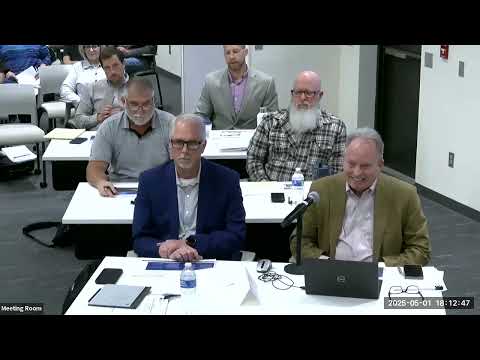
Benton County planning commission hears Republic Services’ proposal to expand Coffin Butte landfill; noise, odor, water and traffic among central concerns
Loading...
Summary
Republic Services and Valley Landfills presented technical studies and answered commissioner questions on May 1 during a Benton County Planning Commission hearing on a conditional‑use permit application (LU‑2024‑27) to expand Coffin Butte Landfill. The company argued the proposal is smaller than an earlier application and includes monitoring and road improvements; commissioners focused on noise, odor, leachate/PFAS monitoring, traffic and fire risk.
Republic Services and Valley Landfills presented technical studies and answered commissioner questions on May 1 during a public hearing before the Benton County Planning Commission on an application (LU-2024-27) for a conditional-use permit to expand Coffin Butte Landfill south of Coffin Butte Road.
The applicant’s team told the commission the current proposal is smaller than a 2021 plan, would extend local disposal capacity by several years and includes road and environmental safeguards; county staff and commissioners focused questioning on noise and odor modeling, groundwater and leachate handling (including PFAS), traffic impacts and fire risk.
Why it matters: Benton County must decide whether the expansion meets local development-code criteria before the Oregon Department of Environmental Quality (DEQ) will process landfill permitting. The decision would affect local infrastructure, waste disposal capacity and monitoring responsibilities tied to public health and environmental protections.
Republic Services framed application, asked for a short extension
Brian Roop, Republic Services’ Northwest area vice president, described the proposal as “a culmination of more than three years of active listening and … planning” with community outreach, and said the current expansion footprint is roughly 50% smaller than the 2021 proposal. Roop asked the commission to consider continuing the public-record period: “we would like to request a 14‑day extension past the closing of public comment to help us work through mainly two things … odor and noise,” he said. The extension request was made on the record but no action on that request was taken during the hearing.
Attorney Jeff Condit, local counsel for the applicant, reminded commissioners that DEQ will not consider its permitting until the county takes action: “DEQ will not consider any application to expand the landfill until they’ve gotten approval from this body,” he said, adding that county conditions could require the operator to maintain state permits in good standing and give the county recourse, up to revocation of the conditional‑use permit, if state enforcement finds violations.
Noise: consultant says updated analysis meets state thresholds; county asks for monitoring
Adam Jenkins of Greenbush Group, who led the acoustic analysis, told the commission the applicant used Oregon Administrative Rules thresholds (the DEQ noise rules) as the assessment standard and conducted ambient monitoring at four locations near noise‑sensitive properties. He said the team refined its analysis by restricting the baseline ambient window to hours the facility would actually be operating (roughly 5 a.m.–5 p.m. for commercial operations and 8 a.m.–5 p.m. for the public), and that with that refinement predicted sound levels fall below applicable limits.
Jenkins recommended the use of ambient‑sensing backup alarms on on‑site vehicles as a “betterment” to reduce community complaints, and he said the applicant has proposed updated, more detailed hours‑of‑operation conditions to be included in the record. Commissioners pressed about monitoring locations and about an outstanding review by an independent consultant cited in the staff report; the applicant said it is working with county staff and the county’s consultant to respond and has proposed periodic noise monitoring as a condition of approval.
Odor: modeling finds low likelihood of landfill as sole source, but applicant to expand monitoring
Jeff Ledford, an odor and air dispersion consultant with SCS Engineers, described two modeling scenarios: a 2023 baseline and a projected 2052 full build‑out. He said DEQ‑standard assumptions — including that about 75% of landfill gas is sent to flares and about 25% may escape as fugitive emissions — were used in the analysis. Ledford said the applicants reviewed 84 DEQ odor complaints from 2022–2024 and, because of incomplete time/location data in many reports, concluded 1% of complaints were “likely” attributable to the landfill, 58% “possibly” attributable and 29% “not likely.”
Ledford noted a major operational change: an enclosed flare came online at the end of 2024 and passed a source test. He said the modeled odor metrics (D/T, dilution‑to‑threshold) did not exceed commonly used detection thresholds in either scenario. In answer to commissioner questions about complaint handling and timeliness, the applicant said it will expand on‑site daily logging and rapid field verification so staff can respond more quickly rather than relying only on complaints routed through DEQ.
Groundwater, leachate and PFAS: monitoring, liner design and disposal partners
Jeff Shepherd (Veil and Environmental Consultants) reviewed the site’s hydrogeology and monitoring program. He said groundwater on the site generally flows north and that the project area is separated from adjoining properties by a local topographic high, and he described the landfill’s bottom composite liner, secondary collection system, interim and final covers and leachate collection and holding ponds. Shepherd said groundwater and surface‑water monitoring points are sampled twice a year and stormwater four times a year, and that the development area will add several monitoring wells and a baseline monitoring period of nine consecutive quarterly events to establish statistical water‑quality limits.
Brent Lurch, Republic’s area environmental manager, described the liner and leachate system as the same engineered design that DEQ previously approved for the site and said the expansion will relocate two lined leachate ponds but keep the same pond design. He told the commission Republic hauled about 40 million gallons of leachate in 2024, and said roughly half went to the City of Corvallis treatment plant and half to the City of Salem under discharge arrangements; he said those transfers represent a small fraction (about 0.5% Corvallis, roughly 0.14% Salem by annual flow) of those municipal plants’ permitted throughputs. Republic said it is working with wastewater partners and exploring disposal options, including potential local options such as Adair Village as facilities and regulations evolve.
On PFAS, Lurch said regulation and testing methods are still evolving and that landfill operators rely on consultants and wastewater partners to adapt as state and federal standards are finalized. He emphasized the company would respond to any new regulatory requirements.
Traffic and road work: applicant to rebuild portion of Coffin Butte Road, volunteer left‑turn lane
Traffic engineer Joe Bessman said the expansion largely shifts landfill operations from the north side to the south side of Coffin Butte Road and does not change how regional traffic accesses the site on Highway 99. He said the applicant proposes to keep existing weigh scales on the north side to preserve queueing capacity and avoid blocking Coffin Butte Road, and to route commercial trucks through a new entrance about 850 feet west of the existing access. To maintain safety and throughput, Republic volunteered to construct a left‑turn refuge lane between the two access points and to rebuild the nearby segment of Coffin Butte Road to a thicker pavement section and wider profile appropriate for a freight route. Applicant representatives said those improvements would be paid for by Republic and estimated the work on the immediate segment at roughly $800,000–$1,000,000; the applicant said the rebuilt segment would be approximately 850 feet in extent.
Fire risk: consultant says standard controls, three likely fire sources, no unacceptable public risk
SCS Engineers’ Jim Walsh summarized a fire‑risk assessment that identified three potential fire sources at landfills: the working face (hot loads), grass or brush fires and subsurface gas‑related smoldering near extraction wells. He described routine controls — limiting waste types, keeping a confined working face, daily cover and on‑site soil stockpiles for emergency burial — plus an on‑site water truck and regular staff training and coordination with Adair Village fire responders. Walsh said there is no “significant risk” to the public or environment from landfill fires at Coffin Butte and described three incidents in 2024 (two grass fires related to legacy open flares and one working‑face fire) that were addressed on site.
Wildlife, archaeology and visual screening
Turnstone Environmental biologist Stephanie James summarized multi‑year surveys for great blue heron, bald eagle, deer and elk. She said two historic heron rookeries were monitored; the western rookery (inside the expansion area) showed no heron use in three consecutive years and is eligible to be considered abandoned under applicable rules, while an eastern rookery had varied occupancy and requires more years of monitoring to be declared abandoned. James said bald eagles frequently use the landfill for scavenging but the field work did not identify active eagle nesting tied to the expansion footprint. She described an agreed monitoring plan with the Oregon Department of Fish and Wildlife and the Oregon Department of Forestry for herons, eagles and deer/elk camera surveys.
An archaeological study was noted on the record; the applicant said one sensitive site is within the area of new scales and will be handled under a monitoring plan with the state (SHPO) and that construction monitoring by a licensed archaeologist would be used if earthwork exposes buried resources.
What the commission asked, and what remains open
Commissioners and staff pressed the applicant on: clarifying monitoring locations and the noise ambient baseline (especially the monitoring location labeled Location 4 in the staff review), specifics and frequency of noise and odor monitoring to be imposed as conditions, PFAS sampling expectations and disposal options, capacity and life estimates for the landfill with and without expansion, whether an expanded tonnage cap tied to the franchise agreement could change traffic/tonnage outcomes, and the reliability of liners and the duration of post‑closure monitoring obligations. The applicant provided technical responses on many points, acknowledged some data remain under review and said it will continue working with county staff and the county’s consultants to refine the record.
No final action was taken. The hearing remained a public record‑building proceeding: the applicant formally requested a 14‑day extension of the public‑comment period to refine noise and odor submissions; commissioners did not rule on that request during the session. County staff reiterated that written materials submitted while the record remains open will be placed into the record, and that late exhibits must be delivered to county staff to become part of the record.
Ending: next steps
The meeting concluded with the chair’s statement that the hearing would recess and reconvene for the public‑comment portion of the hearing on the date and time announced by the planning commission. No vote or conditional‑use decision was made at the hearing. The record remains open to new written materials and the commission signaled it expects to rely on the staff report, expert testimony and any additional submitted evidence when it later evaluates whether the expansion satisfies the applicable sections of the Benton County Development Code.