Get Full Government Meeting Transcripts, Videos, & Alerts Forever!
Get email alerts on the Infrastructure Water topic
No spam. Unsubscribe anytime.
Council declines appeal to create Fletcher Avenue water special-assessment district
Summary
After a lengthy public hearing April 28, the Lincoln City Council voted against moving forward with a special-assessment process to extend city water along Fletcher Avenue from N. 7th to N. 14th Streets; supporters cited water-quality and fire-protection benefits while opponents cited high per-property costs.
The Lincoln City Council on April 28 voted not to advance an appeal seeking creation of a special-assessment district to extend city water along Fletcher Avenue from North Seventh to North Fourteenth Streets.
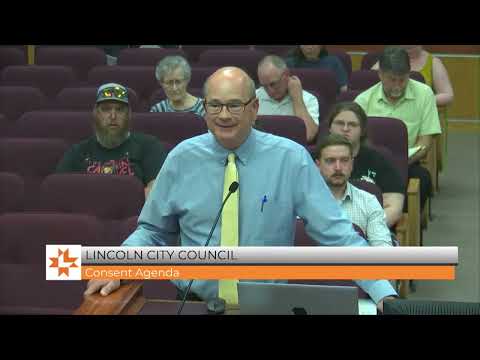
The vote came after a public hearing in which residents, the district requester and city staff described technical, financial and public‑health aspects of the proposed project. Laura Peglas of Lincoln Transportation and Utilities (LTU) summarized the request and the Sar (special assessment revolving) committee recommendation; applicant Keith Spilker said he sought the district because of water-quality and service concerns; several neighbors urged denial because of cost.
The proposal would have led to a formal process to design, bid and potentially construct a water main on Fletcher and to levy assessments for property owners in the affected area. Peglas said the prior cost estimate (prepared in spring 2024) was “a little over $1,100,000” for the water district, with roughly $330,000 assessed to property owners and the water department covering the remainder; property assessments for existing parcels were estimated at a capped $65 per frontage foot. Thomas Schafer, assistant director for transportation, and Steve Owen, assistant director for utilities, answered technical questions about design, impact fees, and why LTU does not permit taps to the large transmission main in the area.
Supporters argued the project would improve water quality, add fire hydrants and provide a long-term benefit. Applicant Keith Spilker, whose property is at 900 Fletcher Avenue, said he started the process in 2023 after receiving an annual well inspection in which his well showed bacteria that required chlorination and that he did not want to wait until service became an urgent health problem: “If I wait until it's needed I can't get it, not in timely fashion.” Neighbor Craig Carlson, who lives at 1001 Fletcher, said hard water had damaged his yard and trees and that city water would address those problems.
Opponents said the up-front cost per property would be high for many long-term residents, many of whom are retired. Greg Roseberry, representing 700 Fletcher, said he had contacted nearly all neighbors and that “none of them has indicated that they are in favor of this project.” Jane Duncan and Larry Ogden told the council the expense would be burdensome and that some homeowners prefer to wait for developer-driven extensions rather than pay an assessment now.
Council members questioned staff about updated project costs, whether properties are within the city’s annexation and what hookups and impact fees would be required if a main were installed. Peglas confirmed the area (except a parcel owned by Heartland Homes) was annexed by AN17015 with effective date Nov. 1, 2017. Schafer and Owen described the standard process: LTU designs, bids and constructs an assessment project; owners may pay an assessment in full or spread it over 20 years; impact fees would apply at time of hookup.
Councilmember discussion focused on whether enough property owners supported moving the district forward and on the affordability for older homeowners. A motion to advance the appeal (to proceed with the assessment-district process) failed on a roll call vote with 1 in favor and 4 opposed (Councilmember Duden voted yes; Shope/Shobe, Beckias, Weber and Chair Washington voted no). The effect of the vote is that the council will not initiate the special-assessment-creation steps for the Fletcher Avenue request at this time.
The decision does not legally prohibit future petitions. Spilker told the council a denial would not be final action on a future request and asked for the opportunity to re-enter the process when conditions change.
Community members may still pursue alternative paths to service, including developer-driven extensions or private arrangements; if the council were to approve a district in the future, staff said there would be additional hearings and a final assessment hearing before any amounts are levied.
Ending: The city will retain the record of public comments and the council’s vote; stakeholders on Fletcher Avenue may return with updated cost estimates or alternate funding proposals if they choose to restart the special-assessment process.