Get Full Government Meeting Transcripts, Videos, & Alerts Forever!
Get email alerts on the Capital Budget Process topic
No spam. Unsubscribe anytime.
Parents and community members accuse Board of cherry-picking capital projects, call for objective prioritization
Summary
Multiple parents and community representatives testified that Centennial High School and nearby Dunloggin Middle School were repeatedly delayed on the capital plan and accused a board member of moving Oakland Mills ahead for personal reasons; speakers demanded transparent, data-driven criteria for CIP prioritization.
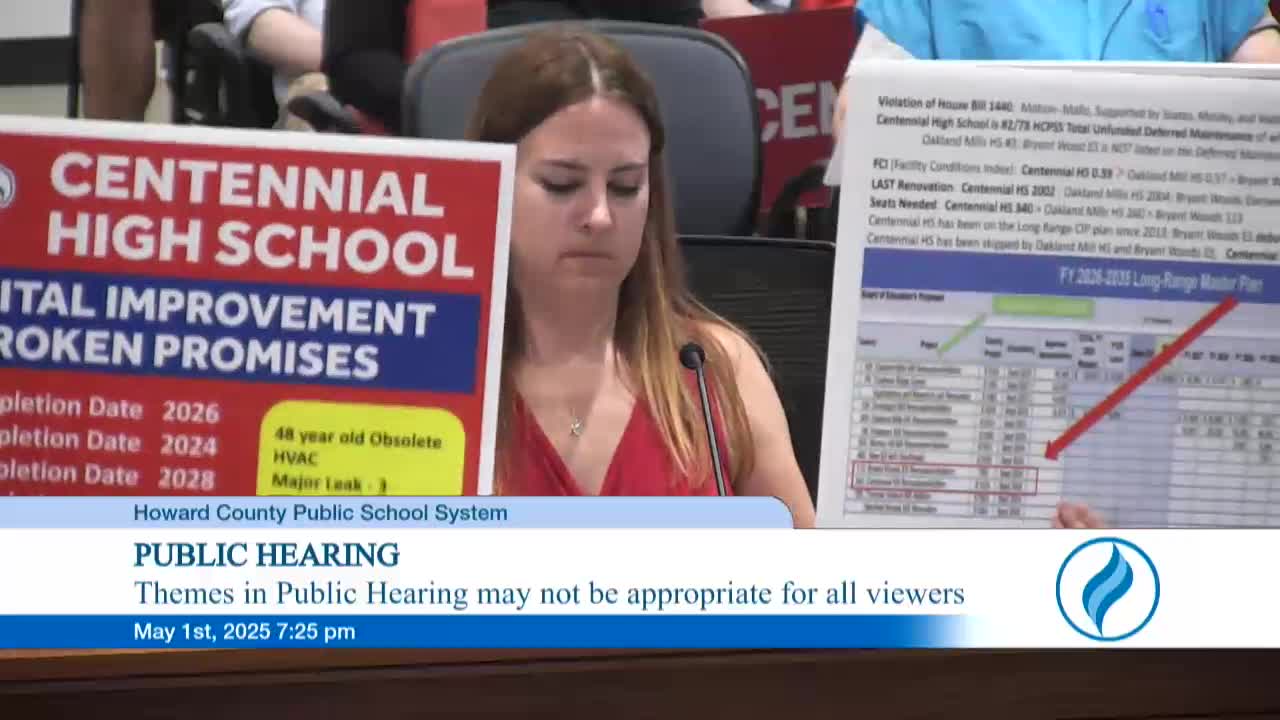
Multiple parents and community representatives used the May 1 public hearing to challenge the district’s capital-prioritization process, saying Centennial High School and Dunloggin Middle School have been repeatedly delayed and asking the Board for more transparent, objective criteria.
Karen Biederman, Dunloggin Middle School PTA president, asked whether promised projects would be funded or “revoked again” after long delays. She cited facility scores and seat-need metrics and urged a “fair and objective data-driven criterion process” for selecting FY2027 capital projects. “From the capital budget, we have $700,000,000 in deferred maintenance. What is the plan to get us out of this crisis?” she asked.
Several speakers alleged possible favoritism in earlier cycles. Daniel Biederman and other parents said Centennial was higher on renovation lists in previous cycles but was later passed over when Oakland Mills High School advanced. “I think there should be disclosure when your children go to a school that you’re voting for and advocating for when it bucks criteria that has been already established by the board,” Daniel Biederman said.
Karina Fisher, speaking for community members who supported an established priority order, asked for integrity, transparency and clear explanations from board leadership about why projects shifted. “That lie also influenced the vote of junior board members, who then apologized to our community and changed their vote,” Fisher said referring to testimony about the state reimbursement program and earlier disclosures.
Why it matters: capital-prioritization decisions determine where limited county and state construction funds are spent, and speakers said perceived inconsistency erodes trust and raises equity concerns across neighborhoods. Witnesses asked the board to publish the data and assumptions used in the district’s scoring and to adopt consistent rules for when projects may be reordered.
No formal board action on prioritization occurred during the hearing excerpt. Testimony requested clearer public disclosure of criteria and timelines and accountability when priorities change.