Get Full Government Meeting Transcripts, Videos, & Alerts Forever!
Get email alerts on the State Facilities Occupancy topic
No spam. Unsubscribe anytime.
DTMB tells House committee it manages 45 state facilities, defends withholding daily badge occupancy data
Summary
Officials from Michigan’s Department of Technology, Management & Budget told a House committee the agency manages a 45-facility portfolio and is pursuing a space study and lease reductions while refusing to release daily badge-based occupancy counts, which it says are security-sensitive.
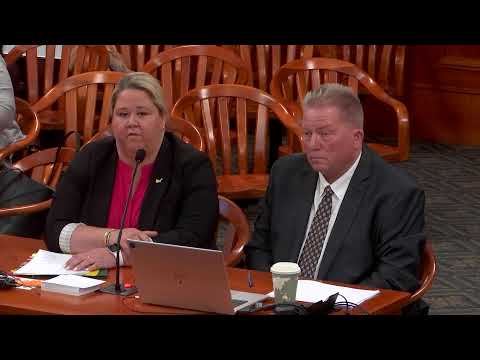
Michigan Department of Technology, Management & Budget officials told the Michigan House Appropriations Committee on a presentation focused on state-owned buildings, leases and occupancy that DTMB manages 45 facilities totaling more than 13.5 million square feet and said it is pursuing a statewide space-analysis study and lease reductions while declining to publish daily badge-swipe occupancy data.
The presentation and ensuing questions centered on why DTMB will not provide daily building-occupancy reports that a Detroit News FOIA request sought, the department’s space study and its plans for leased space and parking as hybrid work practices continue. Mike Turnquist, director of DTMB, said the department considers badge-swipe occupancy data a security concern and offered to brief legislators outside the public hearing.
The issue matters because occupancy and lease decisions affect downtown businesses, parking inventory and the state’s real-estate costs. Lawmakers pressed the department for figures they said are necessary to set budgets and to assess whether long-term reductions in office footprints are appropriate.
Turnquist said DTMB’s current portfolio includes roughly 933 acres of land and more than 14,000 parking spaces, and that the agency manages both large historic office buildings such as Cadillac Place in Detroit and newer facilities built for other agencies. He told lawmakers DTMB has taken over facilities management for some Michigan State Police and Department of Health and Human Services locations — citing the Forensic Post in Grand Rapids, a psychiatric hospital at Cairo (Northville Township) and Walter Reuther Hospital in Westland — and that the Cairo and state lab projects are expected to open in mid‑2026.
On leasing and space use, Turnquist described a decade of work to “right‑size” agency needs, saying DTMB uses a building-occupancy agreement (BOA) process to allocate space and charges agencies a rate intended to cover actual building costs. He said the department has reduced leasing overall, showing a spike in 2020 tied to temporary pandemic needs (PPE warehouses and testing sites) followed by a decline as the agency optimized space. He said capacity is measured as available seats ("butts and seats") and occupancy as seats in use on a given day according to agencies’ BOA allocations.
Lawmakers repeatedly asked whether DTMB possesses daily badge-swipe counts of building entries and whether those data could be provided. Turnquist confirmed that access-control (badge) data exist, are generated automatically and were used during the COVID period to track cases, but he said the department treats the information as security-sensitive and referred requests to DTMB’s FOIA and legal staff. He told the committee he would provide the committee a copy of DTMB’s denial letter to the Detroit News.
Committee members pressed practical questions about hybrid work and space planning. Turnquist said DTMB requires its employees to be on site at least two days per week as a minimum floor and that the department has roughly 2,800 DTMB employees (3,100 when counting the broader department oversight referenced earlier). He said DTMB measures customer and stakeholder satisfaction — citing a jump from 75% to 82% in a customer satisfaction survey from 2019 to 2024 and increases in procurement activity and IT stakeholder satisfaction — and that individual performance plans and quarterly reviews are used to track employee work.
On the independent space-analysis study, Turnquist said DTMB hired CBRE and budgeted $500,000 for the project, with approximately $400,000 spent to date; he said phase one findings were being distributed to committee members and that recommendations are still in development. He said DTMB is examining options including densification, lease consolidation, monetization and possibly selling some state-owned assets to align space with demand.
Lawmakers warned that permanent downsizing of office space without contingency plans could create costs if employees return in greater numbers. Several representatives asked whether DTMB could, if instructed by the governor, accommodate a full return to onsite work; Turnquist replied the department would work to accommodate such an order through densification, lease changes or other measures.
Representative Kelly repeatedly demanded the occupancy numbers and called DTMB’s refusal “nonsense. Absolute nonsense.” Turnquist acknowledged the committee’s interest and offered further, off‑forum briefings and to share metrics previously provided to House Fiscal.
The hearing included questions about parking lots and ramps; Turnquist said building a parking ramp is expensive (he cited roughly $30,000 per spot to construct a ramp) and that some lots remain in demand, so DTMB has piloted pay-by-day parking in at least one lot. He also described long-term lease practices and said DTMB is generally a stable tenant that honors lease terms and that developers take that into account when building for the state.
Committee members requested updated square-footage reports and lease lists; Turnquist said DTMB would work with the committee and House Fiscal to provide or update that information. He also offered to provide recruitment and retention statistics after coordinating with the Michigan Civil Service Commission.
The committee adjourned after the presenters said they would follow up with the requested documents and clarifications.