Get Full Government Meeting Transcripts, Videos, & Alerts Forever!
Get email alerts on the Office Of Inspector General topic
No spam. Unsubscribe anytime.
Senate finance panel hears SF 856 to create Office of Inspector General; debate centers on freeze-authority and Medicaid safeguards
Summary
The Minnesota Senate Finance Committee on May 1, 2025, considered Senate File 856 to create an Office of Inspector General, heard a Legislative Budget Office presentation showing startup and biennial costs in the low millions, and split competing amendments after debate over whether the OIG should have explicit authority to seek court orders to freeze public payments in suspected fraud cases.
The Minnesota Senate Finance Committee on May 1, 2025, considered Senate File 856, a bill to establish an Office of Inspector General (OIG) for state government. Committee members heard a Legislative Budget Office fiscal presentation that estimated start-up and ongoing costs, debated competing amendments over the OIG's authority to seek court orders to freeze public payments, and voted to adopt most changes in amendment A67 while tabling two disputed lines for further consideration.
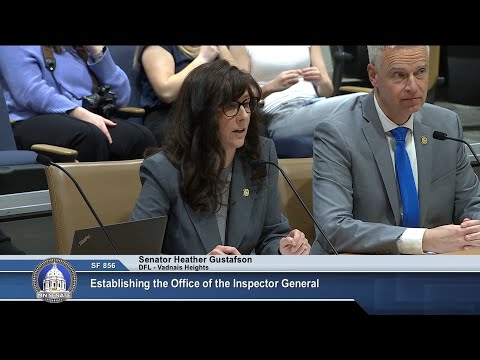
Senator Gustafson, a sponsor of SF 856, told the committee the bill aims to strengthen Minnesotans' trust in government and deter fraud. "When families pay their taxes, they expect those dollars to serve the public good, not to be lost to fraud, misuse, or mismanagement," Gustafson said. The senator described the proposed OIG as "a forward-looking independent entity focused not just on rooting out fraud, but deterring it through system improvements, early detection, and professional accountability."
Legislative Budget Office analyst Mister Erickson reviewed the fiscal note and the supplemental worksheet distributed to committee members. He said the OIG-only portion of the fiscal note shows top-line costs of roughly $3.034 million in the first year and $6.432 million in the second year, for a biennial total of about $9.5 million, and that the office was modeled at 38 full-time equivalents with an estimated 4–6 months to reach full staffing. The fiscal note also lists substantial one-time information-technology and office build-out costs and agency-specific estimates for coordinating with the OIG. Erickson said a summary worksheet showed a total fiscal-note footprint (excluding agencies with zero cost) of about $4.868 million the first year and $6.556 million the second year; a proposed amendment would fund a smaller share of those items (for example, $644,000 for Administration in year one and $430,000 in year two) and would not fund additional FTE requests from other agencies.
Committee members and counsel summarized two competing amendments, labeled A65 and A67. Both make technical and substantive adjustments — including placing the OIG in the executive branch and making the governor the appointing authority — but they differ on a key paragraph describing what the inspector general must do when the OIG "identifies a reasonable suspicion of fraud or misuse." A67 gives the inspector general discretion to seek a court order to freeze or stop distribution of public funds or to alert the relevant commissioner and make a recommendation to freeze funds. A65, by contrast, would require the OIG to immediately alert the relevant commissioner and then sets out a process for when the OIG may investigate independently if the agency's internal investigation is inadequate or too slow; only after further investigation would the OIG recommend freezing payments and notify law enforcement.
Several members emphasized the need to protect federal Medicaid funding and avoid undermining agency investigations. Senator Gustafson said the bill must be constitutional and must preserve federal funding; she said many of the draft changes are intended to avoid conflict with federal Medicaid oversight. Senator Wicklund and others expressed concern that an OIG petition to freeze payments could compromise ongoing investigations or harm program enrollees, noting that the Department of Human Services (DHS) currently has program-integrity staff and that a compromised state-level process could jeopardize cases or federal matches. A committee member cited federal regulation 42 CFR 455.23 in connection with how states may suspend Medicaid payments, and committee discussion centered on whether federal rules preclude additional state remedies or simply establish a baseline.
Supporters of A67 argued that the OIG should have an independent tool to seek court orders when it has a reasonable suspicion of fraud, and that adding redundancy can help stop fraud more quickly. Senator Crude suggested a potential compromise that preserves an agency-first investigative role while retaining an ultimate OIG authority to seek a court order in narrow circumstances.
The fiscal note lists agency-specific numbers: Department of Education staff and a $2.0 million annual appropriation were modeled as transferring into the OIG; Department of Children, Youth and Families (DCYF) estimated roughly $229,000 in fiscal 2027 and $246,000 ongoing to coordinate with OIG requests; Department of Health listed an annual cost of about $487,000 to support investigations related to WIC; DHS listed net costs of about $467,000 the first year and $542,000 the second year after federal fund participation adjustments. The Department of Administration would handle stand-up administrative tasks (accounting, HR, rent and build-out) and a line in the amendment gives Administration, in consultation with Minnesota Management and Budget (MMB), access to OIG-appropriated funds for initial build-out until the OIG is operational.
On procedural votes, the committee first accepted a division of amendment A67 so that all of A67 except two lines (lines 1.18–1.19 on page one) could be voted on separately. Senator Draheim moved to adopt the large portion of A67 (the amendment excluding those two lines); the committee approved that motion by voice vote. The remaining two disputed lines (and the comparable full paragraph in A65) were then the subject of discussion and were subsequently tabled on a motion by Senator Pratt. The committee laid the bill on the table for further work and indicated it will return to the item next week. The meeting adjourned.
The committee record shows sustained bipartisan negotiation: senators and nonpartisan staff reported multiple working-group meetings, and sponsors said they had been collaborating across chambers and parties to refine jurisdictional language, preserve federal funding, and ensure constitutionality. The committee did not take a roll-call vote on the underlying bill; the actions taken were adoption of most of A67 by voice vote, tabling the disputed paragraph, and laying the bill on the table pending further action.