Get Full Government Meeting Transcripts, Videos, & Alerts Forever!
Get email alerts on the Emergency Services topic
No spam. Unsubscribe anytime.
Scotland County EMS outlines staffing changes, rising 911 calls and reliance on part‑time crews
Summary
Scotland County EMS director described rising 911 call volume, a multi‑year switch from a 24/48 to a 24/72 shift model, addition of a fourth ambulance in 2021 and ongoing reliance on part‑time staff to maintain coverage; commissioners pressed for data on utilization and cost implications.
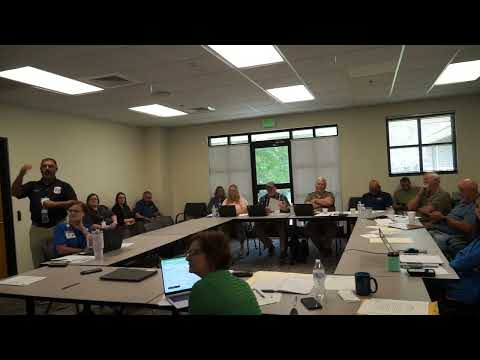
Scotland County EMS director Robert briefed county commissioners on the service’s operations, staffing model and rising 911 call volume, describing a multi‑year shift in work schedules and an increased reliance on part‑time personnel to staff a fourth ambulance.
Robert said the county consolidated 911 dispatch centers in February 2015 so “100% of 911 calls came to 1 location,” and that the EMS service’s call load rose from about 4,000 annual calls in the 1990s to “over 6,000 calls” by February 2016. He told commissioners the service was nearing 8,000 annual 911 calls as call volume steadily increased.
Why it matters: Commissioners and staff said higher call volume and a change in work patterns affect fatigue, recruitment and the county budget. The department moved from a traditional modified 24/48 schedule toward a 24/72 schedule in fiscal year 2022–23 to improve retention and give staff more downtime, and it added a fourth ambulance in 2021 to meet demand. To keep the fourth unit staffed the department relies on part‑time employees, which creates potential budget and benefits implications.
Robert summarized the operational history: in earlier decades Scotland County EMS also ran convalescent and many interfacility transports and operated multiple PSAPs; rising 911 demand and longer out‑of‑county transports reduced that work. He said the Office of EMS in North Carolina governs service protocols and certification requirements for local agencies. He described the previous staffing model as a modified 24/48 rotation that included mandatory on‑call periods for county residents, and said the department trialed and then phased in the 24/72 schedule over three years after polling staff (about 70% supported the change).
On staffing and the fourth ambulance: Robert said the fourth truck is intended to provide northern‑county coverage and to stage at a midpoint when core ambulances are busy. The fourth truck is staffed largely with part‑time employees; the department’s training officers and field training officers provide orientation and on‑the‑job sign‑offs for new hires. Commissioners pressed for utilization and absenteeism numbers and asked for the spreadsheets Robert mentioned that track part‑time hours and benefit thresholds. Commissioner O’Neil warned the county could “lose control of this pretty quickly” if part‑time hours and benefit eligibility are not monitored.
Budget pressure and benefits: Commissioners and staff noted a cost risk if frequently used part‑time employees cross benefit or overtime thresholds. Robert and county staff said a small number of part‑time employees accepted offered health insurance last year, which added roughly $10,000 in unplanned cost; they described active monitoring of hours and use of a spreadsheet to track exposures.
Operations, equipment and training: Robert said the department has upgraded equipment and maintains vehicle replacement practices; the oldest ambulance in the fleet is about 10 years old. He said continuing‑education requirements are significant (144 hours every four years for certification recertification), and that the agency also performs duties beyond EMS—such as emergency management, medical examiner duties and responsibilities normally assigned to a fire marshal when the county lacks one. He noted grant support and the creation of a first‑responder association used to secure equipment, and said through participation in a Duke program the county received 16 defibrillators “absolutely free” placed across county parks and buildings.
What was not decided: The meeting was informational; no formal votes or policy changes were taken during the presentation. Commissioners asked for follow‑up data—utilization by hour, absenteeism, part‑time hour totals and the staff spreadsheet Robert described—so they could assess cost and coverage tradeoffs.
Ending: Robert closed by repeating that the service aims to recruit additional full‑time and part‑time staff and to continue equipment upgrades; commissioners signaled they wanted the requested utilization and cost reports to evaluate whether the current mix of full‑time and part‑time staffing is sustainable.